Have you ever walked into a room and instantly felt happy and peaceful? Or entered a place that made you feel uncomfortable for no clear reason?
The way a space is designed can affect how we think and feel. This idea is at the heart of Vastu Shastra (वास्तु शास्त्र).
Vastu Shastra is an ancient Indian science that explains how to design buildings in harmony with nature. It is not just about superstition or blind belief. It is about understanding directions, plot orientation, sunlight, air, space and energy to create healthy and comfortable homes.
Let us explore this fascinating subject.
What is Vastu Shastra?
The word Vastu comes from the Sanskrit word Vas (वास), which means “to dwell” or “to live.” The word Shastra (शास्त्र) means “sacred teaching” or “divine knowledge.”
So, Vastu Shastra is the sacred wisdom of creating a space where life can be lived in peace, balance and grace.
In the Vedic tradition, a home is not seen as only a physical structure. It is regarded as a sacred place that holds energy, receives blessings and shapes the well-being of the family living inside it. co
This is why Vastu Shastra teaches that the design of a space should be in harmony with the five elements—earth, water, fire, air and space—as well as with the natural and cosmic order.
When a home is aligned through Vastu, it is believed to support peace of mind, spiritual harmony, prosperity and a deeper sense of protection. In this way, Vastu Shastra is not only about building a house. It is about creating a blessed space where divine energy can flow and family life can grow with stability and joy.
Tracing the Origins of Vastu Shastra
Vastu Shastra is mentioned in ancient Indian texts like:
- The Vedas (वेद)
- The Puranas (पुराण)
- The Brihat Samhita (बृहत्संहिता), written by Varahamihira (वराहमिहिर)
These texts explain how buildings should be designed in alignment with natural forces and cosmic order.
In ancient times, kings and architects followed Vastu principles while building the foundations of palaces, forts, temples and even whole cities!
Why Is Vastu Shastra Important?
Vastu Shastra teaches that a home is not just a physical structure. It is a living space that holds energy and quietly shapes the lives of the people inside it.
When a house is planned in harmony with the five elements and sacred directions, it is believed to support:
- Peace of mind and a calmer home atmosphere
- Better health and well-being
- Prosperity, stability and financial growth
- More harmony in family relationships
- Better sleep and emotional balance
- Protection from negativity and disturbance
- Clarity, focus and positive thinking
- Spiritual growth and a stronger sense of inner peace
- A feeling of support, comfort and blessings in daily life
This is why many people turn to Vastu Shastra when a house feels heavy, restless, blocked or lacking in harmony. In simple words, Vastu helps create a home that feels more peaceful, balanced and spiritually uplifting.
The Five Elements of Vastu: Pancha Mahabhutas
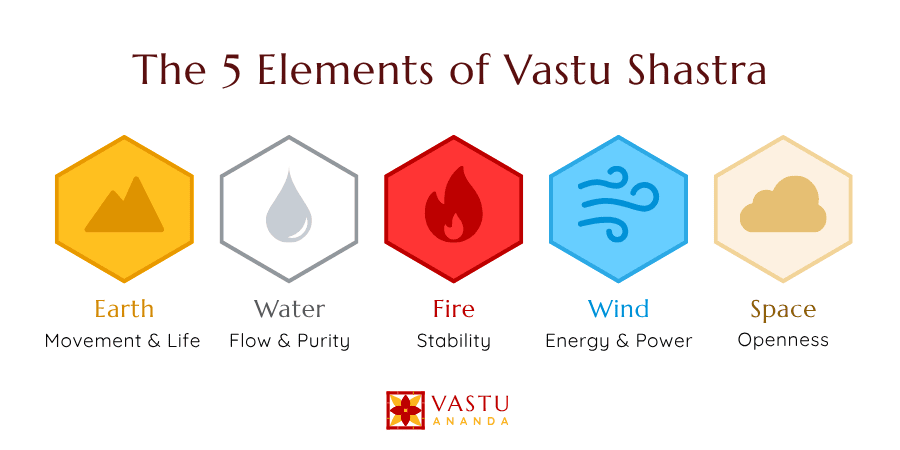
Vastu Shastra is based on five natural elements. These are called the Pancha Mahabhutas (पंचमहाभूत). They include Earth, Water, Fire, Air and Space.
A house designed according to Vastu tries to balance all these elements.
Earth (पृथ्वी) represents stability, support and strength. In Vastu, it is linked with grounding and the feeling of security in a space.
Water (जल) represents flow, purity and emotional balance. It is associated with clarity, freshness and the smooth movement of energy.
Fire (अग्नि) represents energy, transformation and power. In Vastu, it is connected with vitality, action and the active force that drives daily life.
Air (वायु) represents movement, life and circulation. It supports freshness, communication and the natural flow within a home.
Space (आकाश) represents openness and expansion. It is seen as the element that allows peace, balance and energy to exist and move freely.
The Importance of Vastu Directions
What is Vastu compliant and what is not depends mainly on cardinal directions. In Vastu Vidya, there are eight main directions:
- North (उत्तर)
- South (दक्षिण)
- East (पूर्व)
- West (पशचिम)
- North-East (उत्तर-पूर्व)
- North-West (उत्तर-पशचिम)
- South-East (दक्षिण-पूर्व)
- South-West (दक्षिण-पशचिम)
Each direction is believed to have a specific quality.
| Element | Significance | Why It Matters | Direction |
| Earth / पृथ्वी | Stability and strength | Supports grounding, security & steadiness | South-West |
| Water / जल | Flow and purity | Influences clarity, calmness & the smooth flow of energy | North-East |
| Fire / अग्नि | Energy and transformation | Governs vitality, action, heat & active life force | South-East |
| Air / वायु | Movement and life | Supports circulation, freshness, communication & change | North-West |
| Space / आकाश | Openness and expansion | Creates balance, peace, awareness & room for energy flow | Centre / Brahmasthan |
The Two-Stream Theory in Vastu
One important idea discussed in traditional Vastu texts is the Two-Stream Theory (द्वि-ऊर्जा प्रवाह का सिद्धाांत). This concept explains how different natural energy flows interact with a building and influence the environment inside it.
According to Vastu, two main streams of energy move across the Earth.
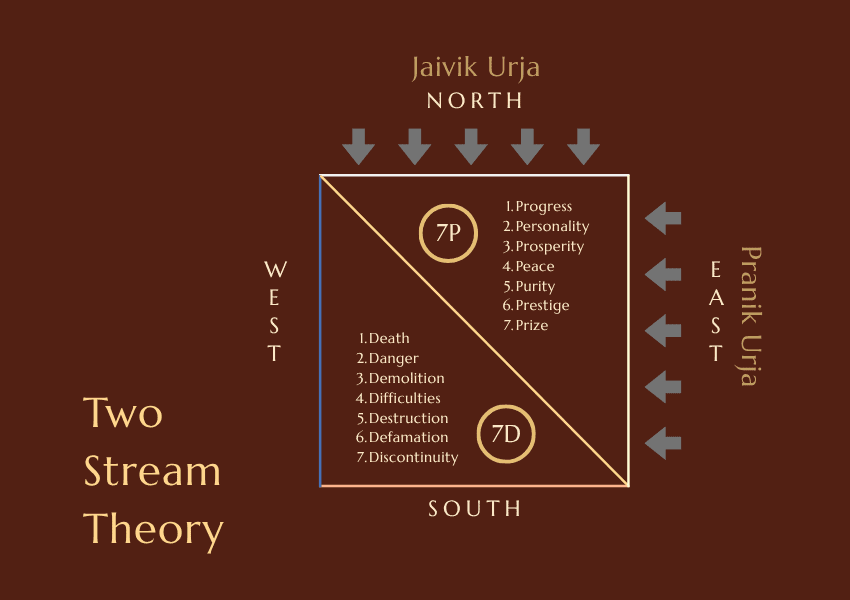
The first is magnetic energy (चुंबकीय ऊर्जा). This energy is related to the Earth’s magnetic field and is believed to flow from North to South. Because of this natural flow, the Northern side of a plot is traditionally considered important for receiving subtle magnetic influences.
The second is solar energy (सौर ऊर्जा), which moves from East to West as the sun travels across the sky during the day. Sunlight carries heat, light and different forms of radiation that affect the temperature and atmosphere of a building.
When these two streams interact, they create what Vastu describes as Jaivik energy (जैविक ऊर्जा) and Pranik energy (प्राणिक ऊर्जा). Jaivik energy is associated with the magnetic flow from the North, while Pranik energy is connected with the solar flow from the East.
When both energies collaborate in a space, it creates a continuous flow of positive energy in the clockwise direction (मंडलाकार). This creates Priti Sangam (प्रीति संगम) and this environment is believed to support health, calmness and stability.
Vastu also describes certain directions as source zones and others as sink zones. The North, North-East and East are considered positive source directions because they receive the combined influence of magnetic and solar streams. In contrast, the South, South-West and West are often treated as sink directions where heavier or balancing energies accumulate.
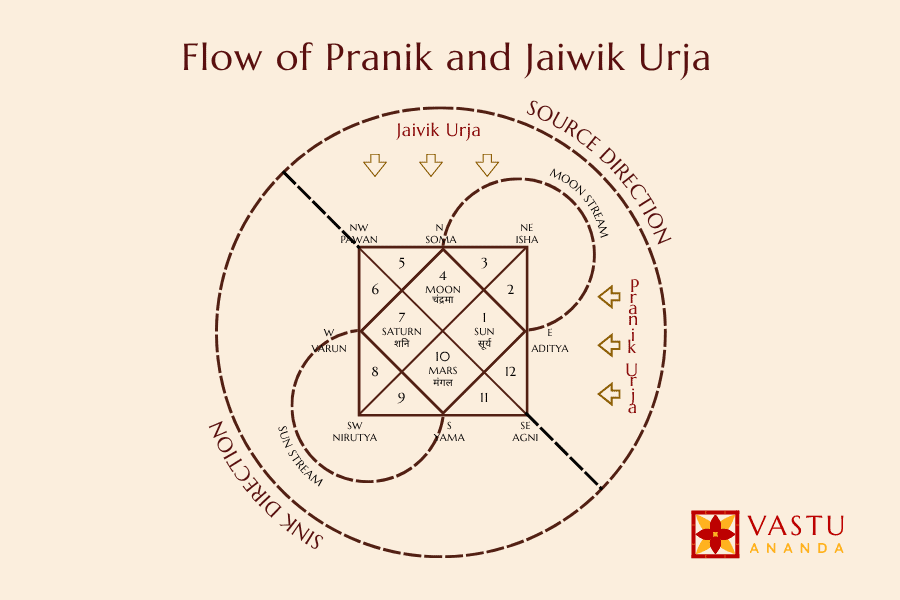
By planning buildings with these natural energy flows in mind, Vastu aims to create spaces where energy circulates smoothly and harmoniously.
What is Vaastu Purush Mandala?
According to ancient belief, every building site is occupied by a cosmic being called the Vastu Purusha (वास्तु पुरुष).
He is imagined lying face down on a plot of land. His head is in the North-East direction and his feet are in the South-West.
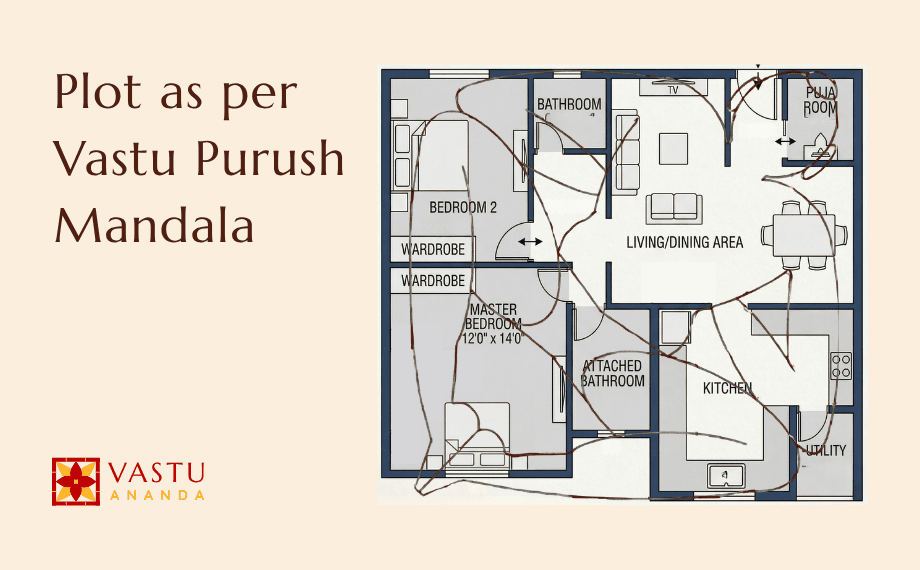
Vastu experts refer to this Vastu diagram, called the Vastu Purusha Mandala (वास्तु पुरुष मंडल), to plan buildings.
This vastu diagram is usually drawn as a square grid that may contain 9, 16, 25 or even 81 smaller squares, depending on the complexity of the design. Each square is believed to be connected with certain natural forces, deities and energies.
The centre of the grid is called the Brahmasthan (ब्रह्मस्थान). This area represents openness and balance. Traditionally, this was kept an open and clutter-free space so that air and light could move freely through the building.
In old houses, this space often became an open courtyard, which helped improve ventilation and natural lighting.
Taking the Vastu Purush Mandala into consideration, it has been seen that if there is any Vastu Dosh (वास्तु दोष) in a specific part/direction of the house, the house head (गृह स्वामी) can face health-related complications in the same body part.
The Mandala is also linked with various planets (गृह) and deities (देवता) in traditional Vastu philosophy. Each square in the grid is believed to be governed and associated with deities like Rahu (राहू), Kubera (कुबेर), Indra (इंद्र) and Agni (अग्नि), each representing different energies and influences.
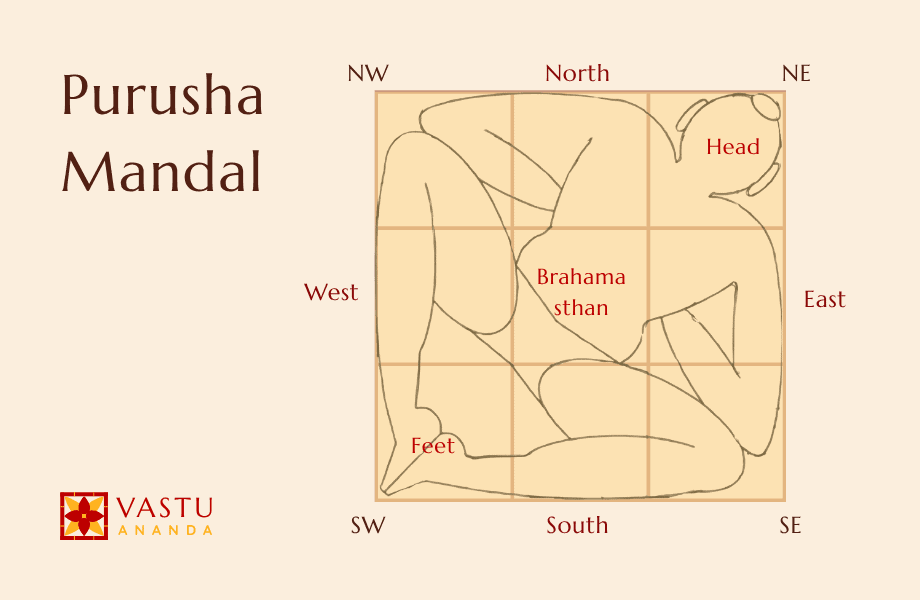
By planning spaces through these zones, the Vastu Purusha Mandala still remains useful for modern homes. It is not just an old concept. Even today, it helps guide the placement of different parts of the house to support balance and positive energy.
Basic Principles of Vaastu Shastra for Homes
Let us understand some simple and practical Vastu tips for home plans.
1. Entrance
The main door is very important. It should ideally be in:
- North
- East
- North-East
These directions allow positive sunlight and air to enter.
2. Puja Room
A prayer room or meditation space is best placed in the North-East direction. This zone is associated with peace, clarity and spiritual energy, which makes it suitable for पूजा, reflection and inner calm.
3. Kitchen
The kitchen is connected with the fire element. The South-East direction is considered ideal.
4. Living Room
The living room is often preferred in:
- North
- East
- North-East
These directions help keep the space open, welcoming and filled with light since this is where family members and guests spend time together.
5. Bedroom
The master bedroom is often suggested in the South-West direction for stability.
6. Study Room
East or North-East is considered good for studying because these directions are linked with clarity and knowledge.
7. Bathrooms
They are usually placed in the North-West or West.
Significance of Sunlight and Air
Long before modern science explained the health benefits of sunlight and fresh air, traditional builders designed homes that allowed these natural elements to enter easily.
Morning Sunlight
Morning sunlight is considered especially beneficial. When sunlight enters a home early in the day, it helps brighten the space and create a positive atmosphere. There are also scientific reasons why sunlight is important.
- Kills harmful bacteria: Sunlight contains ultraviolet (UV) rays that can reduce the growth of certain bacteria and germs on surfaces. This is one reason why clothes are often dried in the sun.
- Boosts mood: Exposure to natural light can improve mood and help the body maintain a healthy daily rhythm called the sleep–wake cycle (Circadian Rhythm). When we receive enough daylight, we usually feel more active and alert during the day and fall asleep easily at night.
- Provides Vitamin D: Sunlight helps the human body produce Vitamin D, which is important for strong bones, a healthy immune system and overall well-being.
Because the sun rises in the East, homes with windows or open spaces facing East often receive gentle morning sunlight.
Cross Ventilation
Fresh air is just as important as sunlight. Cross ventilation means that air can enter a building from one side and exit from another. This allows a constant flow of fresh air through the rooms.
Cross ventilation helps in several ways:
- Removes stale air: It pushes out old air that may contain dust, odors or pollutants.
- Reduces humidity: Proper airflow prevents excess moisture, which can reduce the chances of mold and dampness in walls.
- Keeps rooms fresh: Fresh air can make indoor spaces feel cooler, cleaner and more comfortable.
Many traditional Indian houses were designed with multiple windows, courtyards and open spaces to improve ventilation.
Vastu in Ancient Indian Architecture
Many historical buildings in India follow Vastu principles in their design and layout. Ancient architects often aligned structures according to directions, symmetry and sacred geometry described in traditional texts.
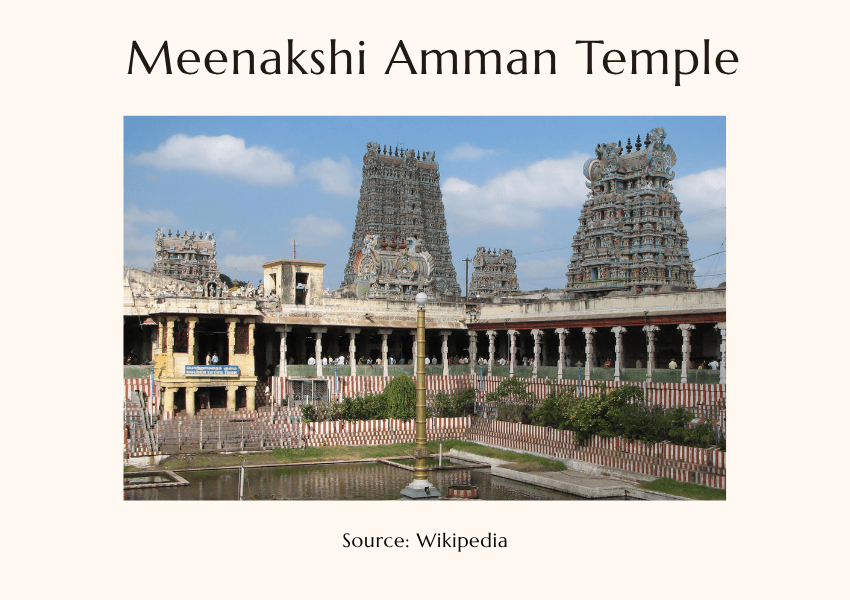
For example, several traditional South Indian temples such as the Brihadeeswara Temple (बृहदीश्वर मंदिर), Meenakshi Amman Temple (मीनाक्षी अम्मन मंदिर) and Sri Ranganathaswamy Temple (श्री रंगनाथस्वामी मंदिर) are aligned toward the East. This orientation allows the first rays of the rising sun to illuminate the temple entrance or sanctum, reflecting the traditional belief that the East direction represents purity and new beginnings.
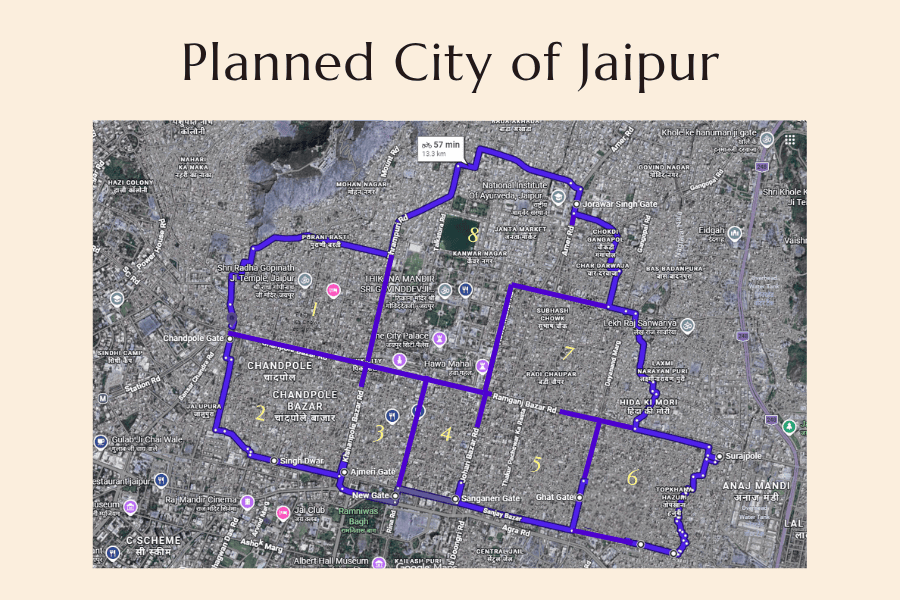
Ancient Indian cities were also designed with careful planning that considered roads, water flow and public spaces. A well-known example is the city of Jaipur (जयपुर), founded in the early 18th century by Maharaja Sawai Jai Singh II (महाराजा सवाई जय सिंह द्वितीय). The city was planned by architect Vidyadhar Bhattacharya (विद्याधर भट्टाचार्य) using principles inspired by Vastu Shastra and classical Indian architectural texts.
The layout of Jaipur includes:
- A grid-based city plan divided into nine rectangular blocks, inspired by the Vastu Purusha Mandala.
- Wide, straight streets intersecting at right angles for organized movement and airflow.
- Well-planned marketplaces such as Johari Bazaar (जौहरी बाजार) and Tripolia Bazaar (त्रिपोलिया बाजार) located along main commercial axes.
- Integrated water management and drainage systems designed to manage monsoon rainfall.
Because of this systematic planning, Jaipur remains one of the earliest planned city in India, combining traditional Vastu concepts with practical urban design.
Significance of VIBGYOR Colours in Vastu
In Vastu Shastra, colours are not seen as decoration alone. They are believed to affect the energy and mood of a space. Many Vastu experts connect colours with the natural elements, directions and the seven shades of sunlight, often remembered as VIBGYOR—violet, indigo, blue, green, yellow, orange and red. This idea comes from the belief that sunlight carries different colour energies and each colour can influence how a room feels.
In general, blue and green are linked with calmness, healing and growth. Yellow is associated with warmth, clarity and wisdom. Orange and red are seen as active colours that bring energy, passion and movement, so they are used carefully. Violet and indigo are often connected with spirituality, depth and reflection.
In Vastu, softer and balanced shades are usually preferred over very dark or harsh colours. The aim is not to follow a fixed colour rule for every home, but to choose colours that support peace, positivity and harmony in each room. When used thoughtfully, colours can help make a home feel lighter, calmer and more spiritually uplifting.
Does Vastu Shastra Have Scientific Logic?
When we look closely, many Vastu ideas are based on careful observations of nature. Ancient builders did not have modern machines or scientific instruments, but they learned by studying how wind patterns, temperature and daily activities affect comfort inside a building.
For instance, many Vastu tips often recommend placing the kitchen in the South-East direction.
In traditional Indian homes, cooking was done using firewood or coal stoves that produced smoke and heat. Placing the kitchen in a corner that allowed heat and smoke to move away from the main living room helped keep the rest of the house cooler and cleaner. Today, modern kitchens still require proper ventilation, chimneys or exhaust fans for the same reason.
Similarly, Vastu’s emphasis on open spaces and proper window placement supports the idea of natural ventilation. Good airflow helps remove indoor pollutants, reduce humidity and maintain comfortable temperatures. Today, architects use the same principle when designing eco-friendly and energy-efficient buildings.
Another example is the placement of heavier structures in certain areas of a building. Structurally, buildings often require stronger support in specific sections to maintain balance and stability.
While Vastu explains this through directional guidelines, modern engineering explains it through load distribution and structural design.
These similarities show that many Vaastu principles are connected to practical ideas about air flow, structural balance and daily living patterns.
Even today, architects often combine traditional knowledge with modern science to create buildings that are both functional and comfortable.
Limitations of Vastu
Applying Vaastu perfectly is not always possible in modern housing situations.
- Apartments and high-rise buildings often have fixed layouts that cannot be changed.
- Urban plots are smaller, limiting flexibility in planning directions and room placement.
- Existing homes and offices may not match traditional guidelines.
Because of these practical constraints, many people choose to follow Vaastu principles in flexible ways that suit modern lifestyles and existing structures.
How Is Vastu Different from Feng Shui?
You may have heard of Feng Shui, which comes from China. Feng Shui is a Chinese system for arranging spaces to improve balance, flow and comfort.
Here is a simple comparison of this parallel architectural system:
| Feature | Vastu Shastra | Feng Shui |
| Origin | India | China |
| Age | Over 5000 years old | Around 3000 years old |
| Focus | Directions and five elements | Energy flow (Chi) |
| Basis | Vedic texts | Chinese philosophy |
Both systems aim to create harmony in living spaces, but their methods are different.
Does Vastu Always Mean Breaking and Rebuilding Homes?
Many people ask Vastu experts for advice. But what is a Vastu consultant and what do they do?
A Vastu consultant is someone who studies Vastu Shastra and uses it to review the layout, design and directions of spaces like homes, offices, shops, schools and other buildings.
A common fear is that a Vastu consultation will always lead to big changes like breaking walls, shifting rooms or rebuilding parts of a home.
Sometimes this fear comes from real experiences. Some consultants recommend major changes without thinking enough about the family’s budget, lifestyle or the limits of the existing building. They also don’t explain the reasoning behind their suggestions.
But Vastu should not be followed in a harsh or impractical way. A good Vastu consultant studies the home carefully and suggests practical changes that work within the current structure.
Vastu should not be followed in a harsh or impractical way.
In many cases, helpful improvements can be made without demolition. Small changes like moving furniture, changing how a room is used, improving airflow or organizing the space better can still make a positive difference. The goal is to balance Vastu principles with everyday needs.
At Vastu Ananda, we believe every home and family is different. That’s why we do not suggest changes blindly. We focus on practical remedies that fit your space, budget and lifestyle. Our aim is to recommend simple and thoughtful improvements that support a better home environment with minimal disruption.
Final Thoughts
Vastu Shastra is not about fear, confusion or blindly following rules. It is a beautiful and time-tested wisdom that helps us create homes filled with balance, peace and positive energy.
In Vastu, a home is much more than walls and rooms. It is a sacred space where families grow, relationships deepen and everyday life unfolds. This is why Vastu Shastra gives so much importance to directions, sunlight, air, open space and the placement of each part of the home.
The true purpose of Vastu is to bring the home into harmony with nature and with the energies that surround us. When this balance is respected, a home can feel lighter, calmer and more supportive for everyone living in it.
That is the real beauty of Vastu Shastra. It reminds us that a well-planned home is not only comfortable to live in, but can also become a source of peace, stability and well-being for the whole family.