If you are buying a home, planning one, or simply trying to make sense of advice from family, brokers and builders, the word vaastu can feel confusing. One person says it is essential. Another says it is superstition. A third says, “Just make sure the flat is vaastu compliant.”
This confusion is real, especially for homeowners who are making serious decisions. When you are spending your savings on a house, you do not want vague answers. You want to know what Vastu Shastra (वास्तु शास्त्र) actually means, and whether it has practical value.
In simple terms, Vastu Shastra is a traditional Indian system of architecture and spatial planning. It looks at how land, layout, direction and proportion work together to create balance, comfort and energy in a built space.
This article explains the meaning of Vastu in clear English. It also covers its history, key terms, the Vastu Purusha Mandala (वास्तु पुरुष मंडल), the meaning of vaastu compliant and how to separate sound principle from popular myth.
Vaastu Meaning: Start With The Words
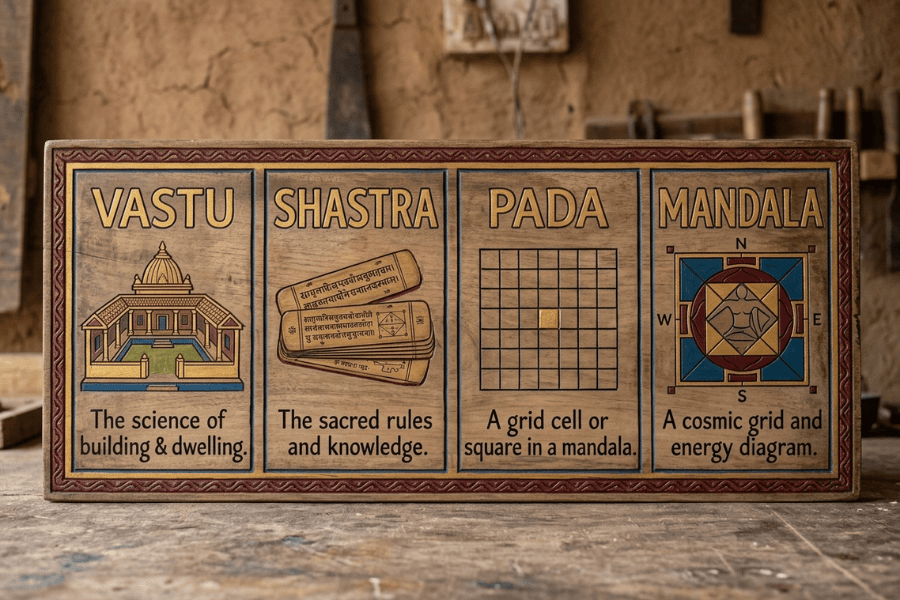
The meaning of Vaastu becomes clearer when you break the term into two parts: Vastu and Shastra.
Vastu comes from a Sanskrit root linked with dwelling, living, or residing. In context, it refers to a dwelling, a site, or a built space. Shastra means a teaching, doctrine, or organised body of knowledge.
So, Vastu Shastra can be understood as the traditional body of knowledge concerned with dwellings and built form. It is often described as the science of architecture in a traditional Indian sense. In plain English, it is best understood as a traditional system of architectural planning.
This matters because many people use the words loosely. A builder may say “This is good Vastu”, while a consultant may refer to “Vastu Shastra principles”. They are related, but not exactly the same.
Vastu And Vastu Shastra Are Not Exactly The Same
A simple way to understand the difference is this:
- Vastu refers to the dwelling, site, or physical space
- Vastu Shastra refers to the knowledge system used to plan that space
That small difference helps clear up a lot of confusion.
A Few Terms That Often Confuse People
Many readers also come across terms like Pada, Mandala, or Homa and wonder what they mean. Before we go deeper, here is a simple reference table.
| Term | Simple Meaning |
|---|---|
| Vastu | Dwelling, site, or built space |
| Shastra | Teaching, doctrine, or body of knowledge |
| Pada (पद) | A division, module, or one of the planning squares within a grid |
| Mandala (मंडल) | A geometric diagram or planning framework |
| Homa (होम) | A ritual fire offering in traditional practice |
| Vaastu Compliant | A property described as being planned in line with Vastu principles |
For many families, this is where the topic first becomes practical. You may hear terms like these while reviewing a floor plan, speaking to a consultant, or discussing a flat with your children before booking it.
Where Vastu Shastra Comes From
To understand the real meaning of Vastu, it helps to know where it comes from. Vastu is not a modern property trend. It has roots in ancient Indian thought on architecture, settlement planning and spatial order.
Traditional architectural ideas linked with Vastu appear in Sanskrit literature and are often connected with the Vedic Period. Over time, these ideas developed through texts, building practice and regional traditions.
This history matters because it shows that Vastu began as a way of thinking about built space. It was not originally a collection of fear-based warnings about every object in the house.
Important Sanskrit Texts Linked With Vastu
Several classical works are often associated with Vastu and traditional architecture. Among the most cited are:
- Brihat Samhita
- Mayamata
- Manasara
- Samarangana Sutradhara
These texts discuss site selection, measurement, orientation, layout and building types. They were written in different settings, so they do not all present ideas in the same way.
How Vastu Moved From Texts To Real Buildings
Vastu was not kept alive by books alone. It was also passed through builders, craftsmen, sthapatis and regional building traditions.
That is why even today, older people in many families may speak about house planning in ways that sound practical rather than theoretical. They may not quote a text, but they still value direction, open space and order.
What Vastu Really Looks At In A Home
When people ask for the vaastu shastra meaning, they often want more than a translation. They want to know what Vastu actually looks at when applied to a house.
At its core, Vastu focuses on site planning, direction, spatial balance and the relation between a building and natural forces such as sunlight and air movement. Traditional explanations often connect this balance with the five elements, including Earth and water, within a larger view of the home and its surroundings.
For a couple buying a flat, this often shows up in very simple questions. Where is the entrance? Does the home get morning light? Is the kitchen tucked into a usable corner? Is the bedroom placed where it feels quiet and settled?
These are not abstract concerns. They affect daily comfort.
Why Direction Matters In Vastu
Direction is one of the most talked-about parts of Vastu. Traditional explanations may speak of the movement of light, heat, air and subtle energy flow through a space.
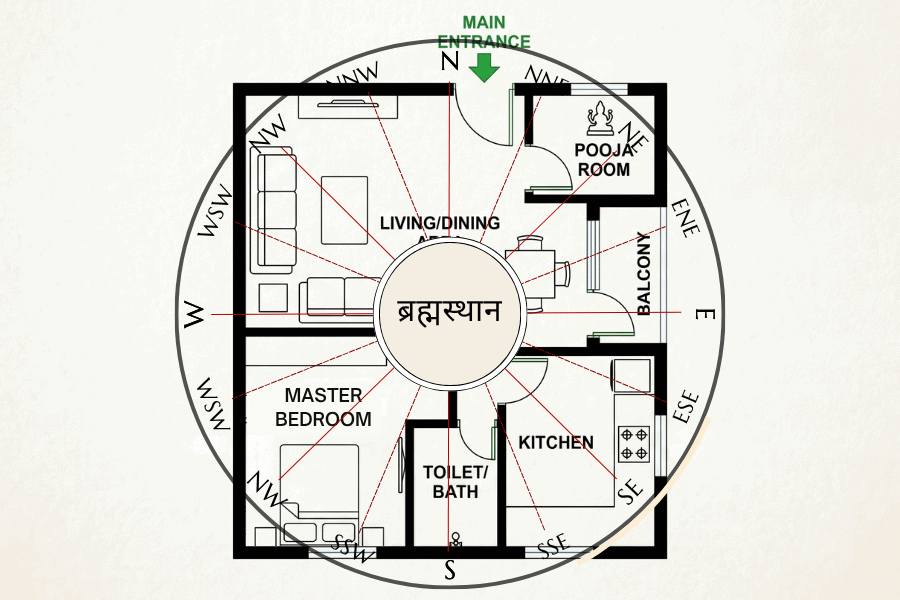
When discussing directions in Vastu for the first time, it helps to name the full 16-zone directional framework often used in practice:
North, North-North-East, North-East, East-North-East, East, East-South-East, South-East, South-South-East, South, South-South-West, South-West, West-South-West, West, West-North-West, North-West, North-North-West.
Not every house can follow this perfectly, especially in cities. But the basic idea is that direction influences how a space feels and functions.
For example, where sunlight enters from the East can affect morning light and comfort. In the same way, poor planning around the main entrance can affect movement, privacy and first impressions.
Vastu Is Also About Daily Use, Not Just Direction
A good layout supports routine. It reduces friction in everyday life.
Think of a home where the entrance opens awkwardly into a cramped passage, or where the family has no proper living room to sit together in the evening. Most people would feel the problem even without using the word Vastu.
That is one reason the subject still matters. Even if someone is not deeply traditional, they still value light, ventilation, order and ease of use.
Is Vastu The Same As Astrology?
No. Vastu is mainly about built space and planning. Astrology is a separate field.
Some people combine the two in modern practice, which causes confusion. It is better to understand Vastu first as an architectural and spatial system.
| Vastu Principle | Why It Matters In Real Life |
|---|---|
| Orientation | Affects daylight, heat and comfort |
| Open space | Helps airflow and breathing room |
| Entrance planning | Shapes movement and access through the main door |
| Room zoning | Improves function and privacy |
| Proportion and order | Supports comfort, clarity and healthy energy flow |
Understanding The Vastu Purusha Mandala
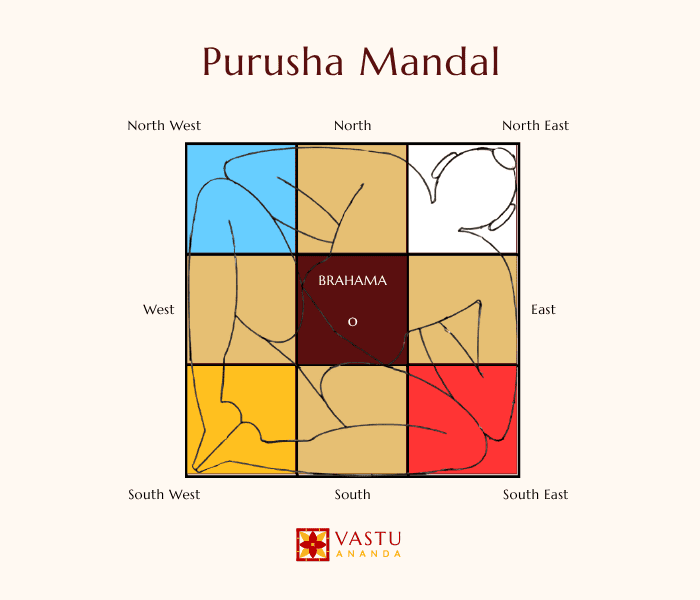
One of the most important ideas in Vastu Shastra is the Vastu Purusha Mandala. The term sounds technical, but the basic concept is simple.
It is a geometric planning grid used to organise space. In traditional thought, it represents an ordered relationship between the built environment, the human body and the directions.
In practical planning, it gives structure. It helps divide a site into measurable parts so that placement feels balanced rather than random.
What A Pada Means
A Pada (पद) is one division within this grid. In plain language, it is one module or one square used in planning.
This is why people searching what pada means in vaastu are really asking about spatial division. The answer is simpler than it sounds.
Why The Grid Still Matters Today
Traditional texts describe many types of grids, including 8×8, 9×9 and 10×10 formats. These grids help planners think about centre, edge, proportion and use.
Modern architects often interpret this flexibly. They may not force a design into a rigid pattern, but they still use the logic of order, zoning and balance.
For homeowners, the takeaway is simple. The mandala is not just a religious symbol. It is also a way of organising space thoughtfully.
What Vaastu Compliant Actually Means
This is one of the most common modern phrases linked to Vastu. It appears often in property listings and builder brochures.
A vaastu compliant home usually means that the property is said to follow accepted Vastu principles in layout, orientation or room placement. But in real life, the phrase can be quite loose.
One builder may use it because the entrance faces a preferred direction. Another may use it after checking the full layout. So the term only becomes useful when someone explains what exactly is compliant.
What Most People Mean By Vaastu Compliant
In everyday property language, people usually mean some mix of the following:
- Suitable orientation
- Sensible entrance placement
- Balanced room arrangement
- Good light and ventilation
- Fewer major layout conflicts
This is why couples buying a house should ask direct questions. If a broker says a flat is vaastu compliant, ask what that means in the actual plan.
Real-Life Example: Why Clarity Matters
Imagine two flats in the same building. One is called vaastu compliant because its entrance faces well, but inside, the layout is cramped and dark. The other has a sensible plan, better air movement and less clutter, yet no one markets it with that label.
Most families would live more comfortably in the second flat. This is why understanding the meaning matters more than trusting a phrase. It also helps explain why Vastu remains influential in real estate, where labels often shape buyer expectations.
Common Vaastu Terms People Often Hear
Some Vastu terms appear often in conversation but are not always explained clearly. A simple explanation can save people from unnecessary confusion.
Pial Meaning In Vaastu Shastra
A pial generally refers to a raised platform, edge space, or veranda-like built feature in traditional Indian architecture. It often acts as a transition between inside and outside.
This is a good example of how many Vastu-related terms are practical architectural words, not mystical ones.
What T Point Means In Vaastu
T point is usually a modern property term. It often refers to a plot or building facing a T-junction.
In Vastu discussion, people may have concerns about such locations based on direction, traffic movement and site condition. But it should be judged case by case, not through blanket fear.
What Excessive Margin Means
A margin usually means open setback space around a building. Excessive margin may describe an uneven distribution of that space.
In simple terms, it points to imbalance in planning. It is not a magical problem, but a question of proportion.
Vaastu Homa Meaning
Homa (होम) is a ritual fire offering performed in some traditions during house-related ceremonies. It may be linked with site blessing, construction, or moving into a new home.
This is important culturally, but it is separate from the planning side of Vastu.
Vastu Or Superstition? Here Is The Real Difference
This is where many readers need clarity. They want to respect tradition, but they do not want to be misled.
Classical Vastu focuses on layout, measurement, orientation and spatial order. It is concerned with how a place is formed and used.
That is very different from the modern idea that every problem in a home can be fixed by moving one object. For example, placing Lord Ganesha near the entrance may hold devotional value, but it does not correct poor planning by itself.
The same applies to other symbolic references. A family may keep an image of Krishna out of faith and affection. That is meaningful in its own way, but it should not be confused with architectural guidance.
Some objects are also given exaggerated claims. For instance, people sometimes ask whether using black marble affects Vastu in a fixed way. In practice, material choice should be understood in context, not treated as an automatic sign of good or bad fortune.
A Balanced Way To Think About Vastu Today
A thoughtful view of Vastu avoids two extremes. It does not dismiss everything as nonsense, and it does not accept every dramatic claim without question.
Good Vastu guidance is often about comfort, proportion, light, ventilation and stability in the way a home is organised. At the same time, for many families, the subject also carries a spiritual meaning shaped by culture, memory and hindu traditions. That is why many sensible people still find value in it.
Why Vastu Still Matters In Modern Homes
Vastu continues to influence home design because some of its core concerns remain relevant. People still want houses that feel calm, functional and healthy to live in.
Modern architects often adapt Vastu in practical ways. They think about daylight, air movement, room zoning and how spaces are used from morning to night.
For example, a retired couple may want a quieter bedroom, better cross ventilation and a layout that feels easy to manage as they grow older. These are modern needs, but they fit naturally with the older concern for balance in space.
This is also why Vastu is discussed not only in houses, but in offices, hotels and commercial spaces. Its lasting appeal comes from the fact that it speaks to how people actually live.
Final Thoughts
So what does vaastu meaning really come down to?
Vastu refers to dwelling or built space, while Vastu Shastra (वास्तु शास्त्र) is the traditional body of knowledge concerned with planning that space well. Its deeper meaning lies in how land, layout, direction and use come together.
For homeowners and families, this understanding is more helpful than labels and fear. When approached with clarity, Vastu becomes less about rigid claims and more about thoughtful planning.
If you want practical guidance rooted in tradition and adapted for modern spaces, Vastu Ananda offers vastu consultations for plots, residential spaces, commercial properties, hotels and offices, along with a vastu basic course and a vastu advanced course for learners.
FAQs
Is Vastu only for homes?
No, Vastu principles are also commonly applied to offices, shops, study rooms, factories, and commercial spaces.
How does Vastu work?
Vastu is based on the idea that the placement of rooms, furniture, entrances, and other elements can influence the overall feel, balance, and functionality of a space.
Is Vastu related to architecture?
Yes, Vastu is often considered a traditional architectural and design philosophy that guides how spaces are planned and organised.
Can Vastu be used in modern homes?
Yes, many people adapt Vastu principles to modern homes and interiors in practical ways without changing the entire structure.