When most people think of Vastu Shastra (वास्तु शास्त्र), they think of practical advice—like the best direction for a room or where the kitchen should be.
But Vastu is not only about placement. There is a deeper principle behind these guidelines.
According to Vastu, every building is constantly affected by the forces around it. Sunlight (धूप), wind (वायु), the Earth’s magnetic field (पृथ्वी का चुंबकीय क्षेत्र) and even planetary influences described in Jyotish Vidya (ज्योतिष विद्या) all play a role in shaping the atmosphere of a space.
These natural and cosmic forces influence how energy (ऊर्जा) moves through a building, which in turn affects how the space feels to the people living in it.
One concept that helps explain this is the Energy Streams principle, also known as the Two Stream Theory.
What Is the Two-Stream Theory?
The Two Stream Theory (द्वि-ऊर्जा प्रवाह का सिद्धांत) suggests that two natural energy currents move across the land and influence the vastu urja energy balance within buildings. These are the Sun’s solar energy and the Earth’s magnetic field.
According to this concept, two primary streams affect all spaces:
- Solar energy stream (सौर ऊर्जा): energy coming from the Sun
- Magnetic energy stream (चुंबकीय ऊर्जा): energy generated by the Earth’s magnetic field
The solar stream moves from East to West, following the path of the Sun across the sky. The magnetic stream flows from North to South, guided by the Earth’s natural magnetism.
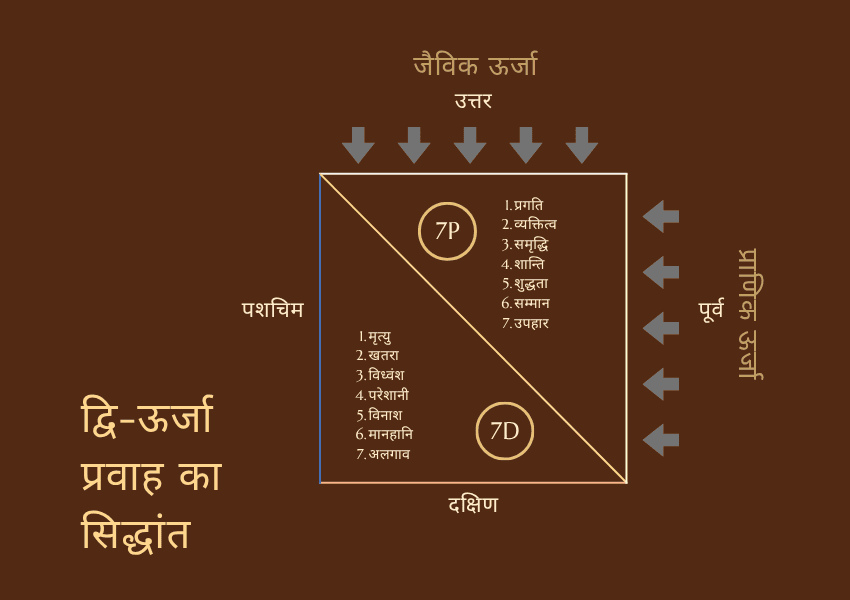
When these two streams cross each other, they create a network of energy movement across the land and through buildings.
By understanding how these energy streams work, we can design homes and buildings that encourage positive energy (सकारात्मक ऊर्जा) and help reduce vaastu negative energy (नकारात्मक ऊर्जा).
| Energy Stream | Source | Direction |
| Solar Stream | Sun | East → West |
| Magnetic Stream | Earth | North → South |
The Cosmic Basis of These Energy Streams
In Vedic science, the Earth constantly receives energy from several cosmic sources, including the Sun, the Moon and the planet’s own magnetic field. These forces influence what traditional texts describe as Pranic urja (प्राणिक ऊर्जा) and Jaivic urja (जैविक ऊर्जा).
- Pranic urja is associated with solar movement and flows from East to West.
- Jaivic urja relates to the Earth’s magnetic energy and flows from North to South.
When these two streams intersect harmoniously, the energy within a building begins to circulate in a balanced, clockwise (मंडलाकार) pattern. In traditional Vastu terminology, this meeting of the two streams is called “Preeti Sangam” (प्रीति संगम)—the harmonious union of natural energies.
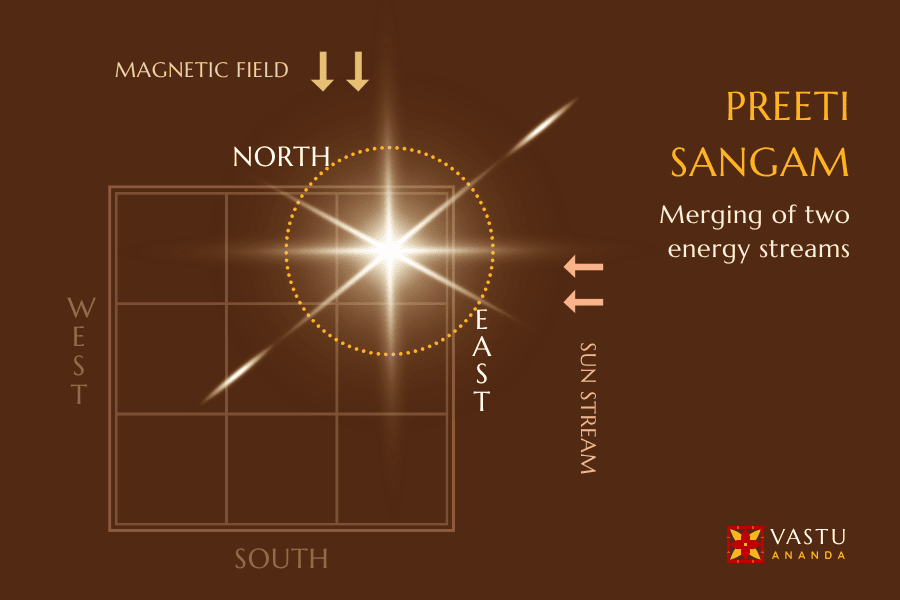
This state is considered most stable during the night, when the Sun moves to the opposite side of the sky and its intense influence reduces.
At this time, the disturbance caused by strong solar effects is minimal, allowing the positive energy within the space to remain calm and balanced.
Parallels Across Ancient Civilisations
The idea that architecture should align with cosmic forces is not unique to India. Many ancient civilisations designed structures according to celestial patterns and natural energy movements.
| Civilisation | Architectural Feature |
|---|---|
| Mayan architecture | Temples aligned with solar cycles |
| Egyptian architecture | Pyramids aligned with stars |
| Ancient Indian temples | Structures aligned with cosmic directions |
These examples show that early builders across cultures understood the relationship between architecture, nature and the universe.

Pranik Urja—Solar Energy Stream in Vastu
The first energy stream described in the Two Stream Theory is the solar stream.
The Sun is the main source of energy for life on Earth. It provides heat, light and vitality. In Vastu Shastra, sunlight is considered a powerful purifier that removes stagnant energy.
This stream is connected with Pranic Urja, the life energy that brings divine blessings and positive energy.
The solar stream moves from East to West, following the daily path of the Sun.
Morning sunlight is especially beneficial because it contains gentle Ultraviolet rays that support health and freshness.
On the other hand, sunlight later in the day has more of the harmful Infrared rays due to the near-vertical angle of the sun.
This is why many traditional homes are designed to receive early sunlight. Ancient temples also often included open spaces that allowed sunlight to enter from East and circulate throughout the structure.
In modern houses, common design suggestions include:
- Windows facing East
- Open courtyards
- Meditation spaces facing sunrise
Jaivic Urja—Magnetic Energy Stream in Vastu
The second stream in the theory is the magnetic stream.
The Earth behaves like a giant magnet. It has a North pole and a South pole, which create a natural magnetic flux across the planet.
This magnetic stream flows from North to South and influences the orientation of buildings.
In Vastu Shastra, this stream is connected with Jaivic Urja, the biological energy that supports life.
The human body also contains magnetic properties. Our brain and nervous system respond to magnetic fields in the environment. Because of this, the orientation of buildings and furniture can affect our comfort.
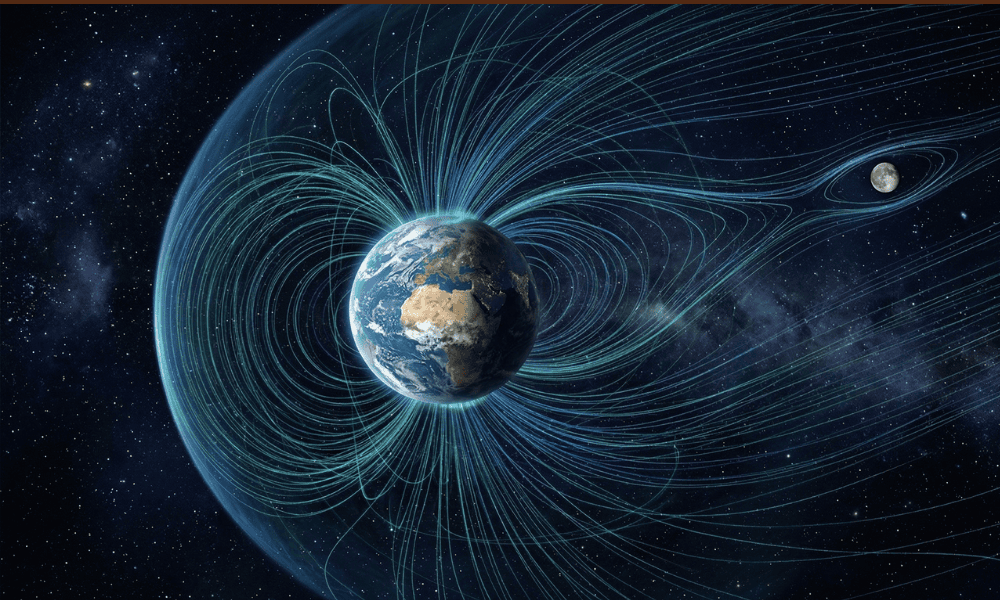
Modern science confirms that magnetic fields affect human behaviour, sleep patterns and even brain waves. This is why Vaastu and magnetism are closely connected.
For example:
- Sleeping with the head towards the South aligns with Earth’s magnetic field.
- Sleeping Northward may disturb natural magnetic alignment.
Also, materials like copper are often used in traditional buildings because they conduct energy and support natural energy movement.
True North vs Magnetic North in Vastu
In modern design, it is important to understand the difference between true North and magnetic North.
True North refers to the geographic North pole of the Earth. Magnetic North refers to the direction indicated by a compass.
In Vastu Shastra, proper alignment is important to maintain correct energy flow.
Builders often use surveying tools from civil engineering to ensure that buildings are aligned accurately.
Decoding Sink and Source Directions
In Vastu Shastra, the North, North-East and East are considered source directions.
This means they are the primary entry points of morning sunlight and positive natural energy (सकारात्मक ऊर्जा) into a space—supporting health and vitality. Because of this, these directions are often kept light, open and less obstructed in architectural planning.
The presence of the Moon stream in this region is also believed to create a calming effect, which helps maintain balance and comfort within the space. It also influences emotional balance, calmness, mental stability and intuition.
| Type | Direction | Meaning |
| Source Direction | North-East | Entry point of energy |
| Sink Direction | South-West | Exit point of energy |
In contrast, the South-East, South and West are often described as sink directions (डूबा हुआ), where energy gradually settles, transforms or exits the space.
As the sun moves from East to West during the day, the intensity of solar radiation increases. By the time it reaches the Southern and Western sides, it carries stronger infrared heat energy.
This is also believed to reduce the effects of positive energy and is known as the region of negative energy (नकारात्मक ऊर्जा).
Importance of Directions in the Two-Stream Theory
In Vastu Shastra, directions are very important because the two natural energy streams move through them in specific patterns. The Pranic Urja carried by the Sun travels from East to West, while Jaivic Urja linked to the Earth’s magnetic flux moves from North to South.
Because of this movement, each direction in a building develops a different type of energy influence.
The energy flow as per vastu is like this: North-East → East → Centre → South-West
The North direction is associated with steady magnetic energy. So it is known to attract opportunities and financial growth.
The East receives the first rays of the morning sun, making it a source of vitality and positive activity.
The North-East zone (ईशान कोण) is the point where solar and magnetic streams meet. Because of this, it is considered the entry point of positive energy.

The South-East is considered the fire zone, which is why activities involving heat, such as the kitchen, are commonly placed here.
The South and South-West directions are linked with strength and stability. This is why it’s better to put heavier walls, beams, equipment or the master bedroom.
Meanwhile, the West and North-West corners are associated with movement and change. So these can be used for storage, guests or transitional spaces.
Ignoring these vastu guidelines can shake up the balance between the two energy streams. This can affect the overall harmony in the home.
Ancient planners used this understanding to guide architectural planning. One of the most important tools in Vastu Vidya was the Vaastu Purush Mandala (वास्तु पुरुष मण्डल), a geometric diagram that represents the body of Vastu Purusha (वास्तु पुरुष)—the cosmic being believed to reside within every building site.
In Vaastu vidya, each direction also carries a specific type of vastu devta energy as per the concept of Navgraha (नवग्रह) from Astrology.
| Direction | Vastu Deity | Effect |
|---|---|---|
| North | Kubera | Wealth |
| East | Indra | Growth |
| South | Yama | Discipline |
| West | Varuna | Strength |
| North-East | Shiva | Wisdom |
| South-West | Nairutya | Stability |
| North-West | Vayu | Movement |
| South-East | Agni | Power |
These energies are important for a house. They ensure warmer relations, less conflict, mental peace and prosperity.
Architecture and Energy Flow
The goal of architectural planning in Vastu Shastra is to support natural energy flow.
This is done by organising spaces according to the Vastu Purusha Mandala.
The Brahmasthan (ब्रह्मस्थान), located in the centre of the house, represents the most sacred space. It should remain open and be a clutter-free space so that energy can circulate freely.
Other important planning elements include:
- Proper entrance placement
- Balanced room positions
- Correct dimensions
Elements like water fountains, aquariums or small water body features can help improve energy movement.
Even the placement of objects like precious stones or metals like copper may influence subtle energy patterns.
What Happens if a Building Ignores These Energy Streams?
Balancing these two energy streams in a building creates a supportive and harmonious environment. This brings stability, comfort and prosperity for the people living there.
However, if the movement of Jaivic Urja and Pranic Urja is disturbed because of poor planning, the natural energy flow in the building may weaken.
According to Vastu Vidya, this imbalance can create difficulties, stress or instability for a family. Some practical issues include:
- Blocked energy flow
- Lack of divine blessings
- Blocked growth
- Problems in career
Ancient books on temple architecture like the Silpa Prakasa (शिल्प शास्त्र) suggested solutions for such problems.
Signs of Negative Energy in a House
When the vastu energy flow becomes disturbed, certain problems may appear. Common signs of negative energy include:
- Constant arguments in family
- Financial struggles
- Poor sleep
- Frequent illness
- Mental stress
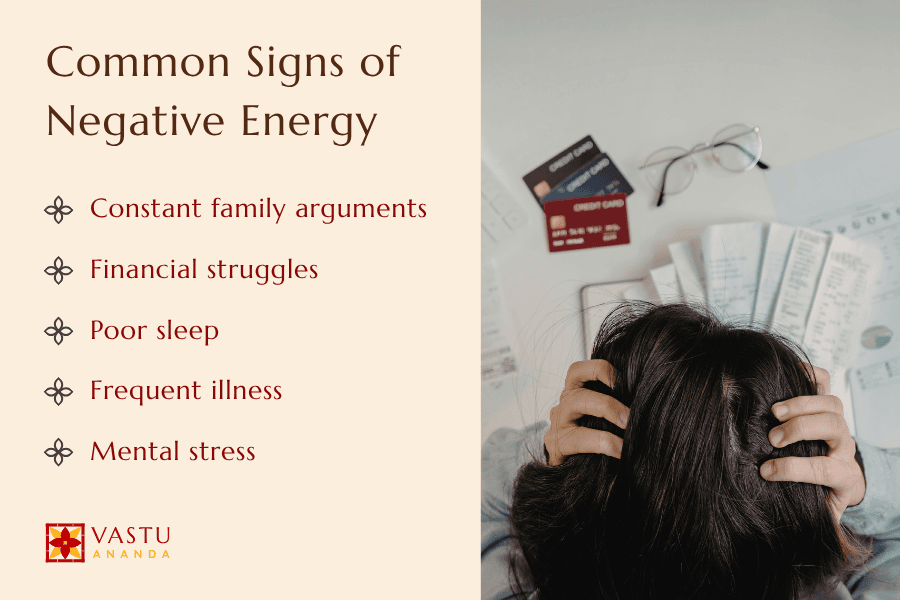
These signs often indicate vastu negative energy (नकारात्मक ऊर्जा) in the home.
Vastu Tips for Positive Energy
Here are some simple Vastu tips for positive energy that align with the two-stream theory.
Allow Natural Light
Sunlight strengthens positive energy Vastu.
Keep windows open in the East direction so morning sunlight enters your home.
Keep the North-East Clean
North-East is the entry point of divine vastu urja.
Avoid:
- Heavy furniture
- Storage clutter
- Toilets
Maintain an Open Centre
The centre of the house should remain light and open. This ensures smooth vastu energy flow across the building.
Use Natural Elements
Plants, water bowls and natural materials increase shubh vastu urja.
Proper Bed Direction
Sleeping with the head towards the South ensures that your sleeping position aligns with Earth’s magnetic field.
This improves sleep quality and overall health
Practical Example of Energy Flow
Let’s understand the significance Vaastu energy flow in the real world.
There are two homes: A and B.
Home A follows the natural energy flow as per vastu.
- Open North-East
- Sunlight from East
- Stable & heavy South-West
Home B blocks these directions.
- Heavy storage in the North-East
- Dark entrance
- Blocked centre
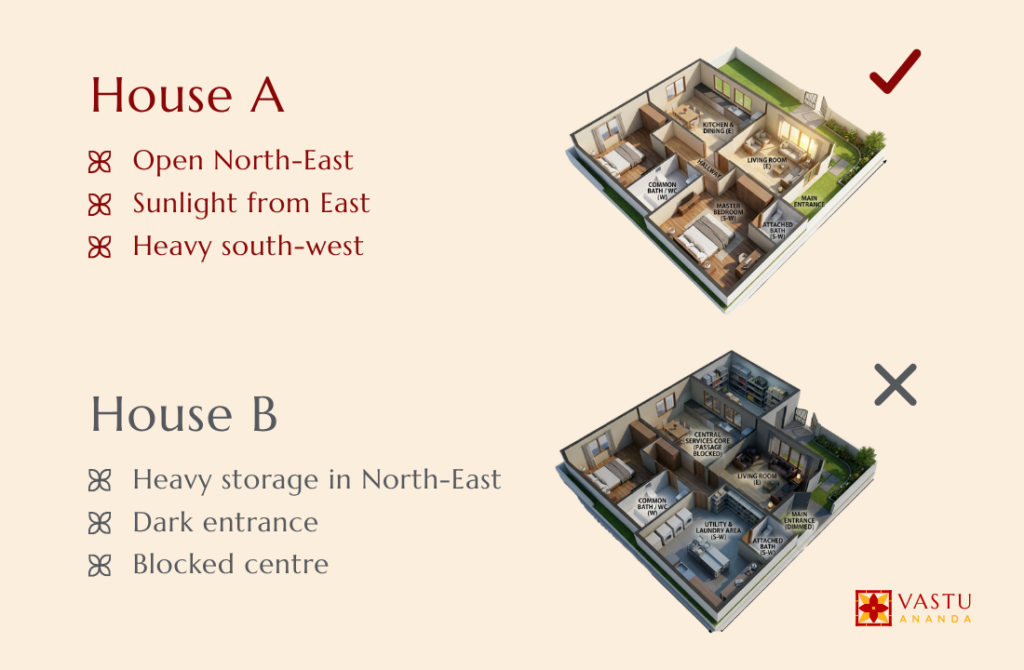
Over time, Home A experiences harmony while Home B may face disturbances.
Final Thoughts
The two-stream theory is one of the most important ideas in Vastu Shastra. It explains how solar and magnetic energy streams influence buildings and human life.
Concepts like magnetic field and sun direction help us design homes that support health, peace and prosperity.
In the end, Vastu is not just about directions or architecture. It is about respecting the natural forces around us and living in harmony with the universal flow of divine vastu urja.