Have you ever walked into a home that looked beautiful but still felt unsettled? The furniture was in place, the colours were pleasant and the rooms were clean, yet something felt off. Many homeowners notice this feeling when a house lacks balance, comfort and the right sense of happiness.
This is where Vastu Shastra (वास्तु शास्त्र) and Feng Shui come into the picture. Both are traditional systems used to improve harmony at home. Both look at energy flow, space and daily living, but they come from different traditions and apply different methods.
That difference matters when a family is buying a flat, planning a bungalow or updating a long-time home for retirement. At that stage, people want something practical, not vague. They want a system that supports peace, health, prosperity and lasting comfort.
What Vastu Shastra Means in Home Planning
Vastu Shastra (वास्तु शास्त्र) is the traditional Indian system of spatial planning and architectural design. It explains how land, rooms, doors, windows, directions (दिशाएँ) and the five elements (पंचमहाभूत) should work together in harmony.
It is often described as a traditional science of dwelling because it studies the relationship between the home, the earth, the sky, natural forces, energy flows and human life. In this system, the structure of the house matters deeply from the very beginning.
This approach also connects with astrology in some traditions, especially when the home is studied in relation to the occupants and the movement of cosmic energies. The aim is to create a house that supports balance, well-being and steady positive energies.
What Feng Shui Focuses On
Feng Shui is a traditional Chinese system that studies how life force moves through a space. It focuses on balance, symbolic placement and the smooth movement of energy flow through the home.
Rather than beginning with the structure alone, Feng Shui often works through internal correction. It may adjust furniture, décor, water features, mirrors, objects and movement patterns within a room.
This makes it more flexible in many ready-built homes, especially where major changes to walls, doors and windows are not possible.
Where Vastu Shastra and Feng Shui Come From
The two systems are ancient, but they come from different civilisations and different design traditions.
Vastu Shastra was developed in India and is closely linked with sacred geometry, directional planning and the relationship between buildings and the earth. Feng Shui developed in China and grew from the study of landform, orientation, water, wind and the movement of subtle forces through a place.
So when comparing these systems, the first difference is simple. One is rooted in Indian planning traditions, the other in Chinese spatial philosophy.
What Both Systems Are Trying To Do
Even though they are different, both systems are trying to solve the same basic problem. They aim to make a home feel balanced, supportive and emotionally steady.
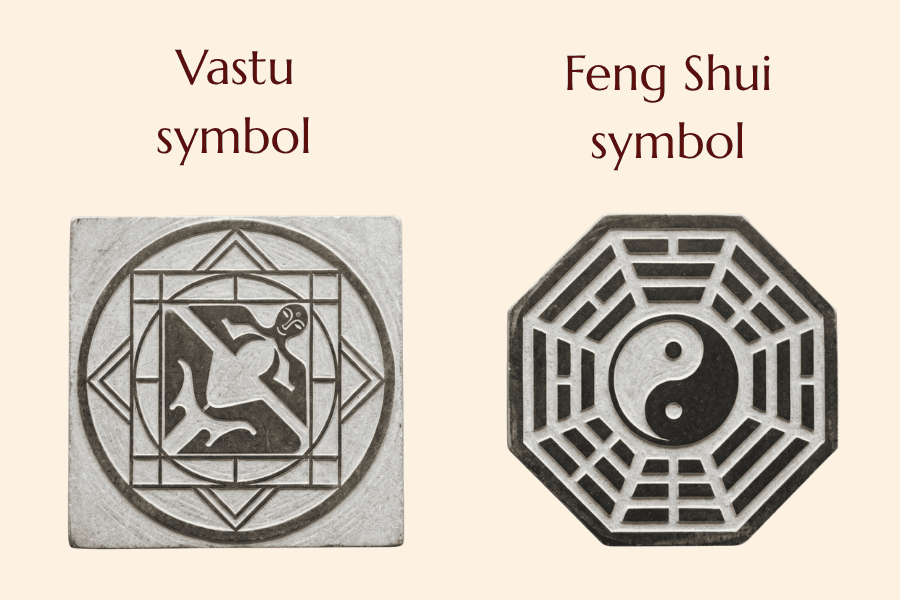
In Vastu Shastra, this is done through direction, layout and the five elements. In Feng Shui, it is done through Chi, symbolic balance, the bagua map and adjustment within the home.
In Indian thought, this living force is often described as prana. In Feng Shui, it is known as Chi. The language is different, but both systems care deeply about the quality of energy flow in a house.
The Main Difference: Structure vs Adjustment
The biggest difference lies in the way the two systems are applied.
Vastu is strongly connected to structure and planning. It looks at the plot, the built form, the entrance and the placement of each room. This is why it is often more useful when a home is being planned from the ground up.
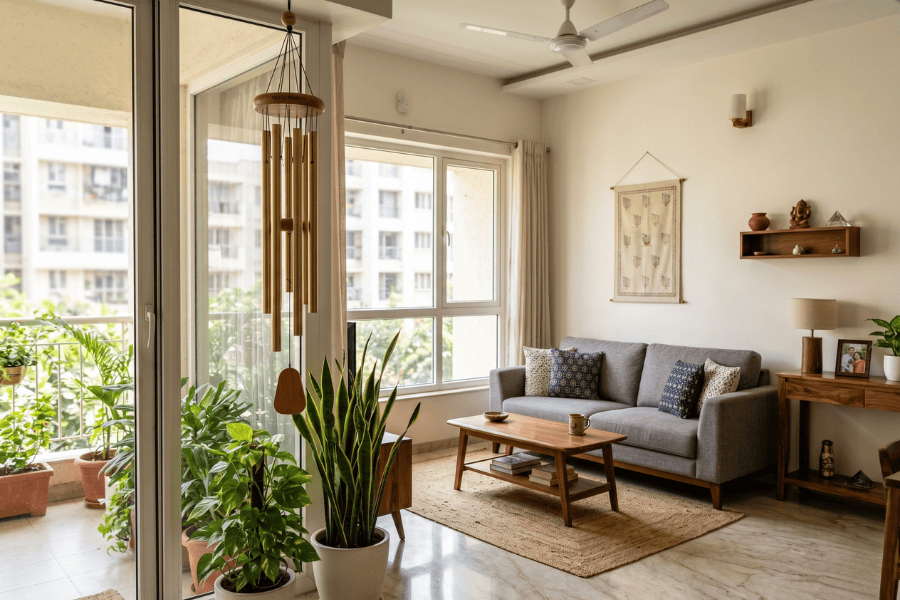
Feng Shui is more adaptive. It usually works within the home as it already exists. Instead of changing the structure, it may use room arrangement, symbolic objects, wind chimes, the Laughing Buddha or carefully placed water features to improve balance.
This is why one system often feels more architectural, while the other feels more corrective.
Even so, Vastu Shastra is not limited to new construction, demolition or major structural changes. It can also be applied in practical ways within an existing home through better room use, furniture placement, clutter removal, directional corrections and simple remedies. Balance can be improved by making thoughtful adjustments that support the natural energy of the space.
| Vastu Shastra | Feng Shui |
|---|---|
| Originated in India | Originated in China |
| Focuses on layout, direction and structure | Focuses on energy flow and interior balance |
| Works best during planning or construction | Works well in existing homes |
| Relies strongly on directions and zones | Uses direction along with the Bagua map |
| Remedies may involve layout changes as well as objects, colour, etc | Remedies often use objects and furniture placement |
| Suits Indian homes and pooja spaces well | Suits a flexible interior that corrects well |
Directions, Zones and Spatial Balance
Both systems value direction, but they use it differently.
In Vastu Shastra (वास्तु शास्त्र), the home is often studied through 16 directional zones. These are:
- North
- North-North-East
- North-East
- East-North-East
- East
- East-South-East
- South-East
- South-South-East
- South
- South-South-West
- South-West
- West-South-West
- West
- West-North-West
- North-West
- North-North-West
Vastu directions remain central to room planning and orientation. In practice, consultants may use compasses to judge direction accurately before recommending a layout.
Feng Shui also values direction, but it often works with the BaGua map, which divides the home into life areas such as family, wealth and relationships. This makes Feng Shui feel more interpretive inside the home, while Vastu remains more closely connected to the building.
Remedies, Objects and Daily Use
The difference also becomes clear in the remedies each system prefers.
In Vastu, remedies may involve room use, entrance correction, zoning and structural changes.
In Feng Shui, remedies may include specific objects and symbols meant to guide positive energies more effectively.
These may include:
- Wind chimes
- Mirrors
- Crystals
- Laughing Buddha
- Water features
- Symbolic décor
In Indian homes, corrective objects mostly include spiritual symbols such as Ganesha near the entrance or Tulsi in a suitable place. It’s also recommended to bring in the water element in the right place or hang appropriate paintings for the room. These have a different role from Feng Shui objects, but they also reflect the idea that a house should support peace, protection and prosperity.
Which Works Better in Real Homes?
For most homeowners, the real question is not which system sounds better, but which one gives clearer and more practical guidance for the home they live in.
In Indian homes, Vastu Shastra usually feels more natural because it is based on direction, layout, room placement and the way energy moves through the built space. It gives a strong foundation to any home, shop or office.
Vastu system usually works best when:
- You are building a new home
- You are choosing a plot
- You are planning a major renovation
- You want direction-based guidance
At the same time, Vastu can also be applied flexibly in an existing flat or ready home through practical corrections in room use, furniture placement, clutter control and simple remedies.
Feng Shui may work better when:
- You live in a readymade flat
- Structural changes are difficult
- You want more flexible internal corrections
- You prefer symbolic placement
Feng Shui is often more object-based and symbolic in its approach, while Vastu gives a clearer architectural framework. For homeowners who want direction-led guidance that suits Indian living patterns, Vastu usually offers the stronger and more lasting system.
How the Difference Shows Up in Each Room
The contrast becomes easier to understand when it is seen room by room.
Entrance
In Vastu, the main entrance is central because it shapes how energy enters the house. Its direction, scale and position matter deeply.
In Feng Shui, the entrance is also important, but the focus may include the visual path, symbolic welcome and what the entry draws into the home.
Kitchen
Vastu system usually gives strong importance to kitchen direction, often preferring the South-East. It also looks at the fire zone and the balance of the elements inside the room.
Feng Shui looks at the kitchen too, but it may focus more on the relationship between fire and water, clutter control and internal arrangement.
Bedroom
In Vastu, the bedroom is studied through direction, bed position and stability. This is especially important in the master bedroom, where rest and grounding are essential.
In Feng Shui, the bed’s command position and surrounding arrangement are often emphasised more strongly.
Pooja Room
This is where Indian planning traditions stand apart. The pooja room has a sacred role in Vastu and is treated with specific directional care.
Feng Shui does not have a direct equivalent in the same cultural sense. That makes Indian spatial guidance more relevant in homes where prayer and spiritual routine remain part of everyday life.
Kids Room
Both systems aim to create calmness and support for children. One may guide the best zone for the room, while the other may pay more attention to the internal arrangement and flow.
Which Is Better for Your Home?
There is no universal winner. The better choice depends on the home, the level of change possible and the tradition you want to follow.
If you are planning a new house, this Indian system is usually stronger because it is built around structure, orientation and the relationship between the home and the earth.
If you live in an apartment and cannot change the layout, Feng Shui may be easier to use because it works more through internal correction.
For Indian homeowners, especially families planning a long-term home, Vastu often feels more natural because it fits local lifestyles, sacred spaces and traditional room planning. The key is not to chase trends, but to apply the chosen system clearly and properly.

Final Thoughts
Vastu Shastra and Feng Shui both aim to create harmony, support and a better home environment. But they differ in origin, method and practical application.
One is more architectural and deeply linked to Indian planning traditions. The other is more adaptive and often easier to use in ready-built homes. Both care about balance, movement, the five elements, the role of metal, wood, water and the quality of life inside the house.
For many Indian homeowners, especially couples planning a long-term family home, Vastu Shastra often offers a more direct and culturally aligned path. But the best choice is always the one that suits your house, your stage of life and the level of change you can make.
If you’re ready to bring Vastu principles into your home or workplace for positive energy, contact us now!