Many home buyers are often told that West-facing homes bring struggle or delay. This creates doubt and fear among them. But in Vastu Shastra (वास्तु शास्त्र), the direction alone does not decide the result. The placement of the main door, room arrangement, open space, weight distribution and the balance of the five elements matter far more.
A well-planned West-facing home can support comfort, progress and steady family life. It can also work very well for people who want practical guidance without breaking walls or changing the full structure. The key is to understand what to place where and what to avoid.
This guide covers the main points that people usually search for before buying, building or correcting a West-facing property.
Do West-Facing Houses Bring Misfortune?
No, a West-facing house does not bring misfortune on its own.
Many people assume that such homes are inauspicious, but that idea comes from half-knowledge. A West-facing home can give stable results when the layout follows proper Vastu guidelines.
The West direction is linked with Lord Varuna (वरुण), the devta connected with water, depth and order. This direction also receives the evening sun. That changes the heat pattern inside the house, which is why planning ventilation, windows and room use becomes important.
What usually creates trouble in a West-facing home is not the direction itself. The real issue is poor planning such as:
- A main door placement in the wrong West zone
- A kitchen in the North-East
- Heavy construction in the North-East
- A cut or extension in the South-West
- Clutter and darkness near the entrance
When these defects appear, residents may feel restlessness, financial pressure, low harmony or slow progress. When the house follows the right direction rules, the same West-facing property can feel grounded and supportive.
Benefits of a West-Facing Home
A West-facing house can give several good results when it is planned with care.
It gets strong evening sunlight. This is useful for homes where family members return later in the day and want brighter common areas in the evening. Good natural light in the West also supports a warm and active feeling in the home.
Secondly, West-facing homes often suit people who want steady growth rather than sudden changes. In Vastu Shastra, this direction is often linked with maturity, discipline and consistency.
A properly balanced West-facing home can support the five elements, or panch tatva (पंच तत्व). This is possible by focusing on stability in Southwest for Earth, clarity in North-East for Water, Action in Southeast for Fire and Movement in North-West for Air. The Brahmasthan should also be free for Energy Flow to support the Space element.
If these zones stay clean and correctly used, the home feels lighter and more settled.
Who Should Prefer a West-Facing Home?
A West-facing home can suit many people, but it is often preferred by those who value discipline, reputation and long-term stability.
It is usually considered suitable for business owners, traders, teachers, administrators and people in other public roles.
It can also suit homeowners who are buying flats in cities where plot direction options are limited. In many apartment projects, buyers do not get full freedom over orientation. In that case, the internal Vastu Shastra of the flat becomes even more important.
For families, a West-facing home can work very well when the master bedroom is in the Southwest, the pooja room (पूजा कक्ष) is in the North-East and the kitchen is in the Southeast. This keeps the key energy zones in order.
Ideal Home Plan for West-Facing Homes
Vastu Shastra experts often divide a direction into sections or padas (पद). For West-facing homes, the best entrance positions are usually in the central or North-West padas. The Southwest end is usually avoided for the main door. Apart from this, room placement is also very important.
Best Room Placements for a West-Facing House
| Area | Best Location |
|---|---|
| Main entrance | Central or North-West zones |
| Master bedroom | South-West |
| Kitchen | South-East or North-West as second choice |
| Puja room | North-East |
| Living areas | North, East, North-East or North-West |
| Children’s room | West, North-West or North |
| Toilets or Bathrooms | West or North-West |
| Staircases | South, West or South-West |
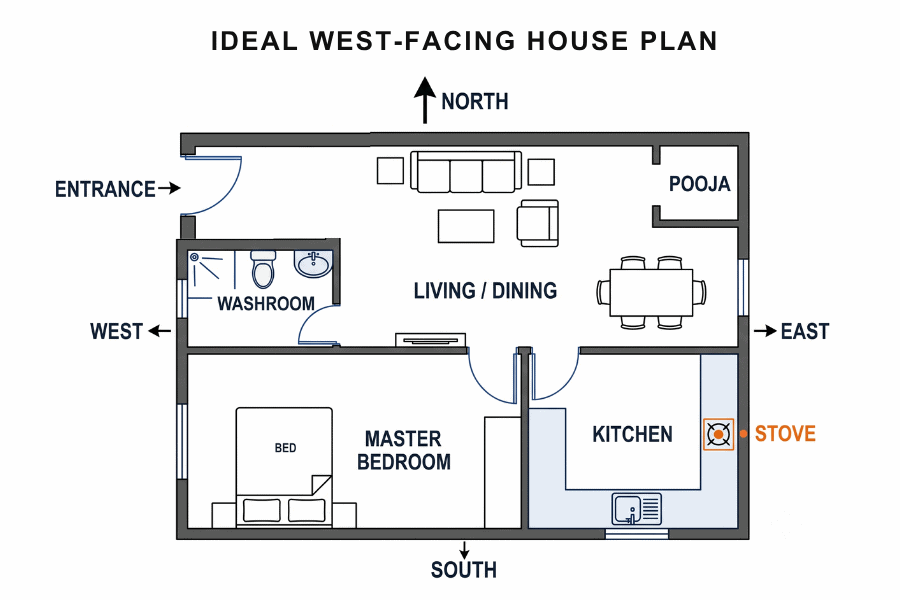
A few planning points matter a lot:
- Keep the North-East light and open
This zone relates to clarity, prayer and water energy. Avoid heavy storage, bathrooms or a blocked corner here. - Keep the Southwest strong and heavier
This zone gives control and stability. It suits the master bedroom, cupboards and heavier furniture. - Place the kitchen in the Southeast if possible
This is the Agni (अग्नि) zone. It supports proper fire energy. If that is not possible, North-West is usually the next choice. - Avoid a kitchen in the North-East
This is one of the most common defects in modern flats and homes. - Let the centre stay open
The Brahmasthan (ब्रह्मस्थान), or centre of the house, should not feel blocked by heavy walls, storage or clutter.
Suitable Decor for West-Facing Homes
Decor should support light, balance and calm. It can improve the feel of the home but does not replace layout changes.
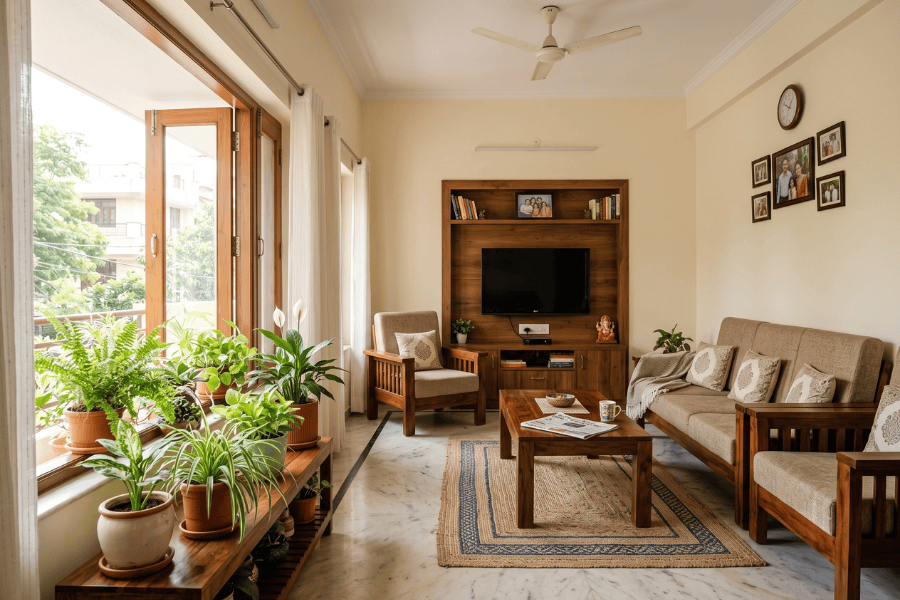
For West-facing homes, use simple colours and clean placement. White, beige, off-white, light yellow and soft earthy shades usually work well. These colours keep the home open and reduce visual heaviness. Harsh dark colours on large wall surfaces can make the West side feel too heavy, especially in smaller homes.
Use these Vastu tips:
- Keep the entrance bright and clean
- Place a proper nameplate at the door
- Use warm lighting near the main entrance
- Keep mirrors on North or East walls where suitable
- Use indoor plants in the North or East
- Avoid thorny plants inside the home
- Keep heavy furniture in the Southwest, West or South
Rounded furniture edges can feel softer in compact flats. Good ventilation also matters because West-facing homes often hold evening heat.
Decor Choices for West-Facing Homes
| Decorative Elements | Good Choice |
|---|---|
| Wall colours | White, beige, light yellow, soft earthy tones |
| Entrance lighting | Warm and bright |
| Plant placement | North or East |
| Mirror placement | North or East wall |
| Heavy furniture | South-West or West |
Myths vs Facts About West-Facing Homes
Many people reject West-facing properties because of common myths. Most of these ideas ignore the full Vastu picture.
Myth: West-facing houses always bring bad luck.
Fact: A good layout and correct entrance placement can make them highly suitable.
Myth: A West-facing home is bad for family life.
Fact: Family harmony depends more on bedroom, kitchen and North-East balance.
Myth: Career growth suffers in a West-facing house.
Fact: Many people in trade, management and public roles prefer such homes.
Myth: Nothing can fix a West-facing defect without demolition.
Fact: Many issues improve through room use, weight balance, lighting and directional corrections.
Common Vastu Doshas to Avoid and Tips to Balance Energy
A dosha (दोष) is a directional or elemental imbalance in the home. Some doshas are common in West-facing properties.
One major dosha is a main door in the Southwest part of the West side. This can disturb stability and create pressure in work or relationships. If shifting the door is not possible, keep the entrance well lit, clean and protected with proper threshold design and disciplined use.
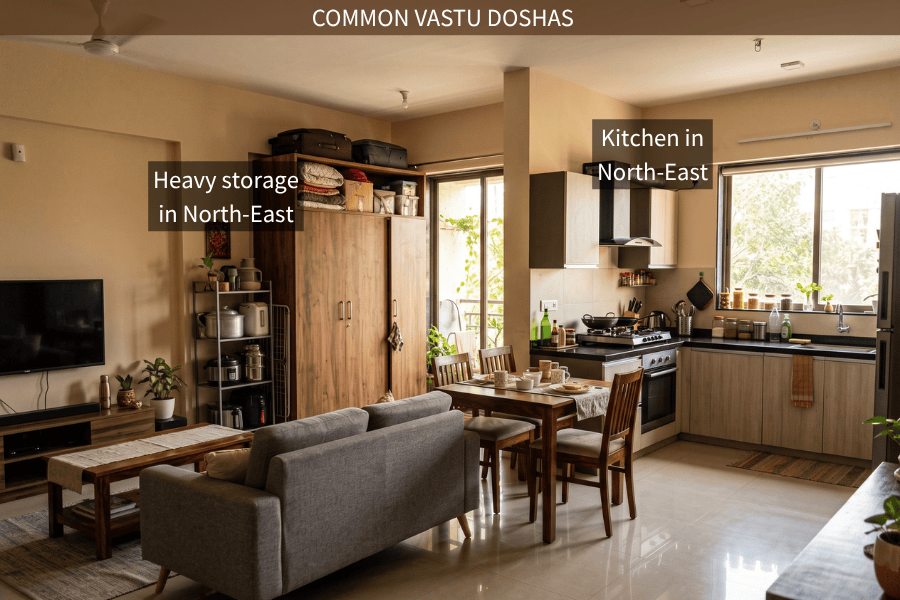
Another common issue is a kitchen in the North-East. This mixes fire and water energies in the wrong way. If you cannot shift the kitchen, keep the North-East as light as possible, avoid red shades there and maintain order.
Heavy storage in the North-East is also a problem. Remove what you can. Keep this area open, clean and calm.
If you are dealing with an existing property, these practical Vastu steps often help:
- Reduce clutter in the North and East
- Increase weight in the South-West
- Improve light near the entrance
- Keep the pooja area or meditation space in the North-East
- Avoid water placement in the South-West
- Sleep with the head towards South or East where possible
Final Thoughts
A West-facing house can be suitable when the plan is right. The main entrance, room positions, weight balance and elemental harmony decide the outcome far more than fear around direction.
If you are buying a property, do not reject a West-facing home in a hurry. Check the actual layout. If you already live in one, simple changes in room use, decor and energy balance can improve the space in a meaningful way.
For a home that still feels unsettled, a proper consultation gives a more exact reading based on the full plan. For personalised guidance on plot vastu, residential vastu, commercial vastu, hotel vastu or office vastu, you can book a consultation with Vastu Ananda. They also provide vastu basic course and vastu advanced course for learners.
FAQs
Is a West-facing house good as per Vastu Shastra?
Yes, it can be good in Vastu when the entrance and internal layout follow proper rules.
Which main door position is best for a West-facing house?
The better entrance positions are usually in the central to North-West zones of the West direction. The South-West end is generally avoided.
Where should the kitchen be in a West-facing house?
The South-East is the best location. North-West is usually the second choice.
Where should the pooja room be?
The pooja room is best in the North-East corner.
Which colour is good for a West-facing house?
White, beige, off-white, light yellow and soft earthy shades usually work well.
Can a West-facing house be fixed without demolition?
Yes, many issues improve through better room use, decluttering, weight balance, lighting and other practical Vastu corrections.