
Buying a corner plot can feel exciting at first. Two open sides, better light and a bigger presence on the street often make it look like a better option than a regular plot.
But many homebuyers pause at the same question: Is a corner plot actually good as per Vastu?
This is especially common when a family is about to invest savings, plan a retirement home or buy a long-term house for children and grandchildren.
In real life, many couples who like a plot because it feels open and premium, but they also worry about the road direction, the entrance and whether the plot will bring peace or constant problems. That concern is valid.
In Vastu Shastra (वास्तु शास्त्र), a corner plot is not judged by appearance alone. It is judged by direction, slope, road position, openness and how the house is planned inside the plot. When the planning is done well, the home is more likely to support comfort, positive energy and the smooth flow of cosmic energy in daily life.
A corner plot can work very well. But it needs clearer planning than a regular plot. In this guide, we will look at which corner plots are considered better, how South-East corner plots should be handled and what house planning rules matter most.
What Corner Plot Vastu Really Means
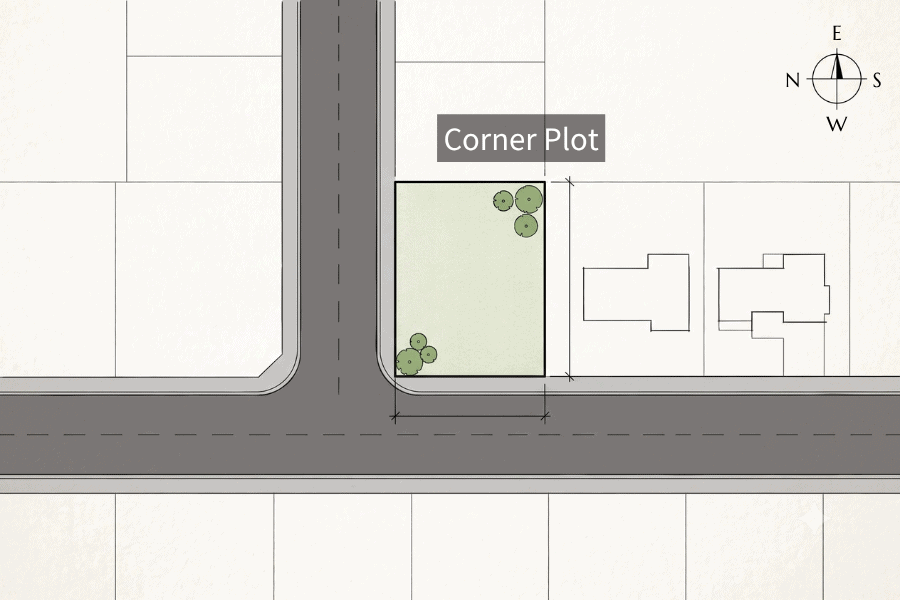
A corner plot is a plot located at the meeting point of two roads. Since it is open on two adjoining sides, it receives the influence of two directions.
That is what makes corner plot Vastu different from the Vastu of a regular plot. With a normal plot, there is usually one main road direction. In a corner plot, the energy flow, access and openness are shaped by two sides.
Why Corner Plots Need Special Vastu Attention
Corner plots give more flexibility, but they also create more decisions. You may have two possible gate positions, more open sides and more exposure to traffic, sunlight and movement.
That is why planning matters more. A badly placed entrance, excess openness in the wrong zone or poor water placement can weaken the overall balance of the home.
Is Buying A Corner Plot A Good Decision?
A corner plot can be a very good choice, but not every corner plot is equally suitable. The result depends on the combination of roads, the shape of the plot and how the built space is arranged.
No corner plot is automatically auspicious or inauspicious.
It becomes favourable or unfavourable based on planning and clear Vastu Principles.
For example, many families buy a corner plot because they want better ventilation and an easier parking layout. Those are real benefits. But if the entrance is forced into a poor location or the South-West becomes too open, the same plot may feel unsettled after construction.
Why Some Corner Plots Feel Better Than Others
The Main Benefits Of A Corner Plot
A corner plot usually gets more natural light and cross ventilation. It may also offer better street access and greater flexibility in planning the gate, parking and front elevation.
For many homeowners, this openness makes the house feel less cramped. Older buyers often like corner plots because they can support better airflow and easier movement around the house. Well-balanced open spaces around the house can also improve comfort and the overall feel of the property.
The Common Drawbacks To Watch For
The same openness can also create problems. A corner plot may face more traffic noise, less privacy and more exposure to harsh sun, dust or headlights from the road.
In some cases, homeowners only notice these issues after moving in. A retired couple may find that a busy road-facing bedroom disturbs sleep, or that a wrongly planned gate brings constant activity too close to the living area.
Why Road Direction Changes Everything
In corner plot Vastu, the road combination matters most. A plot with roads on the North and East sides is usually seen very differently from one with roads on the South and West.
This is because each direction carries a different role in Vastu. A corner plot is shaped not only by where the house stands, but also by which sides stay open to movement and external activity. In practical terms, the site orientation influences both comfort and planning choices.
Practical Factors You Should Not Ignore
Even a directionally strong plot can create trouble if practical details are ignored. Heat from the South and West, poor drainage, difficult turning space for vehicles or weak privacy from the road can affect daily comfort.
Good Vastu should support real life. If a plot looks good on paper but fails on ventilation, drainage or safe access, it needs a second look. The shape of the land also matters here, especially when the site is uneven or irregular. Among all plot shapes, square and rectangular options are usually easier to balance well.
Which Corner Plot Is Best As Per Vastu?
The Basic Rules That Apply To Most Corner Plots
A few Vastu rules are repeated across most reliable guidance. Square and rectangular plots are generally preferred. The South-West should usually stay heavier and higher. The North and East should usually remain lighter and more open.
These are broad principles, but they matter because they help create balance across the whole site.
The 16 Vastu Zones You Should Know
When people talk about direction in Vastu, they often mention only the 8 main directions. But in actual planning, the site is understood in finer segments.
The 16 directional zones are: North, North-North-East, North-East, East-North-East, East, East-South-East, South-East, South-South-East, South, South-South-West, South-West, West-South-West, West, West-North-West, North-West and North-North-West.
This matters because the exact location of an entrance, kitchen, water tank or room is often judged more precisely within these sub-zones, not only by the broader 8 directions.
Best Direction Combinations For Corner Plots
A North-East Corner plot is generally treated as the most favourable. This is because it keeps the North and East sides open, and these directions are usually associated with lightness, growth and clarity.
A North-West corner plot is often seen as moderate. It can work well, but it needs balanced planning. This zone is linked with Vayu, the Air element, so movement and flow become more important here. A South-East Corner plot can also be used, though it calls for more care because of the fire zone.
Corner Plots That Need More Caution
Southwest corner plots are usually handled more carefully because the South-West is expected to be stable, protected and heavy. This zone is often connected with the Earth element, so it should not be left too open or weak.
Plots with cuts, odd extensions or awkward shapes also need caution. In many cases, shape and slope create bigger problems than the direction label alone.
Corner Plot Vastu By Direction
| Corner Plot Type | General Vastu Reading | Main Planning Priority |
|---|---|---|
| North-East Corner Plot | Most favourable | Keep North and East open and clean |
| South-East Corner Plot | Sensitive but workable | Control fire element and entrance placement |
| North-West Corner Plot | Moderate | Avoid instability and poor zoning |
| South-West Corner Plot | Less favourable | Protect stability with heavier planning |
North-East Corner Plot Vastu
A north-east corner plot is generally considered the best option in corner plot Vastu. It supports openness in two directions that are usually treated as light and beneficial.
This type of plot often suits homes where families want peace, prayer space and good morning light. The north-east should stay uncluttered and free from heavy construction where possible. In some traditional references, such sites are also called Eshanya plots. Soft landscaping and suitable plants can also support this zone when used sensibly, especially when they help maintain a calm green space rather than block light.
South-East Corner Plot Vastu
A South-East corner plot has roads on the South and East sides. This makes it more sensitive because the Southeast is linked with Agni, the fire element.
This does not mean the plot is always bad. It means the planning must be more disciplined. Entrance position, kitchen placement and water location become especially important here. In some traditional discussions, these are also referred to as Agneya plots.
North-West Corner Plot Vastu
A North-West corner plot is connected with movement and change. It can suit households with active routines, guests or frequent travel.
But if the planning is weak, the home may feel unsettled. This is why North-West plots need proper room zoning and should not be left too empty in the wrong areas.
South-West Corner Plot Vastu
A South-West corner plot usually needs the most caution. Since this zone is expected to remain heavier and more stable, roads in this area can reduce that support.
Such plots are not always rejected, but they need stronger handling through slope, boundary wall design and room placement.
South-Facing Corner Plot Vastu
A South-facing corner plot is not automatically unsuitable. But it needs extra attention to entrance planning, heat control and internal zoning.
For many families, the real issue is not the South side alone. It is a combination of hot sun, poor shading and a badly planned entrance that causes discomfort later.
North-East Corner Extended Plot
A north-east extension is often seen as favourable when it is proportionate and clean. It can strengthen the openness of the site.
Still, an extended north-east will not fix poor planning in the rest of the house. The full layout must remain balanced.
South-East Corner Plot Vastu: What Homebuyers Should Know
What Is A South-East Corner Plot?
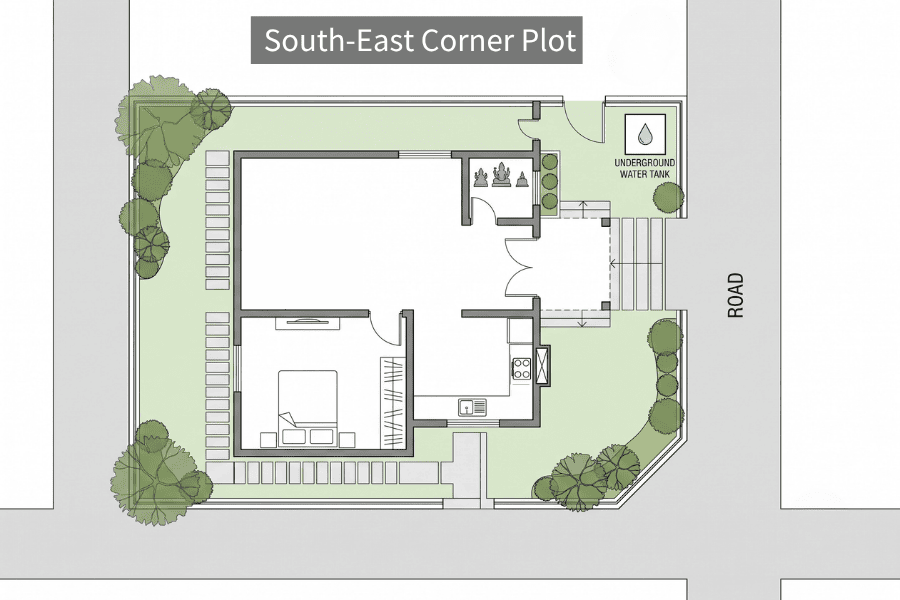
A South-East corner plot has roads on the South and East sides. In Vastu, this zone is called Agneya and is associated with fire, heat, energy and electrical activity.
That is why this plot type gets special attention. Many buyers hear mixed opinions about it and feel confused.
Is A South-East Corner Plot Good Or Bad?
The honest answer is that it depends on planning. Some sources present South-East corner plots as difficult, while others say they can work well if designed properly.
A balanced Vastu view is this: a South-East corner plot is more sensitive than a north-east plot, but it is not automatically unsuitable. If the entrance, kitchen, master bedroom and water elements are handled properly, it can support a comfortable home.
A practical example is a family that buys a South-East plot because it is in a good neighbourhood and within budget. If they place the main door more carefully on the East side, keep water out of the South-East and avoid putting the master bedroom there, the plot can work much better than people assume.
Why The South-East Direction Matters
The South-East is linked with the fire element. This makes it suitable for functions related to cooking, heat and electricity.
But an excess of fire energy can create restlessness. That is why this zone should be active and clean, but not overloaded with the wrong functions.
Best Entrance For A South-East Corner Plot
In most cases, the East side is preferred over placing the main entrance exactly at the South-East corner. A door at the exact corner point is often avoided.
The entrance should also be bright, clean and easy to approach. It should not face clutter, poor drainage or a badly placed utility area.
Kitchen Rules For A South-East Corner Plot
The kitchen usually fits naturally in the South-East zone. This is one of the strongest points of a South-East plot.
The stove is commonly placed in the South-East part of the kitchen and cooking while facing East is often recommended. The sink should not sit too close to the stove, as water and fire are opposing elements.
Useful Remedies For A South-East Corner Plot
Most useful Vastu remedies are practical. Do not place underground water storage in the South-East. Use this zone for kitchen or electrical functions where possible. Keep it clean, dry and free from leakage.
If a bedroom has to be placed in the South-East, reduce heat build-up, avoid harsh colours and keep the room calm. Decorative corrections such as random mirrors should not be used carelessly, because they can create more imbalance if placed without proper understanding.
A Simple Planning Checklist For South-East Corner Plots
| Planning Element | Preferred Guidance |
|---|---|
| Main Entrance | Better on the East side than exactly on the South-East corner |
| Kitchen | Best in the South-East |
| Master Bedroom | Better in the South-West |
| Pooja Room | Best in the North-East |
| Underground Water Tank | Better in the North or North-East |
| Overhead Water Tank | Better in the West or South-West |
How To Plan A House On A Corner Plot
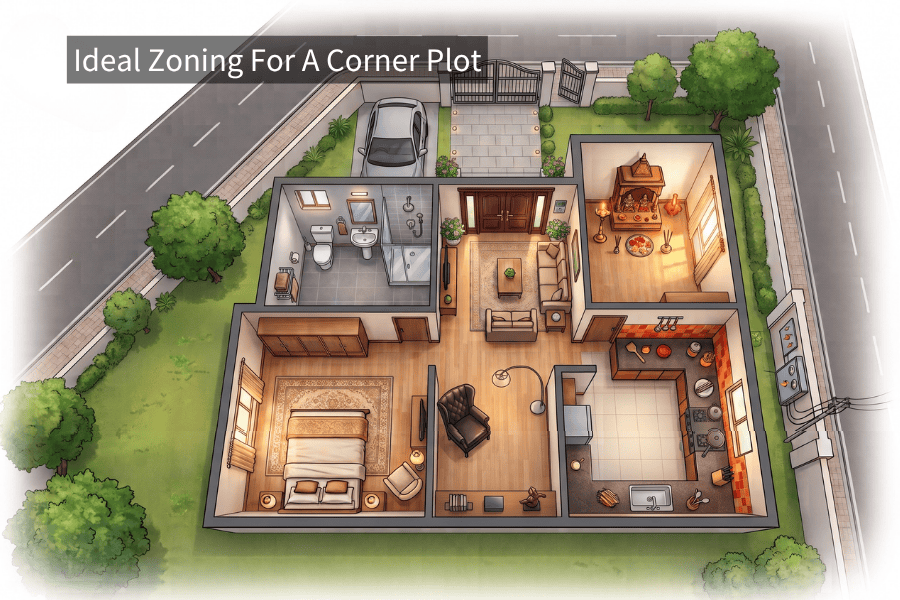
Where The Master Bedroom Should Go
The master bedroom is usually best placed in the South-West. This zone supports stability, privacy and rest.
For older couples, this matters a lot. A bedroom in an overactive zone can feel tiring over time, even if the house looks attractive from outside.
Best Position For The Living Room
The living room can usually be planned in the North, East or North-East depending on the plot and entrance. These areas often feel more open and welcoming.
This is useful for corner plots because the house already has exposure on two sides. A well-placed living room can use that openness without losing privacy.
Where To Place The Pooja Room
The pooja room is usually best in the North-East. It should be quiet, clean and away from toilets or heavy storage.
In many Indian homes, this is still an important daily space. Even a small pooja area feels more settled when placed thoughtfully. In some homes, simple greenery such as bamboo plants is also kept in suitable zones, though such additions should support the layout rather than replace it.
Bathroom, Toilet And Staircase Placement
Bathrooms and toilets are generally better in the West or North-West. The staircase, being a heavy feature, is usually better in the South, West or South-West.
These placements help keep the lighter zones free. On a corner plot, that balance becomes more important because there is more external activity around the home.
Water, Drainage And Utility Placement
Underground water tanks and borewells are generally preferred in the North or North-East. Overhead tanks are usually better in the West or South-West.
The South-East is usually better for electrical panels, inverters and other utility functions linked to heat or power.
Open Space, Setbacks And Boundary Wall Planning
More open space is generally preferred in the North and East. The South and West can carry more weight through walls, built form or taller compound wall treatment.
This helps the plot feel balanced. It also helps with very practical concerns like sunlight control and privacy from the road.
Common Corner Plot Vastu Mistakes To Avoid
The biggest mistakes are usually simple ones:
- Placing the entrance or gate in a sensitive spot without studying the road combination
- Putting water in the South-East or heavy mass in the North-East
- Planning the master bedroom in the South-East or placing the pooja room near a toilet
Another common mistake is ignoring real-life comfort. If the road is noisy, the sun is harsh or drainage is poor, the house will not feel right even if the plan looks acceptable on paper.
This is where guidance from an experienced Vastu expert can be useful, especially before construction begins.
Final Thoughts
A corner plot can be a strong choice when it is planned with care. The key is not to ask only whether the plot is good or bad. The better question is whether the plot can be balanced well.
That is where Vastu becomes useful. It helps you look beyond labels and study how the site will actually support daily life, peace and comfort.
If you want expert guidance for plot Vastu, residential Vastu, commercial Vastu, hotel Vastu or office Vastu, you can explore Vastu Ananda. They also offer a vastu basic course and a vastu advanced course for learners who want to study the subject in more depth.
FAQs
Which Corner Plot Is Best As Per Vastu?
A north-east corner plot is generally considered the best because it combines two directions that are usually treated as light and supportive.
Is A South-East Corner Plot Good As Per Vastu?
It can be good if planned carefully. It is more sensitive than a north-east plot, but it is not always unsuitable.
Which Corner Plots Should Be Avoided?
Plots with irregular shapes, wrong slope, excessive South-West openness or poor water placement are better avoided.
Is A South-Facing Corner Plot Good Or Bad?
A South-facing corner plot is not always bad, but it needs more care in entrance planning, heat control and room placement.
What Is The Best Entrance For A Corner Plot?
The best entrance depends on the road combination and full layout. In general, North or East side entrances are preferred where possible.