Imagine standing at the threshold of your new home, dreams and hopes brimming in your heart.
For many Indian families, building a home is a once-in-a-lifetime step. It carries emotion, responsibility and the hope that the house will bring peace, health and stability for many years.
That is why Vastu Shastra matters so much. And at the centre of Vastu lies the Vastu Purusha Mandala, the sacred energy map that guides the planning of a home.
It explains the role of cardinal directions, the importance of the centre, the placement of rooms and the influence of the 45 cosmic deities.
In simple terms, it helps turn a house into a balanced and blessed home filled with positive energy.
What Is the Vastu Purusha Mandala?
The Vastu Purusha Mandala is a sacred square energy grid used in Vastu Shastra (वास्तु शास्त्र) for planning homes, temples, offices and other spaces.
It shows how divine and natural energies are spread across a site. Each part of the grid has a purpose and each direction carries a different quality.
The word “Vastu” comes from the idea of a dwelling or site. “Purusha” means cosmic being and “Mandala” means sacred diagram or pattern.
Together, it means the sacred layout of the cosmic being of Vastu Purush within a space. This is why the mandala is also linked with mandala architecture and traditional architectural planning in India.
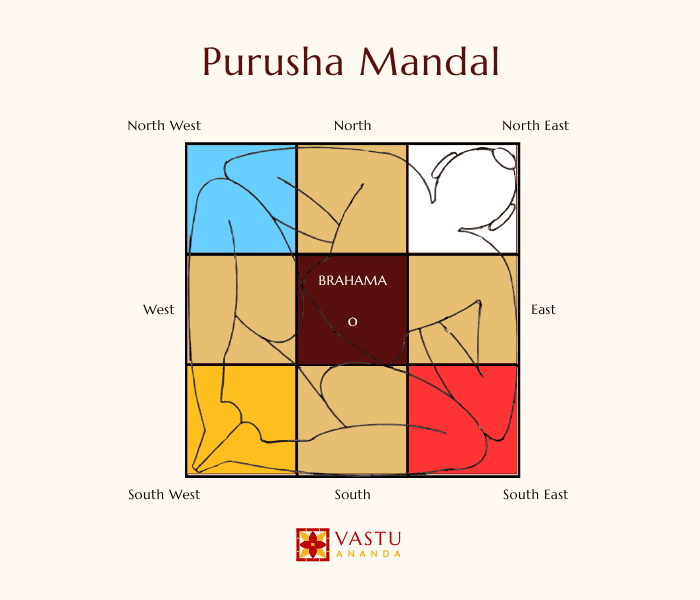
This purush mandala is usually depicted as a square divided into smaller squares called padas (पद). The most common forms are the 8×8 grid with 64 padas and the 9×9 grid with 81 padas.
The centre of the mandala is called the Brahmasthan (ब्रह्मस्थान). This is the most powerful and sensitive part of the space.
Some people also refer to it as a vaastu map, vastu diagram, vastu grid, vastu mandala, vastu mandal or even a vastu circle, although the classical form is typically square-based.
Who Is Vastu Purusha?
Vastu Purush is the presiding deity of a site. In Vastu, every plot is believed to carry his presence.
He is also described as the sacred cosmic being whose body lies across the land. He is shown lying face down on the land, with his head in the North-East i.e. Ishan Kona (ईशान कोण) and his feet in the South-West i.e. Nairitya Kona (नैऋत्य कोण). His body covers the whole site.
This is why the layout of a house is never treated casually in Vaastu. Every zone is connected to a part of his body and to a specific divine energy. These divine forces are also referred to as Vastu Devtas (देवता).
Vastu Purush is worshipped because he protects the space. When a home is planned in harmony with him, the people living there receive support, stability and blessings. This is why many families do Vastu pooja before starting construction.
Many also perform it before Griha Pravesh (गृह प्रवेश), especially when moving into a new home after years of saving and planning.
In simple terms, the Vaastu Purush is the vastu man, vastu god or vastu dev associated with the site.
Origin Story of the Cosmic Being
According to the traditional story, Vastu Purush came into existence from the sweat of Lord Shiva as a powerful cosmic being whose force began to disturb the world’s balance. To bring this energy under control, Brahma and the other deities pinned him face down upon the earth.
As each deity held a specific part of his body, that part became linked with that particular deity, that direction and that energy.
As each deity held a specific part of his [Vastu Purusha] body, that part became linked with that particular deity, that direction and that energy.
This is the basis of the Vastu Purusha Mandala. Texts and traditions often connect this story with sacred sources such as the Matsya Purana (मतस्य पुराण), Brihat Samhita (बृहत्संहिता) and Samrangan Sutradhara (समरांगण सूत्रधार).
This story also explains why Vastu gives so much importance to direction, balance and respect for space. A house is not only made of walls and rooms. It is also made of cosmic energy and sacred order.
Why Vastu Purusha Mandala Matters
The Vastu Purush Mandala helps decide where different parts of the home should be placed. This includes the entrance, kitchen, bedroom, prayer room, study area and water zones.
For example, many families notice that a prayer room in the North-East feels naturally peaceful. In the same way, a master bedroom in the South-West often feels more settled and secure.
It is also believed that if a serious Vastu Dosh affects a particular body zone of the mandala, it may also affect the corresponding body part of the house owner. For this reason, defects in important zones—especially the central and upper regions of the mandala—are treated very seriously in Vastu planning.
This is why the mandala is not only about room placement on a floor plan. It is about planning the house in a way that respects direction, balance, energy points and the living experience of the people inside it.
45 Devtas in Vastu Purusha Mandala Grid
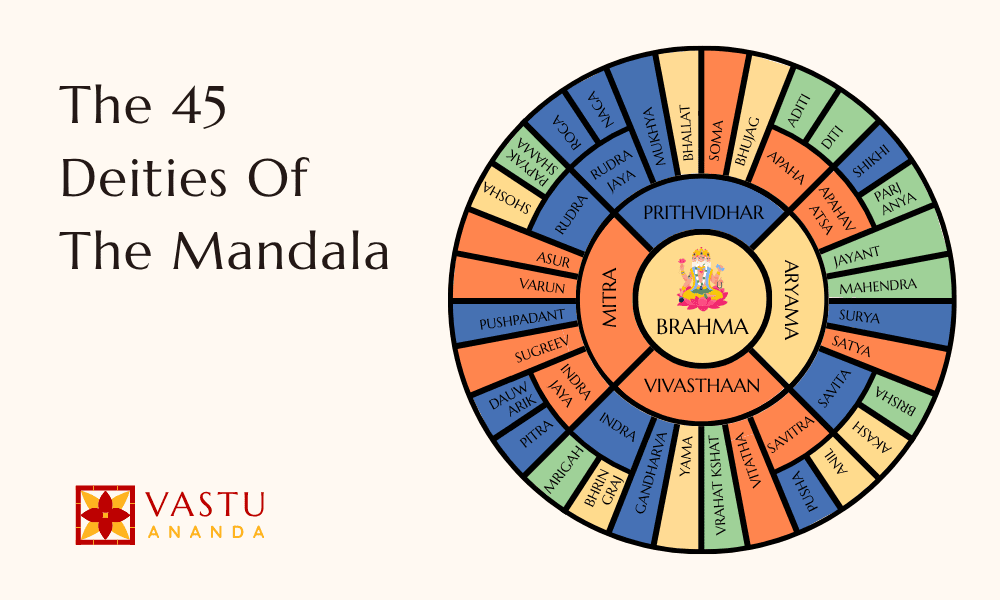
The Vastu Grid is arranged in layers called vithis (विथी). These layers show how energy moves from the centre to the outer boundary of the site.
Each vithi has its own role in the mandala and is linked with a group of deities. Together, these deities form the sacred structure of the Vaastu Purusha Mandala.
Brahma Vithi
The Brahma Vithi (ब्रह्म विथी) is the central zone of the mandala. It includes the Brahmasthan and represents creation, balance and life force.
This is the most sacred part of the space and is ruled by:
- Brahma

Deva Vithi
The Deva Vithi (देव विथी) is the next layer around the centre. It represents the expansion of Brahma’s creative energy in the four main directions.
The deities linked with the Deva Vithi are:
- Prithvidhar
- Aryama
- Vivasthan
- Mitra
These four deities are connected with the four main directions around the centre.
Manushya Vithi
The Manushya Vithi (मनुष्य विथी) is linked with human life, daily activity and movement. It covers the four diagonal directions around the inner grid.
The deities linked with the Manushya Vithi are:
North-East
- Apaha
- Apahavatsa
South-East
- Savita
- Savitra
South-West
- Indra
- Indrajaya
North-West
- Rudra
- Rudrajaya
These deities are closely connected with the flow of life in the home and the way energy supports action, growth and stability.
Paishacha Vithi
The Paishacha Vithi (पैशाचा विथी) is the outermost layer of the mandala. It forms the boundary zone and includes 32 deities placed around the edge of the grid.
These deities are grouped by direction:
North-East
- Aditi
- Diti
- Shikhi
- Parjanya
South-East
- Brisha
- Akash
- Anil
- Pusha
South-West
- Bhringraj
- Mrigah
- Pitra
- Dauwarik
North-West
- Shosha
- Papyakshama
- Roga
- Naga
East
- Jayant
- Mahendra
- Surya
- Satya
South
- Vitatha
- Gurhakshat
- Yama
- Gandharva
West
- Sugreev
- Pushpadant
- Varun
- Asur
North
- Mukhya
- Bhallat
- Soma
- Bhujag
When all four vithis are taken together, they make up the 45 devtas in the Vaastu Purush Mandal:
| Sr. | Vithi | Direction | Deity Name | Sanskrit |
| 1 | Brahma Vithi | Centre | Brahma | ब्रह्मा |
| 2 | Deva Vithi | North | Prithvidhar | पृथ्वीधर |
| 3 | Deva Vithi | East | Aryama | आर्यम |
| 4 | Deva Vithi | South | Vivasthan | विवस्थान |
| 5 | Deva Vithi | West | Mitra | मित्र |
| 6 | Manushya Vithi | North-East | Apaha | अपह |
| 7 | Manushya Vithi | North-East | Apahavatsa | अपहवत्स |
| 8 | Manushya Vithi | South-East | Savita | सवित |
| 9 | Manushya Vithi | South-East | Savitra | सवित्र |
| 10 | Manushya Vithi | South-West | Indra | इंद्र |
| 11 | Manushya Vithi | South-West | Indrajaya | इंद्रजय |
| 12 | Manushya Vithi | North-West | Rudra | रुद्र |
| 13 | Manushya Vithi | North-West | Rudrajaya | रुद्रजय |
| 14 | Paishacha Vithi | North-East | Aditi | अदिति |
| 15 | Paishacha Vithi | North-East | Diti | दिती |
| 16 | Paishacha Vithi | North-East | Shikhi | शिखी |
| 17 | Paishacha Vithi | North-East | Parjanya | पर्जन्य |
| 18 | Paishacha Vithi | South-East | Brihnsha | भ्रंष |
| 19 | Paishacha Vithi | South-East | Akash | आकाश |
| 20 | Paishacha Vithi | South-East | Anil | अनिल |
| 21 | Paishacha Vithi | South-East | Pusha | पुशा |
| 22 | Paishacha Vithi | South-West | Bhringraj | भृंगराज |
| 23 | Paishacha Vithi | South-West | Mrigah | मृग |
| 24 | Paishacha Vithi | South-West | Pitra | पित्र |
| 25 | Paishacha Vithi | South-West | Deewarik | दीवारिक |
| 26 | Paishacha Vithi | North-West | Shosha | शोष |
| 27 | Paishacha Vithi | North-West | Papaykshama | पापयक्षमा |
| 28 | Paishacha Vithi | North-West | Roga | रोग |
| 29 | Paishacha Vithi | North-West | Naga | नाग |
| 30 | Paishacha Vithi | East | Jayant | जयंत |
| 31 | Paishacha Vithi | East | Mahendra | महेंद्र |
| 32 | Paishacha Vithi | East | Surya | सूर्य |
| 33 | Paishacha Vithi | East | Satya | सत्य |
| 34 | Paishacha Vithi | South | Vitatha | वितथ |
| 35 | Paishacha Vithi | South | Vrahat kshat | वृहत क्षत |
| 36 | Paishacha Vithi | South | Yama | यम |
| 37 | Paishacha Vithi | South | Gandharva | गंधर्व |
| 38 | Paishacha Vithi | West | Sugreev | सुग्रीव |
| 39 | Paishacha Vithi | West | Pushpadant | पुष्पदन्त |
| 40 | Paishacha Vithi | West | Varun | वरुण |
| 41 | Paishacha Vithi | West | Asur | असुर |
| 42 | Paishacha Vithi | North | Mukhya | मुख्य |
| 43 | Paishacha Vithi | North | Bhallat | भल्लाट |
| 44 | Paishacha Vithi | North | Soma | सोम |
| 45 | Paishacha Vithi | North | Bhujag | भुजग |
Among them, Aryama Devta, Mitra Devta, Varuna Devta and Soma Devta are often discussed for their directional influence in Vastu.
At the centre of all these energies is Brahma. The remaining deities are placed around him in layers, creating the sacred map of the house.
How Vastu Purush Directions Shape Energy
The Vastu Purush position in the home is understood through the full site layout. In the Vastu Purusha Mandala, he lies across the entire plot and his position helps define the energy of each direction.
His head faces the North-East and his feet lie in the South-West. This body position forms the basis of directional planning in Vastu.
North-East
The North-East, also called the Ishan Kona (ईशान कोण), is linked with the head and face of Vastu Purush. This is the most sacred part of the home and is associated with purity, prayer, wisdom and spiritual energy.
This zone is also considered the source direction of life energy in the Two-Stream Theory (द्वि-ऊर्जा का सिद्धांत), full of positivity.
That is why it is often considered ideal for the pooja room, meditation and water elements.
South-East
The South-East or Agni Kona (अग्नि कोण), is linked with the right arm and shoulder of Vaastu Purusha. It carries the energy of fire, action and transformation.
This is why it is usually best suited for the kitchen, electrical appliances, Televisions, etc.
South-West
The South-West, also called the Nairitya Kona (नैऋत्य कोण), is linked with the lower body, thighs, knees and feet of Vastu Purush. It carries heavy and grounding energy.
In the Two-Stream Theory, this direction is considered to be the sink direction of positive energy as this is where the sun sets.
It is often preferred for the master bedroom, heavy walls and important storage.
North-West
The North-West or Vayu Kona (वायु कोण), is linked with the left arm and shoulder of Vastu Purusha. It is associated with movement, interaction and change.
This is why it may suit guest use, utility areas and spaces with regular movement.
East
The East (पूर्व) is linked with light, clarity and fresh beginnings. It supports vitality and a positive daily rhythm.
South
The South (दक्षिण) carries strength, discipline and control.
West
The West (पश्चिम) is linked with steadiness, maturity and support.
North
The North (उत्तर) is associated with flow, opportunities and prosperity.
At the centre of all these directions lies the Brahmasthan, which is associated with the central body region of Vastu Purush, especially the navel area. This area should always be light, open and uncluttered.
Traditionally, the directions are also connected with the Ashta Dikpalakas (अष्ट दिक्पाल), the guardians of the eight directions.
So in Vastu, even the same layout can feel very different when placed in a different orientation.
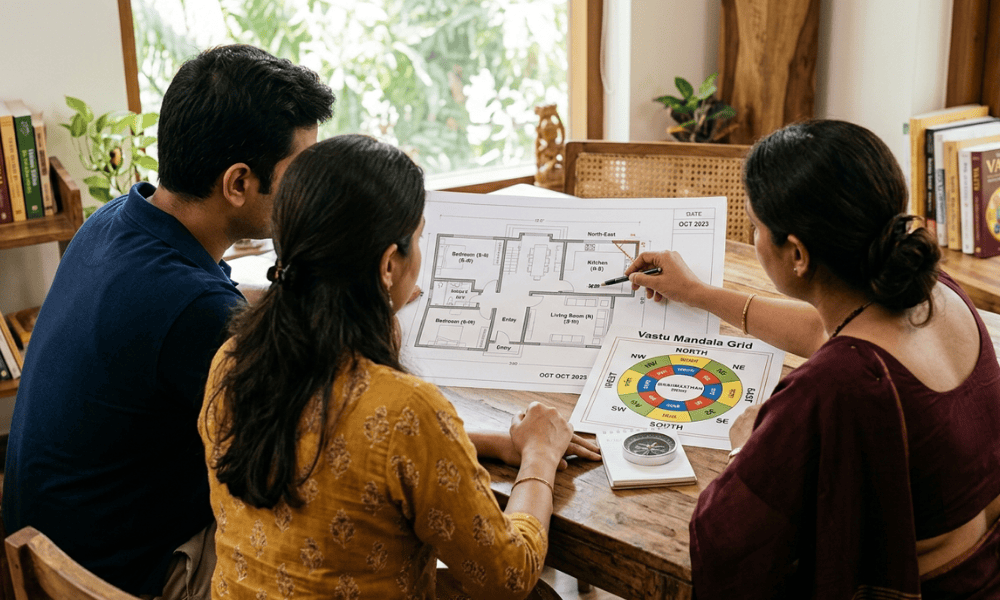
Scientific Basis of the Mandala
The scientific concept of Vastu Purusha is understood through the complete wisdom of Vastu Vidya. It shows that space has order, structure and energy.
Sages in the Vedic period divided land into measured parts and gave each direction and zone a role. This formed a complete system of architecture where all the five elements (Earth, Water, Fire, Air, Space) are balanced.
The grid, the centre, the directions and the placement of functions all work together. This is why the vaastu purusha mandala architecture tradition remains important in Indian building knowledge even today.
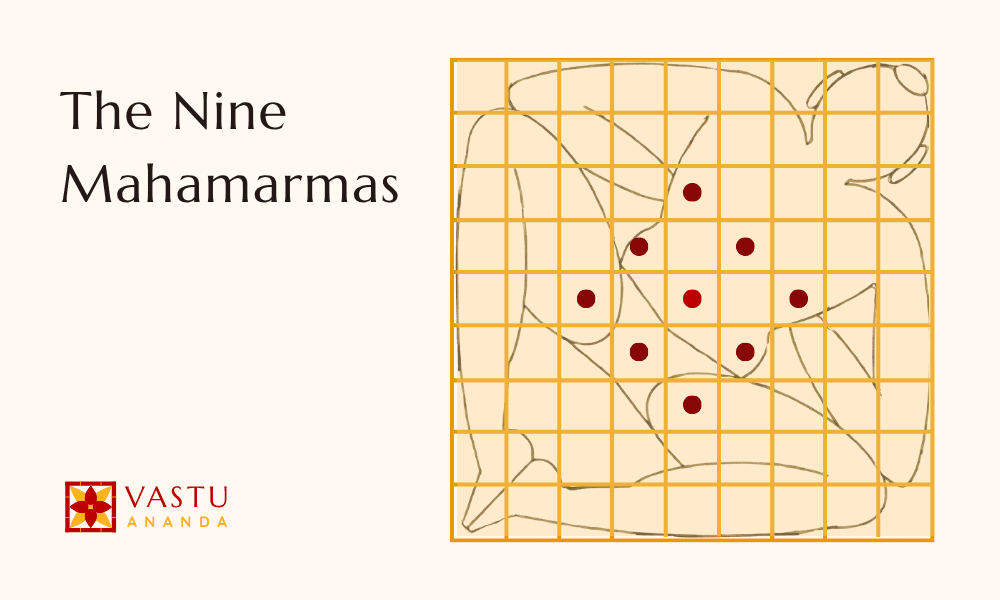
Brahmasthan & the Nine Mahamarmas
The Brahmasthan is the central energy field of the mandala. It is linked with Brahma and should be kept open, clean and undisturbed.
The Brahmasthan also contains sensitive energy points known as Marmasthaan (मर्मस्थान). According to Brihat Samhita, there are Nine Maha Marmasthanas, formed where the main energy lines of the mandala intersect.
These vital points are associated with key body regions of the Vastu Purush, including the head, mouth, heart, navel, anus and the nipples.
These Marma points should be treated with great care. Heavy load, deep cuts, pillars, nails, clutter or improper construction over these points are believed to disturb the energy of the space.
Connection With Nine Planets in Vedic Astrology
The nine planets or Navagraha (नवग्रह) are important in Vedic thought and Vastu Shastra both. They are Surya, Chandra, Mangal, Budh, Guru, Shukra, Shani, Rahu and Ketu.
Some planets are considered more supportive in certain conditions and some may bring challenges depending on their position. Their strength is also judged by whether they are currently exalted, debilitated or in their own sign in the Zodiac chart.
In traditional practice, planetary influence may also be considered while choosing timing for Vastu-related rituals and important beginnings.
What Is Bhadra Kaal?
Bhadra (भद्र) Karan, also called Vishti Karan (विष्टि करण) is an important period of time in muhurta-based planning (मुहूरत-अनुसार).
Mythologically, Bhadra is described as a fierce feminine force associated with Vishti Karan. She is often said to be the daughter of Surya and the sister of Shani and is known for a stern and inauspicious presence during certain periods of time.
Because of this, Bhadra Kaal came to be treated as a period when auspicious beginnings should be avoided. That is why it is still checked in Vastu-related muhurta selection, especially for rituals such as bhoomi poojan, foundation work and Griha Pravesh.
Bhadra Kaal came to be treated as a period when auspicious beginnings should be avoided.
Vastu Mandala Myths vs Facts
A common myth is that the Vasthu Mandalam is for temples only. In truth, it applies to flats, independent houses, offices and commercial spaces too.
Some people search for the vastu purush pratima and assume the symbol alone is enough. In Vastu, it is the actual energy blueprint of the site. So what matters most is whether the layout of the house follows the right energy zones.
There is also a myth that Vastu can be checked through a few basic rules. In reality, every space needs to be studied properly through its layout, directions and room placement.
Rituals, Remedies and Vastu Mandal Pooja
Vastu Mandal Pooja is commonly performed before construction begins, during important stages such as foundation work or before Griha Pravesh. It is done to seek blessings from Vaastu Purush and the deities of the mandala to bring harmony to the space.
The pooja usually begins with site or house purification, followed by sankalp (संकल्प) and the invocation of deities. Common offerings may include flowers, rice or grains, turmeric, kumkum (कुमकुम), water, deepak (दीया), incense and prasad (प्रसाद). In many cases, a kalash, coconut and other havan samagri (हवन सामग्री) are also used, especially when the ritual includes a small havan.
Vastu Shanti pooja is performed when a space is believed to have imbalance or Vastu Dosh. This may be done before moving in or when repeated disturbance is felt in the space. The ritual often includes Ganesh puja, Kalash Sthapana (कलश स्थापना) and Navagraha prayers for peace and protection.
Remedies also include changes in room use, specific rituals, a Vastu Yantra or other direction-based corrections. Some people also keep symbols like Gaja Lakshmi or even a Money Plant for supportive energy, but these should never replace proper Vastu planning for homes.
Frequently Asked Questions
1. Where should Vastu Purusha be placed in the house?
Vastu Purusha is understood to exist across the site itself. He is not placed like a normal object. If a Vastu Yantra is used, it should be placed with proper guidance in the North-East direction.
2. Which direction does the head of Vastu Purusha face?
The head of Vastu Purusha faces the North-East.
3. How do you draw a Vastu Purusha Mandala for irregular plots?
For an irregular plot, the first step is to check the plot shape, extensions, cut corners and exact direction alignment. Based on that, the Vastu Purusha Mandala is mapped onto the site to identify which zones are regular, extended or affected.
4. What makes a home Vastu-friendly?
A Vaastu-friendly home has correct direction-based planning, a balanced centre, proper entrance and suitable room placement.
5. How can you please Vastu Purush?
Vastu Purush is pleased through respectful planning, pooja, mantra, site purity and proper use of the directions.
6. Who is the god of Vastu?
Vastu Purush is the presiding deity of the site in Vastu Shastra.
7. How many divisions are there in Vastu Purusha Mandala?
The mandala is commonly studied in 8×8 = 64 pada and 9×9 = 81 pada forms.
8. Is it necessary to install a Vastu Purusha Yantra in the house?
Not always. The most important thing is proper Vastu planning and balanced use of the space.
9. Why is the Vaastu Purusha Mandala important in house planning?
It gives a sacred blueprint for placing rooms in the right zones so the home supports peace, health and prosperity.
10. Why is Vastu Purush worshipped in Vastu Shastra?
He is worshipped because he is the guardian and life force of the site.
Final Thoughts
The Vastu Purusha Mandala is the heart of Vastu Shastra. It helps us understand the energy of a space in a clear and practical way.
When we understand Vastu Purush, the 45 deities, the Brahmasthan and the role of directions, we can plan homes with more care and confidence.
For many people, a home is not just property. It is the place where they want peace in later years, comfort in daily life and blessings for the family.
That is why the Vaastu Purusha Mandala still matters today.
If you want Vastu Purush Manadala aligned guidance, explore Vastu Ananda for plot vastu, residential vastu, commercial vastu, hotel vastu, office vastu and more. You can also learn through our Basic and Advanced Vastu course.