Industrial Vastu Shastra is not only about where a building sits in a plot orientation. In real factory planning, the most important question is how the production zone works with the movement of materials, machines, workers and finished goods.
When the layout is not planned well, businesses often face delays, repeated breakdowns or poor coordination between departments.
Across most manufacturing units, a few broad industrial vastu principles remain consistent. At the same time, each industry has its own functional nature. That is why industrial vastu should be applied with care, not copied in a generic way.
Industrial Vastu Zones for Production
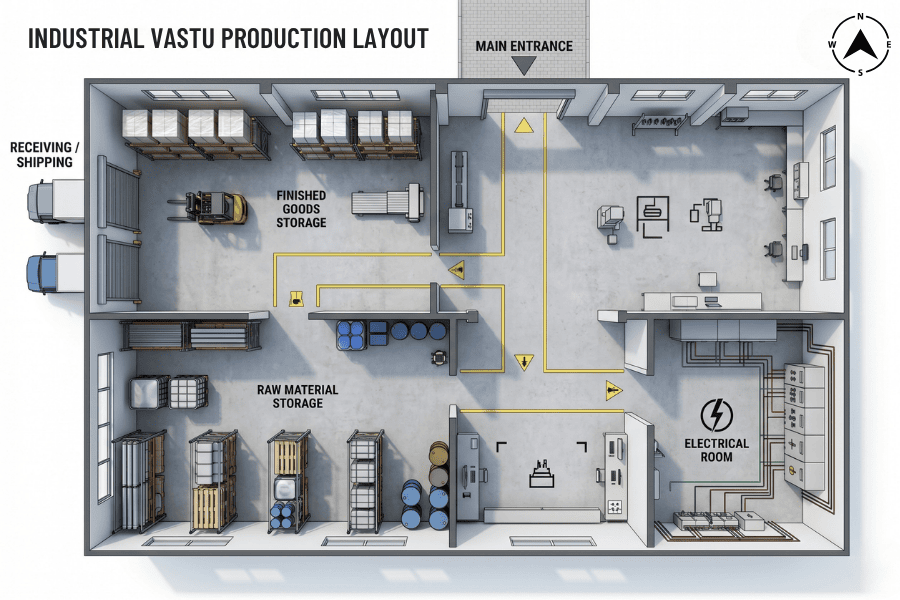
The zone of production is the working heart of an industrial unit. It includes processing, manufacturing, assembly, packing and the internal flow from raw material intake to finished goods dispatch. In many factory settings, industrial vastu works best when power systems, movement paths and storage are planned together rather than in isolation.
For most factory units, the following vastu guidelines create a practical base:
- Keep the production process as smooth and continuous as possible, ideally in a clockwise movement
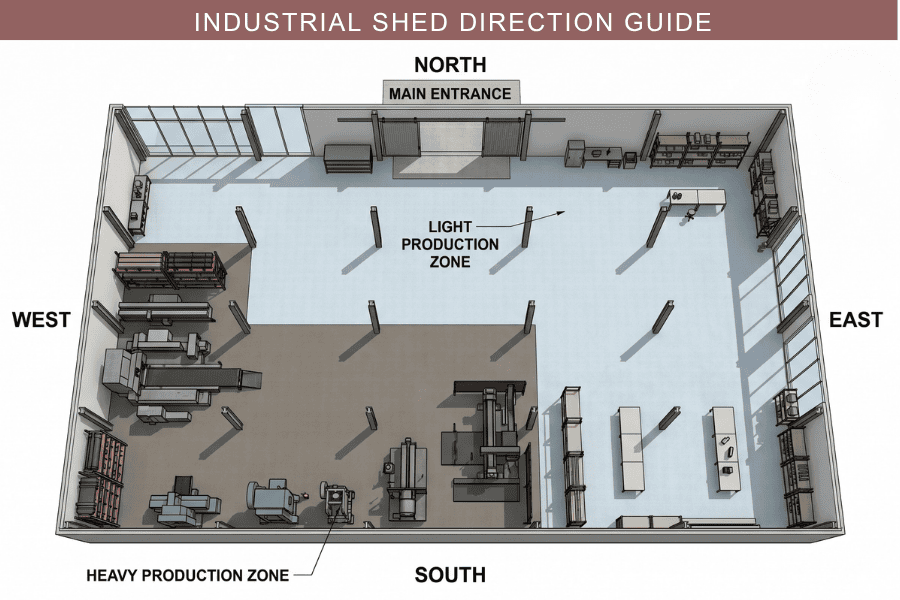
- Place heavier machinery and dense manufacturing processes in the South, South-West or West
- Use the South-East for heat, fire and power-related equipment such as boilers, furnaces and electrical control systems
- Keep more open and lighter space in the North and East
- Avoid overloading the North-East, which is generally better for lightness, cleanliness and water elements
The correct placement depends on both the nature of the machine and the process sequence. A good Vastu-based factory layout should reduce crossing movement, keep hazardous functions controlled and support easy supervision.
In many cases, the main gate of the factory also affects how movement enters the site, so access planning should be reviewed alongside production zoning. A proper slope towards the North or East can also keep the factory site functionally balanced.
| Production Element | Vastu Shastra Guidance |
|---|---|
| Heavy machinery | South, South-West or West |
| Heat and electrical equipment | South-East |
| Raw material storage | West |
| Finished products storage | North-West |
| Water sources | North-East |
Vastu Tips for Different Industries
Different industries handle different materials, temperatures, workflows and safety risks. So while the main vastu shastra principles remain similar, the application changes depending on use. Strong factory vastu (फैक्ट्री वास्तु) planning also depends on how each factory handles material load, safety and daily raw‑to‑finished goods flow.
Stone
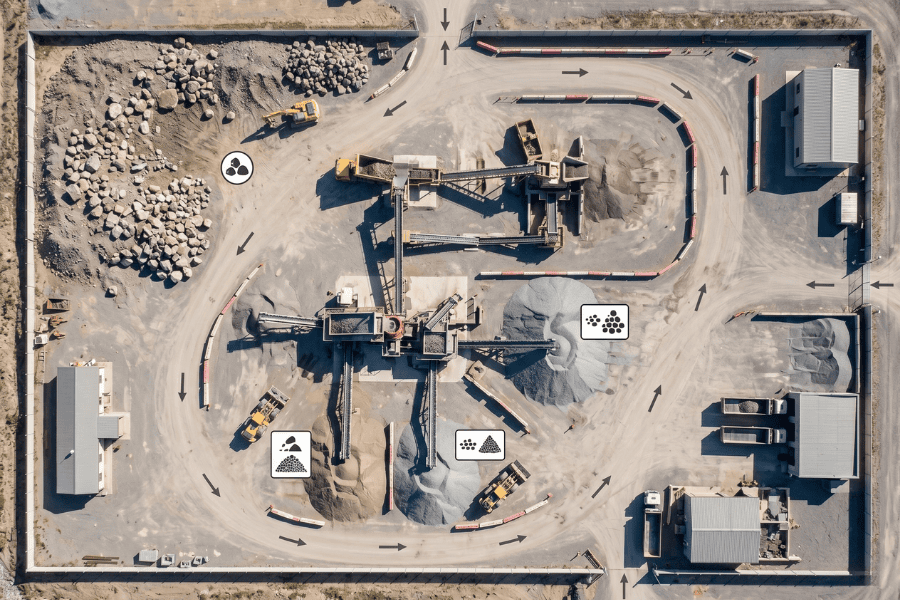
In industries working with a stone crusher unit, weight, vibration and rough material movement are central concerns. Raw stone and aggregates are heavy, so raw materials are generally better kept in the South-West, South or West. This supports the heavy nature of the load and keeps the lighter zones free within the factory.
For the factory shed, a regular rectangular or square space is usually more suitable than an irregular shape. The industrial shed can be stronger and more closed in the South and West, with relatively more openness in the North and East. Neutral or earthy colours often suit this kind of industrial setting better than very bright shades. The slope of the shed roof or site should also allow easy flow of water without collecting near the production zone.
The crushing machinery and related heavy equipment should be placed with care. Factory vastu guidance always suggests placing these heavy machines in the South, South-West or West.
Production units and packaging should not feel congested. Material should move clearly from input to crushing, screening, loading and dispatch systems. Finished goods storage can be planned in the West or North-West to support outward movement.
Iron and Steel
Iron and steel units are strongly associated with heat, load and structural weight. Raw materials such as scrap, billets or metal stock are usually better in the South-West, West or South. This keeps the heavier inventory in stable zones.
The industrial shed should be solid and practical, with the higher and heavier feel naturally supported in the South and West. Muted industrial shades such as grey, off-white or beige are appropriate. In a large factory, the office location should not interrupt the heavy production zone and is often better planned away from the hottest sections.
Machinery and equipment for metal work, rolling, cutting or fabrication should be aligned with the load and heat involved. Heavy machines are generally more suitable in the South or West, while furnaces, welding power systems and electrical panels should lean towards the South-East.
Production and packaging should be separated enough to avoid crowding around hot zones. Finished steel products can be stored in the West or North-West, especially where dispatch turnover is regular. In this type of factory, good circulation also supports safer movement for workers.
Plastic
Plastic manufacturing often combines heat, moulding, power use and repetitive process flow. Raw material storage is preferable in the West, South or Southwest corner, depending on the form and quantity of the material. If liquid inputs are used in specialised units, placement may need extra care.
The factory shed should remain simple in form. A rectangular layout helps organise moulding, processing, trimming and packing without wasted movement. Light neutral shades usually work well for the industrial shed and production spaces.
Machinery such as moulding units, heating equipment and process machines should be handled according to their function. Packaging should be close enough to production for smooth transfer but not so close that it disrupts workflow. Finished goods storage is usually more suitable in the North-West or West.
Chemical
Chemical (रासायनिक) units need stricter planning because material nature, ventilation and safety are more sensitive here. Raw materials should be zoned based on whether they are solid, liquid, reactive or flammable. In general, heavy stock can remain in the South-West or West, while chemicals linked to heat-based handling need careful placement with technical compliance.
The shed must prioritise order, ventilation and safe segregation. Size should support safe circulation rather than just storage density. Colours should remain subdued and professional. The factory should also ensure that water lines, drainage and emergency wash points are planned properly and do not conflict with hazardous material storage.
Machinery, reactors, mixers, boilers and electrical systems often involve the fire element (अग्नि तत्व), so the South-East becomes especially important for related equipment where technically suitable. The main production area should be stable and not broken into scattered pockets.
Packaging in chemical units must be organised away from hazard conflict points. Finished goods can be placed in the West or North-West if the dispatch flow supports it. If there is an attached administrative office, it should be placed in a calmer part of the factory away from high-risk activity.
Food
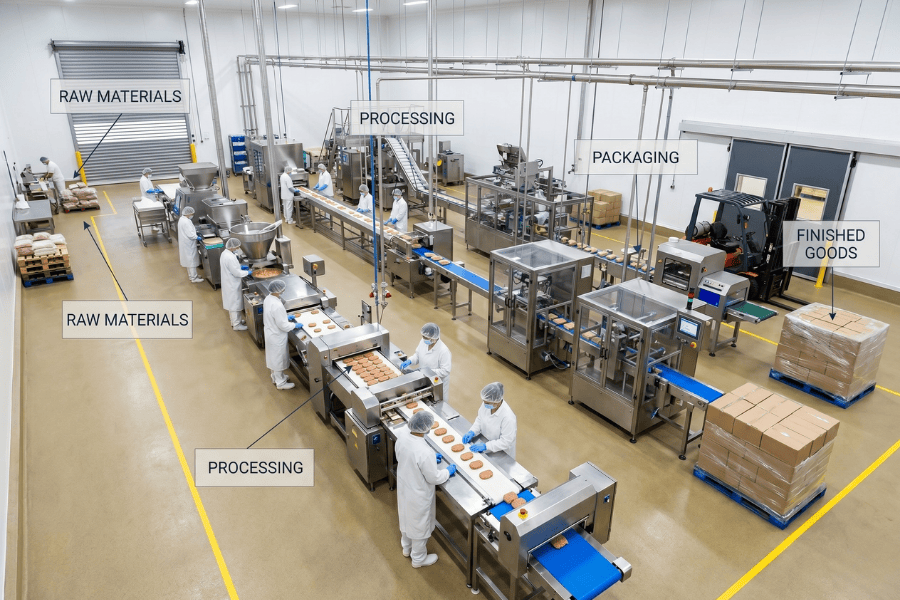
Food units require cleanliness, freshness and process discipline. Raw materials such as grains, ingredients or packaging stock should be stored neatly, with heavier bulk stock in the South-West or West where possible.
The factory shed should feel well-ventilated and uncluttered. A regular shape is preferable. Clean, light colours are often more appropriate in food units because they support visibility and hygiene. In food processing, clean water access is also essential, so water storage and supply points should be planned with care.
Machinery placement should distinguish between heavy processing machines and cooking or heating equipment. Heat-based equipment is generally better in the South-East. Production and packaging must be especially clean and sequential, from washing or preparation to processing, packing and dispatch.
A useful rule for food factories is this:
- Keep raw and finished goods clearly separate
- The North-East should be a clutter-free space
- Maintain smooth internal movement without backtracking
Finished goods storage can be kept in the North-West or West, especially when quick dispatch is required.
Rubber
Rubber manufacturing can involve heat, compression, moulding and strong odours. Raw materials should usually be stored in the South-West, South or West. This suits the heavier and denser stock common in many rubber units.
The industrial shed should support a practical production line and proper ventilation. Neutral shades are generally more suitable than loud colours. The factory’s main entrance should allow vehicles and materials to move without blocking production access.
Machinery with heat or curing functions should align with the South-East where possible, while major production machinery zones can be placed in the South or West. Packaging should be close to final production but clearly organised. Finished goods storage is usually stronger in the North-West or West.
In rubber manufacturing, industrial vastu can be especially useful when the factory handles both heat and heavy stock in one compact site.
Garment
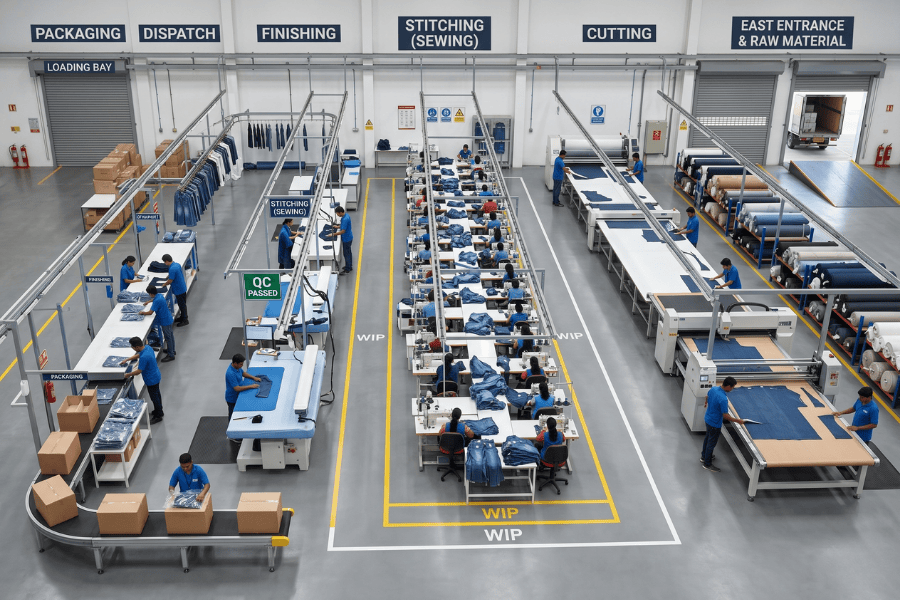
Garment factories are different because much of the work is lighter, more worker-driven and process-based. Raw materials such as fabric rolls can still be substantial in bulk, so they are often better in the West, South or South-West.
The industrial shed should feel airy and efficient rather than heavy. This industry benefits from a layout that supports cutting, stitching, checking, ironing, packing and dispatch in a simple sequence. Some also consider the South-East favourable for garment-related production activity, especially where power-driven machines are used.
Machinery and equipment such as cutting tables, sewing lines and finishing stations should be arranged for movement and supervision. Finished garments are often best kept in the North-West for easy outward movement.
Paint
Paint manufacturing and storage require special attention because of flammable materials, liquids and mixing processes. Raw materials should be zoned carefully, with heavy stock in the South-West or West and all hazardous materials handled as per safety standards.
The factory shed should be well-planned and regular in shape. Because this industry often includes mixing, chemical handling and heat-sensitive operations, the South-East becomes important for fire and electrical functions where practical. The main gate should support controlled inward and outward movement so the factory does not face unnecessary congestion near storage units.
Mixing, blending and process systems must not create chaotic movement. Packaging should be organised after the main production sequence, with no unnecessary overlap. Finished goods storage is commonly more suitable in the West or the North-West.
In this kind of factory, industrial vastu should always be applied together with technical safety standards and proper handling of water, chemicals and ventilation.
| Industry | Vastu Shastra Advice |
|---|---|
| Stone Crusher | Heavy load balance, strong raw material zoning, clear dispatch |
| Iron and Steel | Heavy machinery in South/West, heat systems in South-East |
| Plastic | Controlled heat placement, smooth moulding-to-packing flow |
| Chemical | Safety-led zoning, controlled fire element, clean segregation |
| Food | Hygiene, lightness, separation of raw and finished goods |
| Rubber | Heat handling, ventilation, stable production zones |
| Garment | Simple, airy layout with efficient packing movement |
| Paint | Hazard-aware planning, careful fire zones and storage units |
Final Thoughts
The zone of production in industrial vastu is best understood as a system, not a single room or direction. The right factory layout supports weight in the right places, fire in the right places, movement without confusion and storage without blockage. That is why raw materials, machinery, packaging and finished goods must be planned together.
A practical industrial vastu approach respects both traditional guidance and operational reality. When applied properly, it can help create a factory that feels more stable, efficient and easier to run. Good factory vastu is not just about one machine or one room. It is about how the whole factory works together, from the main gate to the production floor, from water planning to dispatch, and from the office to the storage zone.
If you are planning a new unit or reviewing an existing one, Vastu Ananda offers consultations for plot vastu, residential vastu, commercial vastu, hotel vastu, factory vastu and office vastu, along with learning options through a vastu basic course and vastu advanced course.