
Have you ever walked into a bedroom that felt cold, yet somehow not comfortable?
Many people notice this at home. The air conditioner works, the room cools down, but sleep still feels broken. You wake up with a stiff neck, a dry throat or the feeling that the air was hitting you all night.
This is one reason air conditioner placement matters in Vastu Shastra (वास्तु शास्त्र). The direction of the unit, the wall it sits on and the way the air moves across the room can all affect the comfort, peace and energy balance of your home.
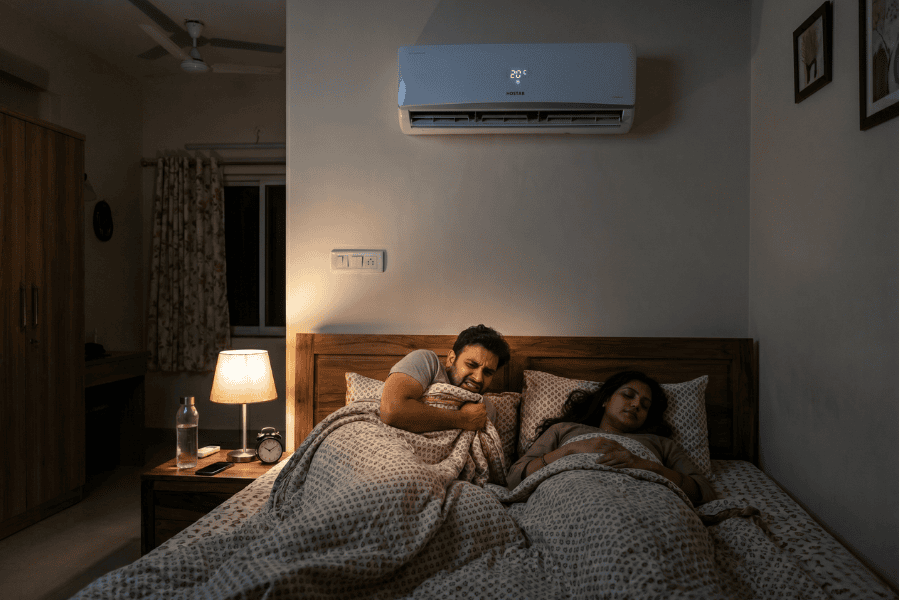
For many homeowners, especially couples setting up a home or men and women in their 50s and 60s, this is not a small issue. At that stage of life, comfort matters more. People want a room that feels settled, not one that needs constant adjustment.
In this guide, we will look at AC direction as per Vastu in a clear and practical way. You will learn the best wall for the AC, the right position in the bedroom, which directions to avoid and whether a north wall AC is a good idea.
Why AC Placement Matters In Vastu
An AC is not just a cooling machine. It adds an electrical element to the room. Because the air conditioner generates heat, it also adds a fire element (अग्नि) and affects how the space feels every day.
That is why Vastu looks at its placement carefully. If the unit is badly placed, the room may feel harsh, restless or physically uncomfortable even when the temperature is fine. Vastu principles account for healthy living when talking of AC placement.
You can see this in real homes. A couple may install the AC wherever the technician suggests, only to find that one person feels freezing while the other still cannot sleep properly.
How ACs Fit Into Vastu for Home Appliances
In Vastu, home appliances should suit the purpose of the room. Air-conditioning devices are active electrical items, so they should be placed in a way that supports comfort and balance.
Vastu is often explained through zones. When people first hear about directions, they usually think only of north, south, east and west. But traditional Vastu also refers to a 16-zone grid: north, north-north-east, north-east, east-north-east, east, east-south-east, south-east, south-south-east, south, south-south-west, south-west, west-south-west, west, west-north-west, north-west and north-north-west.
You do not need to overcomplicate every AC decision with all 16 zones. Still, knowing this helps you understand why exact placement is often discussed in more detail than just the basic 8 directions.
How AC Placement Can Affect Sleep and Well-Being
If the airflow falls directly on the face, neck or chest, sleep can suffer. This is especially true for older adults, who often become more sensitive to cold air and body stiffness over time.
Vastu is not only about the wall or direction. The flow of air matters just as much. Cool air should move gently across the room. It should not keep falling on one person through the night or hit a chair where someone sits for long hours reading, resting or watching television.
Best Direction for AC as per Vastu
In many homes, the AC is best placed on the south, west or north-west side of the room. These areas are commonly preferred in Vastu because they often suit active electrical appliances better than more delicate zones.
The aim is simple. The AC should cool the room well without making the space feel heavy or uncomfortable. When placed correctly, an air conditioner can uplift the energy of your home, balance out all five elements and bring in prosperity.
If you want a quick summary before looking at room-wise guidance, this table gives a simple view of preferred and avoided AC positions as per Vastu.
Quick Guide to AC Direction as per Vastu
| Placement Area | Vastu View | Practical Note |
|---|---|---|
| West Wall | Commonly preferred | Often allows balanced cooling across the room |
| South Wall | Commonly preferred | Works well in many home layouts |
| North-West Wall | Acceptable alternative | Useful when west or south is not possible |
| North Wall | Can work with care | Avoid making the wall feel too heavy or blocked |
| North-East Zone | Usually avoided | Considered too light and subtle for a bulky AC unit |
| Above The Bed | Not preferred | May disturb sleep and create direct discomfort |
| Near Study Table | Not ideal | Direct airflow can reduce comfort and focus |
| Directly Facing Sofa Or Seating | Better avoided | Constant airflow on the body may feel uncomfortable |
| Split AC | Easier to place well | More flexibility in wall choice and airflow direction |
| Window AC | Depends on window location | Placement options are usually more limited |
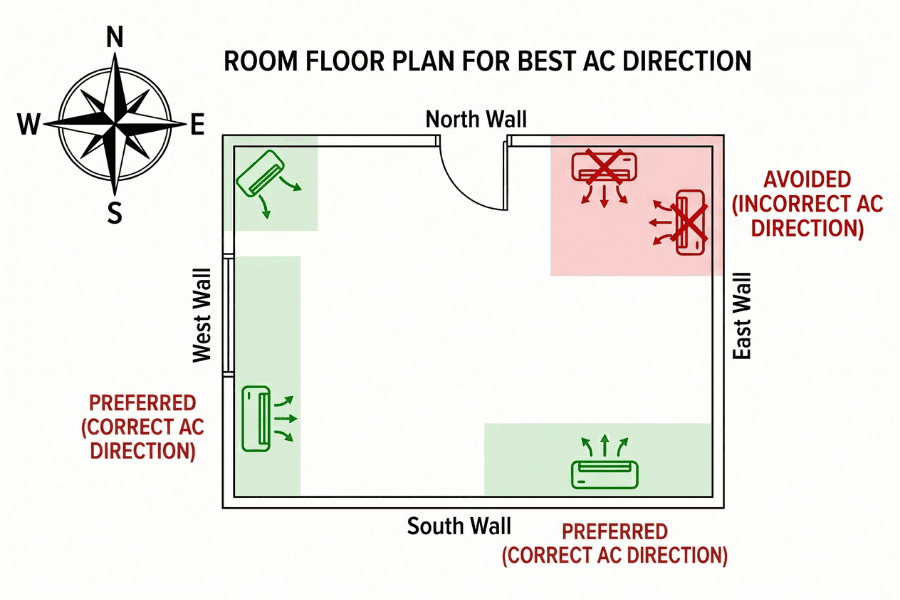
The AC should not blow directly onto the bed, sofa or a seat where someone spends a lot of time. If a family member keeps saying, “The AC air comes straight on me,” that is usually a sign the placement needs attention.
The best wall for AC installation is one that gives balanced cooling and does not make the unit feel too heavy in the room.
In many Indian homes, the west wall works well. In others, the south wall makes more sense. The final choice should support both Vastu and daily comfort.
The AC should be installed at a normal upper-wall height so the air circulates properly. If it is too low, it may feel heavy and uncomfortable. If it is too high without proper planning, the room may not cool evenly.
Bedroom AC Placement: What Works Best
The bedroom is where AC placement matters most because it directly affects sleep.
This is easy to recognise in real life. A couple may cool the room well, yet one person still wakes up at 3 am to lower the temperature while the other pulls the blanket closer because the air is hitting too hard.
Where Should You Install The AC in a Bedroom?
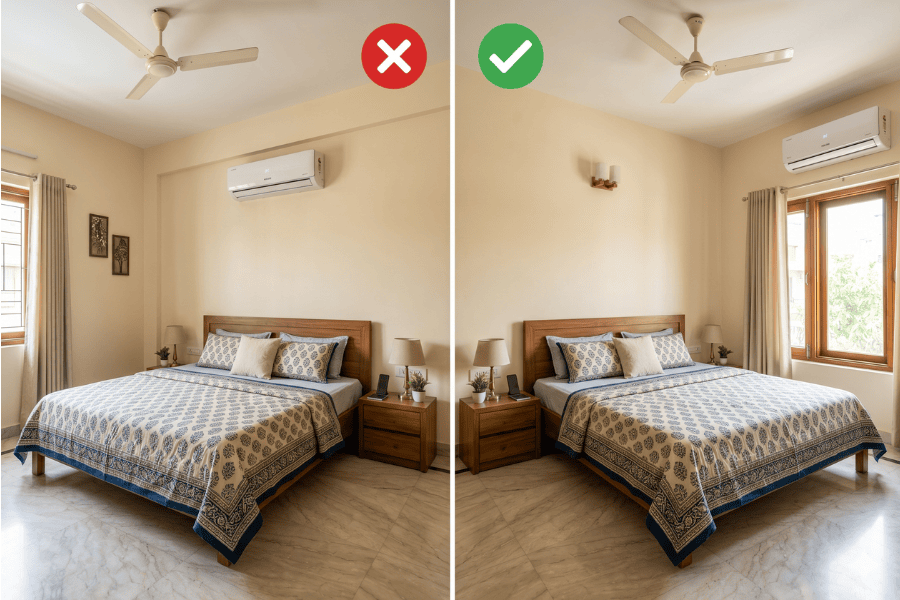
A good bedroom AC position allows indirect cooling across the room. According to Vaastu Shastra, the west or south wall works well. The unit should not sit too close to the headboard or feel like a heavy object hanging above the bed.
The best direction for a bedroom AC is usually one that supports calm and even cooling. The West direction and south walls are commonly preferred. North-west may also work when the room layout does not allow the first two options.
Bedroom AC Directions to Avoid
In Vastu, the north-east is usually considered light and subtle. A bulky electrical item here may not be the best fit, especially if it becomes the first thing you notice in the room. It is often advised to avoid placing a heavy AC unit in the exact north-east zone.
You should also avoid placing the unit where the airflow falls directly on the sleepers as this can affect the positive energy in the room. In Vastu Shastra principles, this direct and harsh airflow can lead to economic loss.
It is also better to avoid a position that makes the room feel cramped or unbalanced. This often happens in smaller bedrooms where the AC is forced onto the only empty wall without considering the bed position.
Above the Bed or Near a Study Table
This is usually not ideal.
An AC above the bed can direct cooling onto the head and chest. Near a study table, it can make the person sitting there uncomfortable after some time. In both cases, everyday use tells you quickly whether the placement is working.
Simple Bedroom AC Positioning Tips
Try to place the AC where:
- The air spreads across the room, not at the pillow
- The unit does not sit directly above the bed
- The airflow does not fall on one person more than the other
- The room still feels open and restful
Split AC vs Window AC in Vastu Shastra
From a Vastu point of view, split ACs are often easier to place well. That is because they give more flexibility in wall choice and airflow direction.
The best walls to place the indoor unit are west and north-west. The outdoor unit is best placed on the south wall.
A window AC depends on the window location, so options are naturally fewer.
This is common in older homes. Many families keep a window AC in the same opening for years, even when the cooling feels uneven. A split AC usually gives better control if you are renovating or moving into a new home.
North Direction for AC Placement
Many homeowners ask whether an AC can be installed on the north wall. The answer is yes, in some cases. But it should be done with care, not simply by default.
In Vastu, the north side is generally linked with openness and movement. Because of this, the area should not feel blocked or weighed down by a bulky unit placed without thought.
A clean north side often feels lighter and more open. If the AC is too central or too large, it may disturb that feeling. That is why some consultants suggest shifting the unit slightly instead of fixing it in the exact middle of the wall.
Pros and Cons of a North-Side AC
Pros:
- Can work when other walls are blocked
- May support good cooling in some layouts
Cons:
- May feel too heavy in a zone that should stay open
- May create visual imbalance if the indoor unit is large
In many cases, it is better to avoid the exact centre of the north wall. A slight shift towards the north-west side may feel more balanced.
Tips for Installing an AC on the North Side
If you place the AC on the north wall:
- Keep the wall area uncluttered
- Avoid direct airflow towards the bed or sofa
- Avoid placing it too centrally if it looks heavy
- Check comfort after installation before finalising the room setup
Final Thoughts
The best AC direction as per Vastu is not about following one rigid rule.
It is about choosing a position that supports comfort, even airflow and stability in a balanced room. In many homes, the west direction, south direction or north-west placements work better, while the north-east is usually treated more carefully.
If you are setting up a new home, renovating a bedroom or trying to improve a room that never feels quite right, even a small change in AC placement can make a noticeable difference.
If you would like expert guidance for your home, Vastu Ananda offers Vastu consultations for plot vastu, residential vastu, commercial vastu, hotel vastu and office vastu. They also offer a Vastu basic course and vastu advanced course for learners.
FAQs
Which direction is best for AC as per Vastu?
West and south walls are commonly preferred. North-west is often used as a practical alternative.
Can AC be installed in the north direction?
Yes, but it should be placed carefully so the north side does not feel blocked or heavy.
Is it okay to place AC above the bed?
It is better to avoid it because direct airflow may disturb sleep and comfort.
Which is better as per Vastu, split AC or window AC?
A split AC is usually easier to place properly because it gives more flexibility.