Have you ever stood at your main door and felt that something just does not look right?
Many homeowners feel this when a large tree stands right in front of the entrance. The house may be beautiful, the garden may be green, yet the entry feels blocked, dark or heavy. For families buying a new home, this can become a real worry: should you ignore it, remove the tree or look for a Vastu remedy?
In Vastu Shastra (वास्तु शास्त्र), trees are not seen as negative by default. In fact, they are an important part of a healthy home. But when a tree is too large, too close or directly in line with the main entrance, it may create both practical and Vastu-related concerns.
This article explains where trees should be avoided, which types need more caution and what you can do if a tree or pillar stands in front of the main door.
Why Tree Placement Matters In Vastu
In Vastu, the effect of a tree depends on more than its name. Its size, spread, age, direction and distance from the house all matter.
A small plant near the veranda is very different from a large old tree pressing visual weight onto the entrance. This is why one home may feel calm and balanced while another feels closed, even if both have greenery.
Vastu also pays close attention to direction. When people discuss the 16 zones, they should mean the full set: North, north-north-east, North-East, east-north-east, East, east-south-east, South-East, south-south-east, South, south-south-west, South-West, west-south-west, West, west-north-west, North-West and north-north-west.
Some of these zones are usually kept lighter and more open. Others can hold more weight. That is why tree placement is always judged by location, not only by species.
For example, many homeowners try to keep the North Direction and the North East Corner less burdened by heavy growth so early light and openness are not lost.
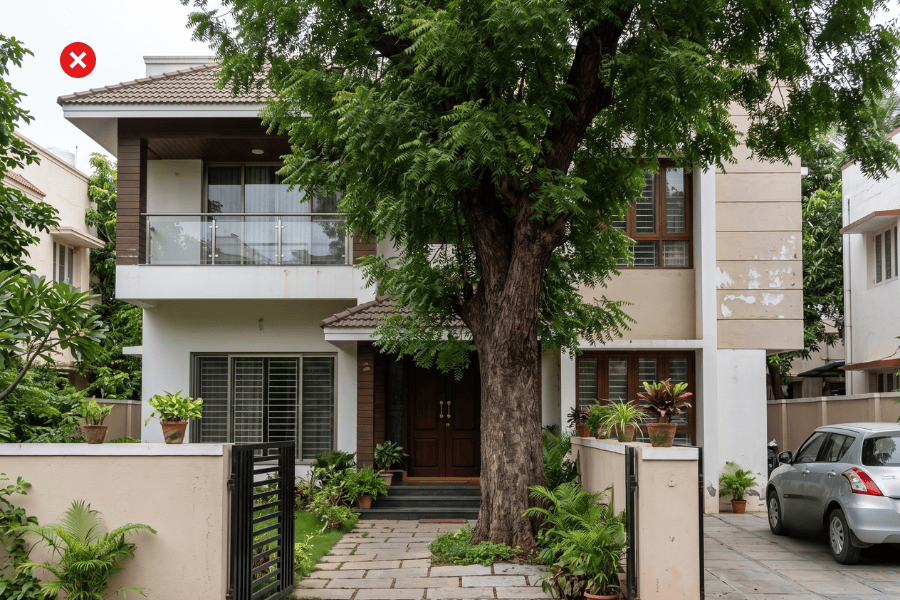
Where Trees Work Well And Where They Do Not
Not every tree near a house creates a problem. The issue usually starts when the tree is badly placed for the size and layout of the plot.
Large trees are generally more suitable where they do not block the entrance, reduce early light or sit too close to the structure. Smaller plants and shrubs are easier to manage and are less likely to create heaviness.
This is important for older homeowners too. A tree that looks beautiful in the first few years can become difficult to manage later. Falling leaves, thick roots and deep shade can slowly turn into daily irritation.
A common real-life example is a retired couple moving into a peaceful independent house. At first, they like the mature tree near the gate. But after a few months, they notice the entrance stays dim, the walkway is always covered with leaves and the front door no longer feels open. In Vastu terms, this kind of heaviness near the entrance deserves attention.
The same applies to fast-growing climbers. If they spread over the entry or walls without control, they can make the front of the home feel closed and untidy instead of balanced.
Spots Around The House Where Trees Are Best Avoided
The most sensitive place is directly in front of the main door.
This is one of the most repeated principles in Vastu-based home planning. A tree exactly facing the entrance can interrupt the sense of welcome and make the main door feel visually blocked.
Trees planted too close to the house walls are also best avoided. Over time, roots can affect paving, drainage or nearby structures. Dense branches can reduce airflow and keep parts of the house damp and shaded.
Another area that usually needs caution is the lighter side of the plot, especially where openness, light and movement are preferred. Large trees in such areas may upset balance more quickly than people expect.
A home should have enough breathing space around the entrance. When that is lost, even a good house can start to feel uncomfortable.
Which Trees Need More Caution Near A House
Instead of asking for a fixed list of “bad” trees, it is better to look at the kind of problems a tree creates.
Large trees with wide canopies or strong roots need the most care. On a small plot, they can dominate the house too much.
Thorny plants and dry-looking trees near the entrance are also usually avoided in Vastu guidance. Even in practical terms, they can make the home feel harsh or poorly maintained.
Trees that shed heavily can also become an issue, especially for homeowners who do not want constant sweeping or slippery entrance paths during the rainy season.
Some plants are also discussed with caution in Vastu when placed near the entry. A cactus, for instance, may be easy to maintain, but many people avoid it near the main door because of its sharp form.
Likewise, very large sacred trees such as the banyan tree are respected, but they usually need far more room than an ordinary home can provide.
Some traditional guides also speak carefully about species such as Neem, jamun and ashoka, not because they are automatically harmful, but because the effect depends on the plot size, the direction and how close the tree stands to the house.
| Tree Type Or Condition | Why It Can Be A Problem | Where It Becomes More Serious |
|---|---|---|
| Very large spreading tree | Creates visual heaviness, shade and root pressure | Small plots, near entrance, close to walls |
| Thorny tree | Feels harsh and less welcoming | Near gate or main door |
| Poorly maintained tree | Dead branches, clutter and neglect weaken the entrance | Front yard, walkway, porch area |
| Tree with aggressive roots | May affect paving or nearby structure | Next to compound wall or house base |
A simple way to judge this is to stand at your main gate and ask: does the tree support the home, or overpower it?
A Tree In Front Of The Main Door: Why It Worries So Many Homeowners
The main entrance is very important in Vastu because it is treated as the point where movement, opportunity and positive energy enter the home.
So when a tree or pillar stands directly in front of it, people naturally worry. And honestly, even without Vastu, many homeowners can feel the problem straight away. The entrance may look cramped, shaded or awkward.
This concern often comes up when families are finalising a house purchase. The home may tick every box, but then someone notices a thick tree trunk exactly in line with the door. That one detail can create doubt.
Still, not every tree near the entrance is equally serious. A tree to one side may be far less troubling than one directly aligned with the door. Distance also matters. A tree far from the threshold may have little effect compared with one standing close to the steps.
If the entrance blocks fresh sunlight, the effect often feels stronger. People may describe the house as dull or heavy even before they can explain why.
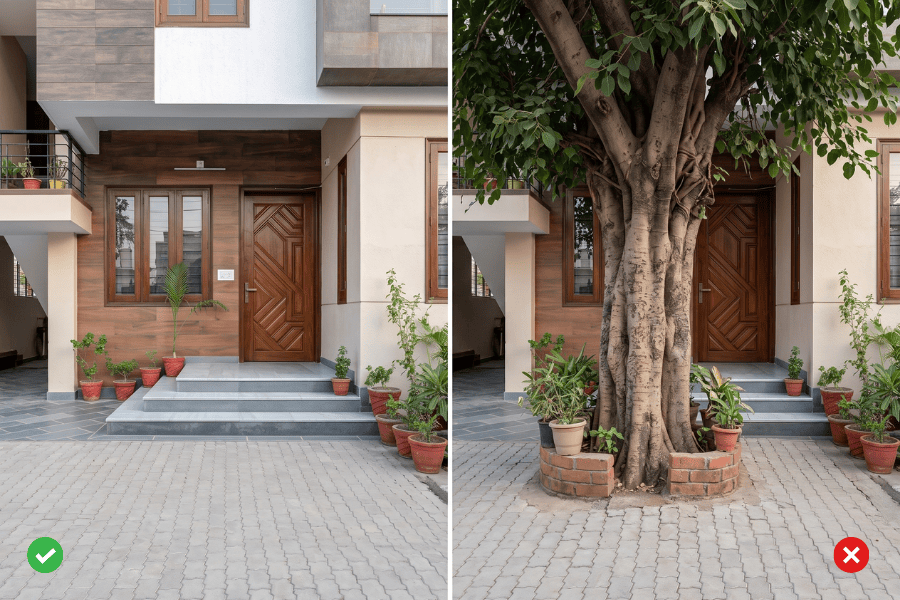
What To Do If There Is A Tree Or Pillar In Front Of The Entrance
If removal is possible and lawful, that is the simplest correction.
But in many homes, that is not realistic. The tree may be old, valued by the family, protected by local rules or even rooted outside your boundary. In such cases, the right approach is to reduce the obstruction.
Start by checking whether the tree is truly in direct line with the door. Sometimes it only appears central from one angle.
Then improve the entrance itself. Better lighting, a clean threshold and a clearly marked approach can reduce the feeling of blockage.
Pruning also helps. When thick branches are cut back and the trunk line becomes less visually heavy, the entrance often starts to feel lighter.
In some homes, the path to the entrance can also be adjusted slightly so the movement into the house feels more natural. This does not mean making dramatic changes. Even a small correction in approach can help.
5 Practical Vastu Remedies That Can Help
Here are five practical remedies often used when a tree or pillar affects the main entrance:
- Keep the direct path to the main door open, clean and easy to walk through
- Prune overgrown branches to reduce shadow and visual heaviness
- Strengthen the entrance with good lighting and a well-maintained threshold
- Use balanced landscaping so the entrance feels organised, not crowded
- Review the exact alignment of the tree, gate and door before deciding the defect is severe
These are practical corrections, not miracle cures. Good Vastu usually works through balance, clarity and proper placement.
In many homes, a cleaner and brighter entrance supports a stronger sense of prosperity. People often describe this as the house feeling more settled and welcoming.
If The Tree Cannot Be Removed
This is a very common situation.
A family may say, “The builder planted it years ago,” or “This tree was here before we bought the house.” In older neighbourhoods, mature trees are often part of the street itself, so removal is not even an option.
If that is your case, focus on maintenance first. Remove dead growth, keep the base area clean and make sure the entrance does not feel neglected.
Next, strengthen what you can control. A bright entrance, a clean walkway and neat greenery around the door often improve the overall feel more than people expect.
Also, look honestly at whether the entrance was weak to begin with. Sometimes clutter, poor lighting or a badly planned approach is adding to the problem.
Where the layout allows, some people place gentle greenery away from the main line of entry, such as a tulsi plant or small basil plants, to support a cleaner and calmer front area.
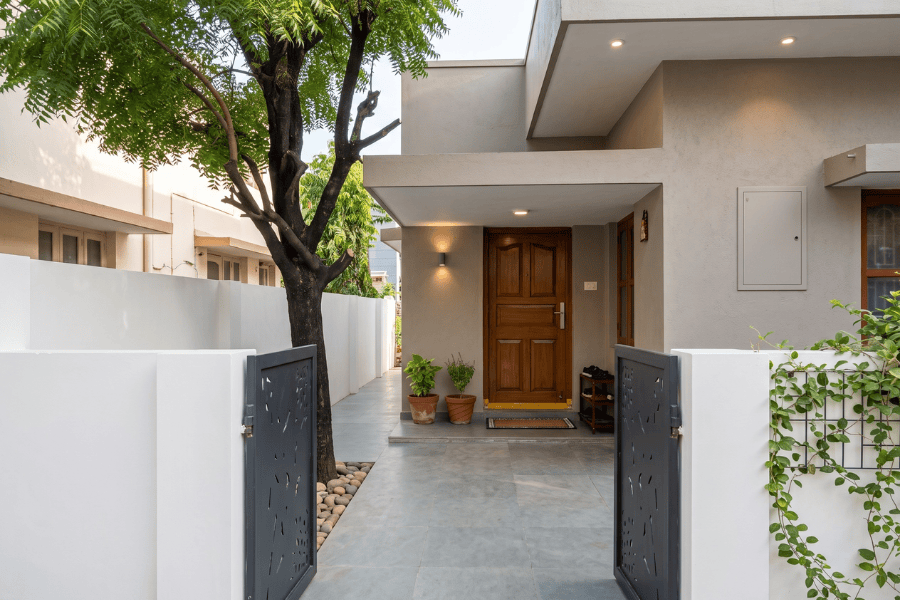
Trees, Plants And Balance Around The Home
It is important not to turn this topic into fear. Trees are valuable. They give shade, privacy and a sense of life around the house.
The goal of Vastu is not to remove all trees. It is to place them with thought.
Smaller plants are usually easier to manage near the home entrance. They keep the area fresh without creating the same blockage as a mature tree.
This matters especially for couples planning a long-term home. A garden should not become a burden after ten years. It should remain easy to maintain and pleasant to live with.
Some homeowners also ask about useful or symbolic plants. Well-placed medicinal plants can be a good addition when they are easy to maintain and do not crowd the entrance.
A money plant is often discussed for indoor or decorative use, but it should still be placed in a way that does not create clutter near the main doorway.
Some families also ask whether species such as lemon trees or the sandalwood tree are suitable. The answer depends less on the name and more on the available space, maintenance and whether the placement keeps the entrance area open and free from obstruction.
Likewise, plants linked in tradition with purity or daily worship, such as Tulsi, may be valued for the sense of care they bring to a home.
Simple Vastu Tips Before You Plant A Tree
Before planting, keep these points in mind:
- Avoid a large tree directly in front of the main door
- Do not plant big trees too close to the house wall
- Keep lighter zones of the plot more open where possible
- Choose trees based on future growth, not current size
- Trim dead or diseased branches without delay
- Keep the entrance brighter, cleaner and more open than the rest of the front area
It also helps to think about the role of the plant in daily life. A banana plant may suit one household well, while a tall coconut tree needs much more planning because of height, falling parts and long-term maintenance.
Some owners also keep plants hoping to support money and wealth, but Vastu works best when the home is also practical, open and easy to maintain.
In the same way, avoid placing anything near the entrance that feels too harsh or imbalanced. Even symbolic elements linked with fire should be handled with care in relation to the doorway and overall layout.
Final Thoughts
A tree becomes a Vastu concern when it blocks, crowds or overpowers the home, especially at the entrance.
If you have a tree in front of the main door, do not panic. First look at its actual position, size and effect on light, movement and visibility. In many cases, careful pruning, better entrance design and regular maintenance can reduce the problem meaningfully.
For homeowners, especially those buying a long-term family home, this is the right way to think about Vastu: calmly, practically and without fear.If you would like expert guidance, Vastu Ananda offers consultations for plot vastu, residential vastu, commercial vastu, hotel vastu and office vastu. They also offer a vastu basic course and vastu advanced course for learners who want to study the subject in more depth.
FAQs
Why are trees around the home important in Vastu?
In Vastu, trees and plants are believed to influence the flow of energy around a house. Their placement, size, and type can affect light, space, and the overall atmosphere of the home.
Which trees are generally avoided near the home according to Vastu?
Large trees with dense shade, thorny plants, and trees with heavy root systems are often avoided too close to the house, especially near the main entrance, because they may block light and movement.
Are thorny plants considered unfavourable?
Yes, thorny plants are commonly considered less suitable near the main house area, as they are believed to create harsh or uncomfortable energy. However, they may still be used in outer garden boundaries depending on the space.
Is it okay to have a peepal tree near the house?
A peepal tree is traditionally respected, but it is generally not recommended very close to the home due to its size, strong roots, and cultural significance.
Why is a banyan tree usually avoided near residential spaces?
Banyan trees are large and expansive, with strong roots and wide spread, so they are typically avoided near homes because they can dominate the space physically and energetically.