Trees play a quiet but powerful role in Vastu Shastra. They shape light, shade, movement and the feel of a home. In traditional Vastu thinking, the right tree in the right place can support balance, health and stability. The wrong tree, or even the right tree in the wrong direction, can disturb that balance.
In practice, people want to know much more. Is neem better than mango? Can a banana tree go near the entrance? Is bonsai really discouraged? What about sacred trees like peepal and banyan? And where exactly should large trees be planted?
This guide answers these questions, covers the importance of trees in residential Vastu and gives a clear explanation of every tree species.
Why Trees Matter in Residential Vastu
In Vastu, a home is not seen as separate from nature. The plot, sunlight, wind, open space and greenery all work together.
Trees are especially important because they affect three things at once: energy flow, physical space and everyday comfort.
A well-placed tree can create privacy, soften heat and support a calm atmosphere. A badly placed tree can block morning light, crowd the entrance or create heaviness in the wrong zone.
Large trees can affect foundations with their roots. Dense branches can block light and air. Thorny or decaying plants can make a space feel tense or neglected. So even when Vastu speaks of negative or positive energy, many rules also align with sensible home planning.
Key Vastu Principles for Trees at Home
- Keep the North-East light, open and free from heavy or big trees
- Prefer larger trees in the South, South-West or West directions
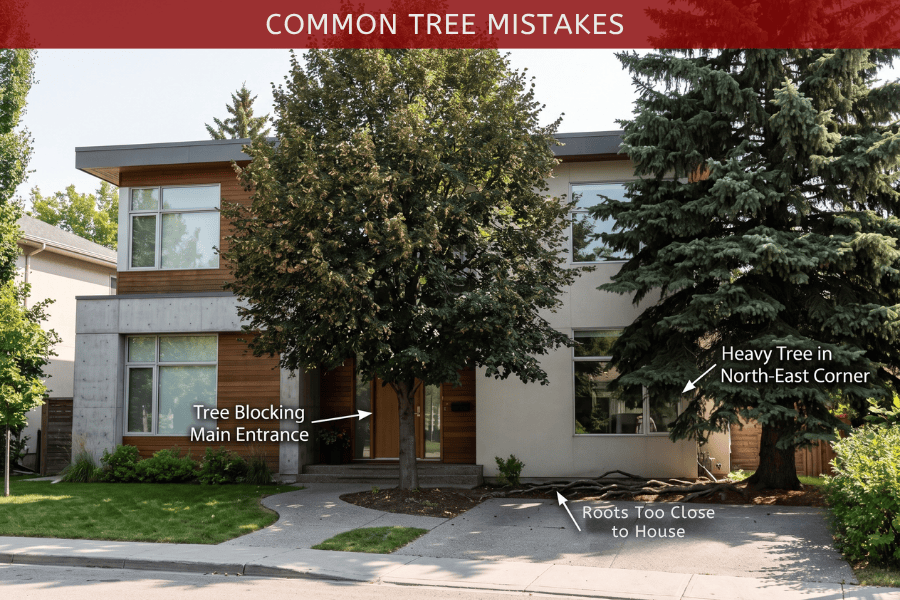
- Avoid planting any tree directly in front of the main entrance
- Do not let dense trees block healthy morning sunlight from the East
- Treat sacred and very large trees with care, especially near house boundaries
Best Trees for Home as per Vastu
People should ideally choose trees that are useful, well-maintained and proportionate to the plot. Species that support health, fruit, shade or spiritual value should be favoured, but always match them to the right direction.
Among commonly recommended trees in Vastu are neem, amla, ashoka, coconut, banana, bamboo, lemon and mango. These are often seen as supportive because they are either useful in daily life, culturally auspicious or suited to home gardens when placed carefully.
That said, there is no single “best” tree for every property. A tree that works well in a large South-West garden may be unsuitable for a small urban front yard.
Vastu and Different Tree Types
The species below are explained from a home Vastu point of view.
Amla
Amla (आँवला) is generally considered an auspicious and beneficial tree because of its healing value and sattvic association. It is a good choice for homes with enough space, provided it is not allowed to dominate the entrance or the North-East direction.
Amaltas
Amaltas (अमलतास) is admired for its bright yellow flowers and graceful form. It is usually treated as a positive ornamental tree when planted with care. Because it can grow large, it is better suited to side or rear garden zones rather than cramped front areas.
Ankole
Ankole (अंकोल) should be treated like any medium to large tree: not in the North-East and not too close to the main structure. Where traditions are less clear, direction and scale should guide the decision.
Apple
Fruit-bearing trees, lik apple (सेब), can be positive if they are healthy and well placed. Avoid crowding them near the entrance or in the North-East.
Arjun
Arjun (अर्जुन) is respected in Indian tradition and valued for medicinal use. It can be considered supportive in larger properties. Since it is a substantial tree, West or South-side placement is usually more sensible than lighter zones.
Ashoka
Ashoka tree (अशोक) is among the most commonly recommended trees in Vastu. It is often linked with peace and the removal of sorrow. Its upright growth also makes it a popular boundary choice. It is generally seen as favourable for homes.
Bamboo
Bamboo (बाँस) is widely regarded as auspicious, especially for growth and flexibility. Smaller decorative bamboo is often suggested in the East or South-East direction. It should still be maintained neatly, because overgrown bamboo can create clutter rather than harmony.
Banana
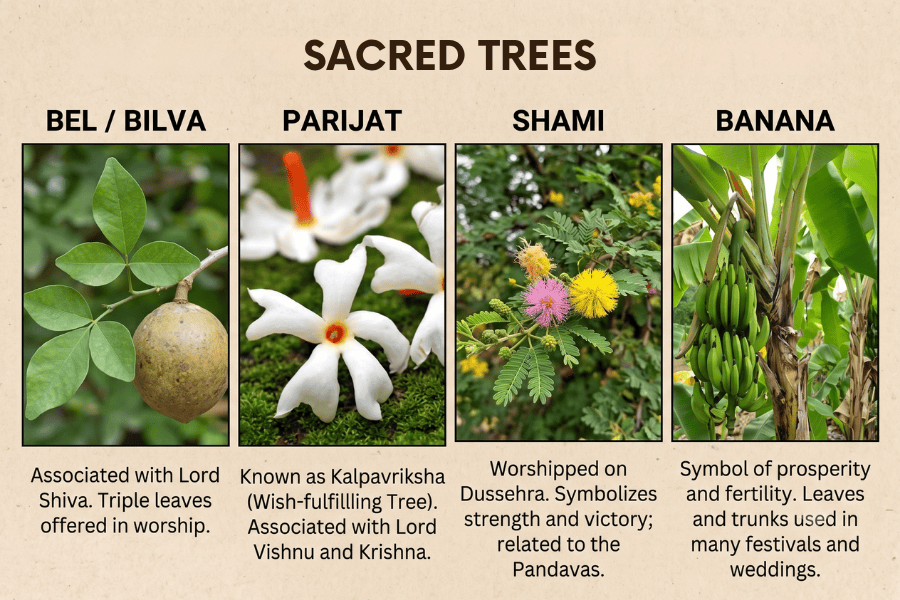
Banana tree (केला) carries strong religious significance and is often seen as auspicious. Some traditions favour it in the North-East, especially in spiritual or puja-related settings, while others advise care because of its moisture-heavy nature. For homes, it works best in a clean, intentional space rather than as random backyard growth.
Banyan
Banyan tree (बरगद) is sacred and powerful, but generally not advised within the boundary of a residence. Its roots spread widely and its scale is too heavy for most home settings. It is better suited to temples, open land or community spaces.
Bel / Bael
Bel or Bael (बेल) is highly regarded for its spiritual association, especially with Lord Shiva. It is usually treated as auspicious, provided it is planted with respect and not allowed to create overcrowding near the core of the house.
Bonsai
Bonsai trees are commonly discouraged in Vastu Shastra because they symbolise restricted or stunted growth. Even when visually attractive, it does not align well with the idea of natural expansion and healthy life force.
Bilva
Bilva (बिल्व) is closely related in cultural understanding to Bael and is considered spiritually positive. It is often treated as a sacred tree rather than a mere ornamental choice.
Babul
Babul (बबूल) is usually treated with caution in Vastu because it is a thorny tree. Thorny species are generally not preferred near the home as they are believed to create tension and disturbance in the space. If planted at all, it is better kept away from the main residential zone.
Champa
Champa (चम्पा) is appreciated for its fragrance and beauty. Flowering trees can be good for home energy when maintained well. Champa is usually acceptable in gardens, especially when it does not crowd open, light-bearing areas.
Christmas Tree/Fir
Fir (देवदार)or ornamental conifer can be used decoratively, but dense evergreen growth should not create visual heaviness at the entrance or in the North-East.
Coconut
Coconut (नारियल) is considered auspicious in many traditions. It is often recommended for the South or West side of a property. It should be planted where falling fronds and shade do not interfere with circulation or safety.
Curry Leaf
Curry leaf (कड़ी पत्ता) is a useful and generally positive plant for homes. Useful edible plants are often welcomed in Vastu Shastra when they are healthy and not overgrown. It suits kitchen gardens well.
Custard Apple
Custard apple (सीताफल) can be a positive fruit tree if there is enough room. As with other fruit trees, place it carefully so it does not crowd lighter zones or block entry paths.
Drumstick
Drumstick (सहजन) is valued for its everyday use and medicinal quality. It can be a practical home tree, though its placement should still follow the basic rule of keeping large or active growth away from the North-East.
Guava
Guava (अमरूद) is commonly grown in home gardens and can be suitable if maintained well. Fruit trees are generally acceptable, but fallen fruit and poor maintenance can attract insects, which is not considered favourable.
Gulmohar
Gulmohar (गुलमोहर) is visually striking but grows broad and strong. It is better for larger plots and should not be placed too close to the house. Think of it as a landscape tree, not a compact home-corner tree.
Jackfruit
Jackfruit (कटहल) is heavy in both size and symbolism. It suits larger outer areas better than small internal gardens. South or West-oriented placement is usually more balanced.
Jamun
Jamun (जामुन) is often included among acceptable trees when planted in suitable outer zones. It should not dominate the front entry or the North-East.
Jasmine
Jasmine (चमेली) is considered a positive plant in Vastu because of its soft fragrance and calming effect. It is often associated with peace, purity and a pleasant home atmosphere. Jasmine plant works well in home gardens when it is healthy and does not create clutter around entrances or windows.
Kadam
Kadam (कदम्ब) has cultural and devotional associations. It can be a meaningful tree for larger homes, though again it is better suited to a thoughtfully placed garden area than a tight strip.
Lemon
Lemon trees (नींबू) are widely treated as positive in Vastu Shastra and is often associated with cleansing and protection. It is one of the better choices for home gardens. Still, avoid putting it in a position that blocks light or movement.
Mango
Mango (आम) is culturally auspicious and deeply rooted in Indian tradition. Its leaves are used in rituals and its presence is generally favourable. Because it can grow large, it is better suited to the West, South or South-West in homes with enough land.
Marigold
Marigold (गेंदा) is widely seen as auspicious in Indian tradition and is often used in pooja (पूजा) and festive decoration. In Vastu, it is valued for its bright, uplifting presence and is generally considered a good choice for the home garden. It is especially useful for adding colour without creating heavy visual weight.
Money Plant
Money Plant (मनी प्लांट) is one of the most popular Vastu plants for prosperity. It can be placed as a climber or an indoor plant in the South-East. Keep it healthy and avoid wild, messy growth outdoors.
Neem
Neem tree (नीम) is among the strongest positive choices in Vastu Shastra because the neem tree is linked with purification, health and protection. It is also one of the few trees repeatedly praised for both practical and symbolic value.
Palm
Palm (पाम) depends on the variety. Decorative palms can work well when used in proportion to the home. Large palms should still follow the same rule as other bigger trees and not overwhelm light zones.
Papaya
Papaya (पपीता) is a useful fruit plant for homes and can be kept if the garden is maintained well. Its placement should be practical and open, not cramped or directly before the main door.
Parijat
Parijat (पारिजात) is highly valued for its fragrance and sacred association. It is generally treated as a positive plant for the home garden, especially in a calm, clean setting.
Peepal
Peepal tree (पीपल) is sacred, but not usually recommended inside home boundaries. It grows large, has strong roots and is better suited to temples or open spiritual spaces.
Pine
Pine (चीड़) is not a central species in most Vastu advice. If planted, it should be treated based on size and shade impact. Avoid using it in a way that makes the entrance or North-East feel heavy.
Pomegranate
Pomegranate (अनार) is usually seen as a positive fruit-bearing plant associated with fertility and abundance. It can work well in a home garden if kept orderly.
Sandalwood
Sandalwood (चंदन) is regarded as highly auspicious because of its sacred and soothing qualities. It is linked with spiritual purity, ritual use and a refined, sattvic environment. In a Vastu context, sandalwood is viewed positively, though it is not usually a common home garden tree for every property.
Saptaparni
Saptaparni (सप्तपर्णी) is a large tree and may not be ideal for tight residential plots. Where used, it belongs in outer or heavier zones, not near the open core of the property.
Shami
Shami (शमी) is widely considered auspicious in Indian tradition and is linked with spiritual significance. It is often seen as a good choice when planted respectfully and maintained well.
Tamarind
Tamarind tree (इमली) is frequently treated with caution in Vastu Shastra. It is often considered unsuitable close to the home and associated with heaviness or unfavourable energy. It is one of the more consistently discouraged trees for residential placement.
Tulsi
Tulsi plant (तुलसी) is one of the most auspicious in Vastu and is deeply respected in Indian households. It is associated with purity, protection and spiritual wellbeing. Traditionally, a tulsi plant is placed in a clean and open area, often in the East or North-East, where it can receive good light and regular care.
Auspicious vs Inauspicious Trees at a Glance
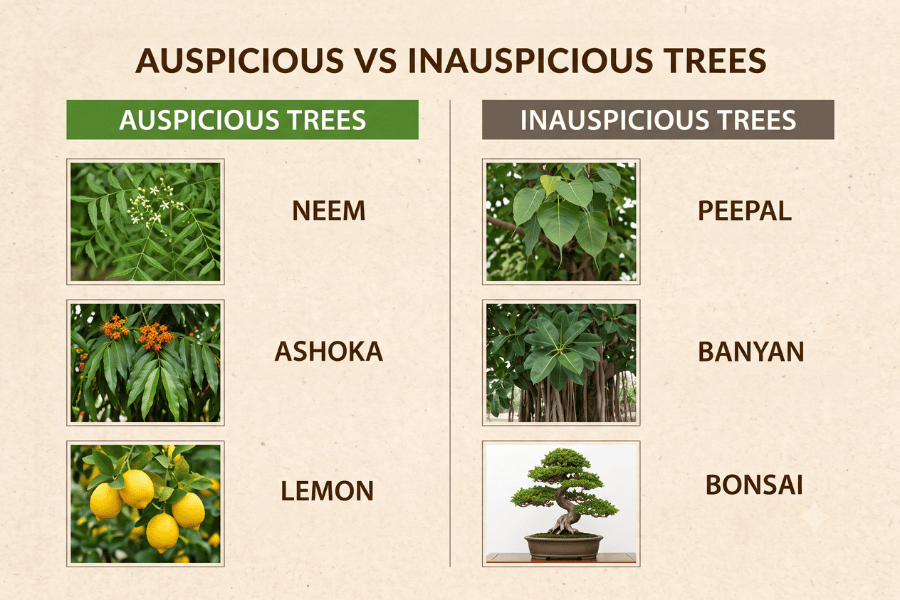
| Generally Favourable | Usually Treated With Caution |
|---|---|
| Neem, Ashoka, Amla, Bamboo, Jasmine, Lemon, Coconut, Mango, Money Plant, Shami, Parijat, Pomegranate, Tulsi | Babul, Banyan, Peepal, Bonsai, Tamarind, very thorny plants |
Dos and Don’ts for Trees at Home as per Vastu
Choosing the right tree is only one part of the decision. In Vastu Shastra, the way you place, maintain and manage trees matters just as much. A healthy, well-placed tree can support harmony in the home, while a badly placed or neglected one can disturb light, movement and balance.
Dos
- Do plant larger trees in the South, South-West or West directions where their weight feels more balanced
- Do keep the North-East direction light, open and free from big trees
- Do choose useful and healthy trees such as neem (नीम), amla (आँवला), ashoka (अशोक) or lemon (नींबू) when the plot allows
- Do maintain trees properly by trimming dead branches and removing dry leaves or fallen fruit
- Do make sure trees do not block the main entrance, windows or important sunlight from the East
- Do consider the mature size of the tree before planting, not just how small it looks now
- Do keep enough distance between large trees and the house boundary to protect walls, paving and foundations
Don’ts
- Don’t plant heavy or fast-spreading trees in the North-East corner
- Don’t place any tree directly in front of the main door
- Don’t grow sacred large trees like peepal (पीपल) or banyan (बरगद) within a small residential boundary
- Don’t keep bonsai trees as a remedy for growth, since it is often seen as symbolising restriction
- Don’t allow dense trees to block morning light and airflow
- Don’t keep thorny plants around the home unless there is a specific reason and proper placement
- Don’t ignore signs of decay, disease or root spread, as neglected trees can affect both the energy and structure of the home
Final Thoughts
When people ask about trees for home according to Vastu, they often expect a simple good-or-bad list. In reality, the answer is more thoughtful than that. Vastu considers species, direction, size, symbolism and the overall balance of the property.
Some trees, such as neem, ashoka, lemon and bamboo, are usually welcomed. Others, such as peepal, banyan, bonsai and tamarind, are approached with caution in residential settings. But even the most favourable tree needs proper placement. A good tree in the wrong zone can still create an imbalance.
If you want expert guidance for your specific plot or home layout, Vastu Ananda offers consultations for plot vastu, residential vastu, commercial vastu, hotel vastu and office vastu, along with vastu basic and advanced courses for learners.