

Television is a strong source of light, sound and movement in the home. In Vastu Shastra (वास्तु शास्त्र), these qualities are closely linked with the Agni tattva (अग्नि तत्व) or fire element. That is why TV placement is not a small detail.
The direction, wall choice, viewing position and even the room where the TV is kept all shape the energy of the house.
When the TV is placed in the right zone, it supports comfort, smoother family interaction and a more balanced living room. When it is placed in the wrong zone, it creates restlessness, heat, arguments and mental distraction.
This becomes more noticeable in modern homes where the TV is often the centre (Brahmasthan) of the sitting area.
In this guide, we will cover the key dos and don’ts for TV direction as per Vaastu. We’ll talk about the best wall in the living room for TV, directions and spaces to avoid as well as simple remedies for Vastu dosh (वास्तु दोष).
We will also look at furniture guidance that supports a better energy flow around the television.
Why TV Direction Matters in Vastu
Every direction in Vastu is ruled by a specific energy field and devta. A TV is not a neutral object. It emits light, sound, heat and electrical energy. That is why it must be aligned with the correct directional force.
The home is governed by the five elements:
- Prithvi (पृथ्वी) or Earth
- Jal (जल) or Water
- Agni (अग्नि) or Fire
- Vayu (वायु) or Air
- Akash (आकाश) or Space
A television carries strong fire and active electromagnetic energy. If this energy enters a calm or sacred zone, it disturbs the balance of the home.
For example, the North-East is linked with Ishanya (ईशान कोण) and the head of the Vastu Purush and supports clarity, prayer, wisdom and purity. Placing a TV there weakens that subtle energy.
On the other hand are zones that are naturally connected with the Fire element. This means that directions like South-East (अग्नि कोण) can handle electrical activity more effectively.
TV direction also matters because the living room is a shared family space. The wrong placement can increase irritation and scatter attention. The right placement keeps the room functional while preserving a smoother energy flow.
What Is the Best TV Placement in My Living Room As per Vaastu?
टीवी रखने की सही दिशा is usually connected with the South-East, South or West side of the living room, depending on the room plan. In most homes, the TV should be placed in a way that keeps the North-East open, light and peaceful.
The living room is a public zone of the house. It needs movement, comfort and conversation, but it also needs order. The TV should not dominate the entire room’s energy. It should sit in a direction that can absorb its fire and electrical force without disturbing the natural flow.
Choosing the TV Wall
The wall matters because it determines not only where the TV is mounted, but also how the people in the room sit, face and interact with the space.
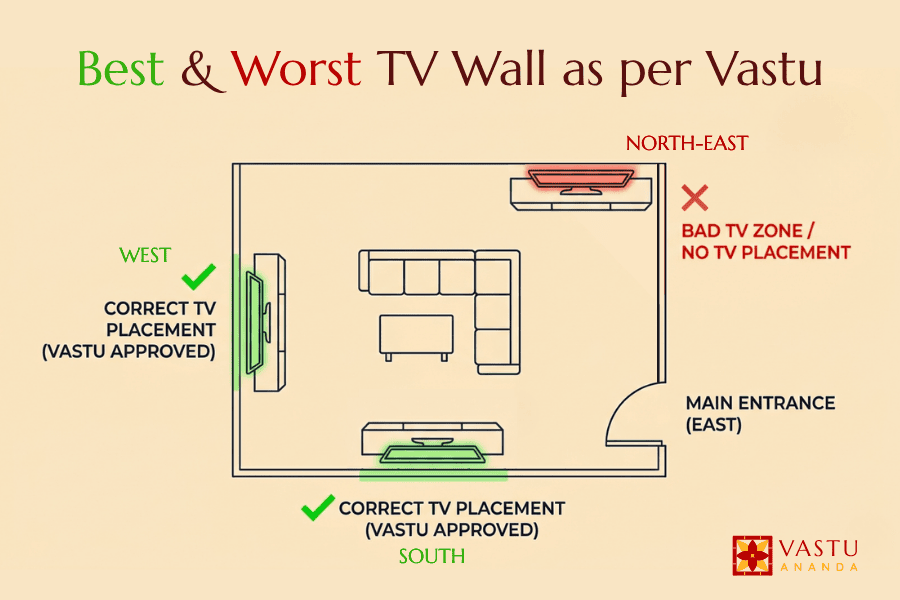
In most cases, the South or West walls are ideal for placing the TV in the living room.
A TV on the West wall works well because the West is suited to heavier placement. It allows the screen and cabinet to sit in a grounded position without disturbing the lighter energy of the room.
Similarly, the South wall is also suitable for a TV. This is especially when the main seating is placed in the West or South-West and the North-East is kept uncluttered.
Can I install my TV on the North or the North-East wall?
You should avoid placing a TV on the North wall. But if there’s no option, it can be worked with, granted that the North-East remains clear. The TV should never push into the North-East corner.
The North-East is one of the most sensitive zones in Vastu. It is the space of prayer, wisdom, mental clarity and divine flow. It is linked with lightness, spiritual order and purity. A TV in this area creates constant visual and sound disturbance. This weakens peace in the home and makes the room feel mentally crowded.
How High Should My TV Be?
The TV should be mounted at a comfortable eye level when seated. In Vastu terms, the screen should not feel aggressive or dominating. A very high TV creates strain, tension in the body and a sense of pressure in the room.
The screen should not be too high above the natural line of sight. The unit should feel anchored and proportionate to the wall. The TV should also not be mounted over a sacred shelf or directly above symbols of worship. The area below the TV should remain organised and not filled with chaotic wires.
Where Should I Face While Watching TV?
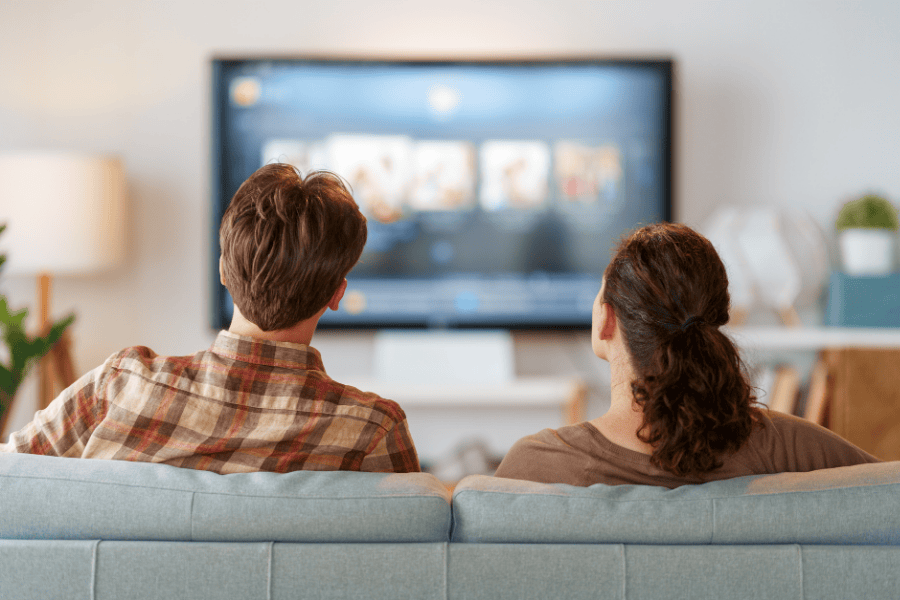
Ideally, the viewing position should let you sit comfortably without straining your neck.
Can I face East to watch TV as per Vastu?
Yes, facing East while watching TV is generally considered good. In the Two-Stream Theory in Vastu, East is associated with Surya energy (प्राणिक ऊर्जा), clarity and a fresh flow. It supports a more uplifted and attentive state.
Seating Arrangement for the TV
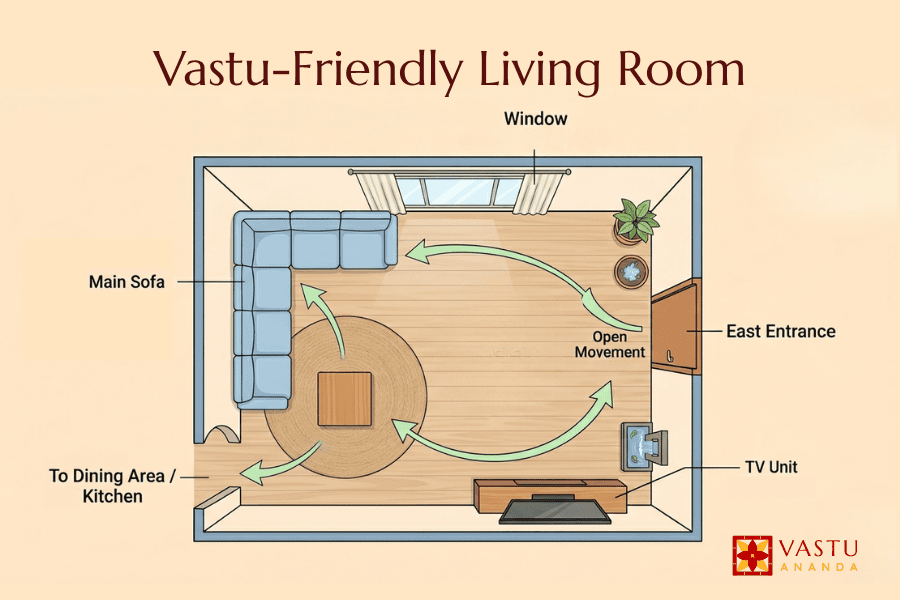
The seating arrangement around the TV should support balance, not crowding. Keep the heaviest seating, such as a main sofa, on the South or West side of the room when possible. This allows lighter movement in the North and East.
Here are some quick living room seating tips:
- Place the main sofa against a South or West wall.
- Keep the North-East corner open and clean.
- Avoid blocking windows in the East.
- Do not crowd the TV unit with too many decorative objects.
- Make sure there is enough walking space in front of the seating.
More Vastu Tips for Your TV Setup
A good TV setup is not only about direction. It is also about how the unit is designed, how the appliance is maintained and how the surrounding space is managed.
Best Side for a TV Unit As per Vastu
The TV unit should ideally be placed on the South, South-East or West side of the living room. If the unit includes storage, heavier cabinets can stay toward the South-West or West side, while lighter décor can remain in the North or East.
Ideal TV Volume
The TV volume should be moderate. Very loud volume increases agitation and creates aggressive energy in the room. This especially affects family conversations and emotional stability. A constantly loud TV activates stress and makes the home feel unsettled.
TV Cleanliness
Dust and clutter around the TV attract stagnant energy. The screen, stand and cables should be kept clean and tidy. Smudges, exposed wires and piled-up remotes create a mess, which creates energetic disorder.
Do this for a cleaner TV setup:
- Wipe the TV and unit regularly.
- Hide or organise wires properly.
- Remove broken decorative items near the TV.
- Avoid stacking unnecessary gadgets around it.
- Keep the area well-lit and fresh.
Bad Directions for TV Placement
Some directions are simply not suitable for a television because they disturb the natural role of that zone.
Why Is the Northeast a Bad Spot for TV?
The North-East is the most important direction to protect from heavy and fiery objects. This zone carries spiritual and mental purity. It is linked with water-like subtlety, openness and divine grace.
A TV introduces heat, noise and overstimulation. That directly damages the calm quality of the North-East corner.
इस दिशा में बिल्कुल भी न रखें टीवी. The North-East should not hold a TV, large speakers or other heavy electronic appliances.
The centre of the room (ब्रह्मास्थान) should also stay open. A TV unit that blocks the flow of movement or visually dominates the centre can create imbalance.
Here is a simple directional summary:
| Direction | Vaastu for TV | Significance |
| South-East (Action) | Good | Best for electrical appliances and fire energy |
| South (Stability) | Good | Stable and supportive for heavier fixtures |
| West (Freedom) | Good | Practical for TV units |
| North (Wealth) | Moderate | Use only if North-East stays clear |
| East (Life energy) | Moderate | Can work in some layouts if not too dominant |
| North-East (Divine energy) | Bad | Disturbs purity, peace & spiritual energy |
| Centre | Bad | Blocks flow and creates imbalance |
Why Avoid TVs in the Bedroom As per Vastu
The bedroom should support rest and healing. A TV in the bedroom does the opposite. It activates the senses and keeps the mind alert. That is why Vastu generally advises against TVs in the bedroom.
The bedroom should support rest and healing. A TV in the bedroom does the opposite.
Affects Sleep
A bedroom TV delays sleep, scatters the mind and creates an overstimulated atmosphere before rest.
Exposure to blue light right before bed also affects sleep quality and consequently affects overall health Vastu. This is why many health authorities advise reducing screen use before sleeping. This practical guidance aligns closely with Vastu principles.
NHS has prescribed certain guidelines to reduce screen strain and improve TV viewing conditions.

Affects Energy Flow
The bedroom should hold soft, grounded energy. A TV adds sharp fire and movement. This disturbs the room’s emotional stability and weakens the bonding energy between partners. It also makes the room feel like an extension of the living area rather than a place of rest.
TV Placement in Bedroom
Where to keep the TV in the bedroom? बेडरूम में किस दिशा में रखें टीवी? If a TV must be kept in the bedroom due to space limits, place it in the South-East direction of the room if possible. Avoid the North-East and avoid placing it directly opposite the bed in a way that dominates the space. It should be covered or switched off fully when not in use. A closed cabinet is better than an open screen.
What Happens if You Place the TV Wrong?
A TV placed in the wrong direction disturbs the overall energy of the home. The space starts to feel hotter, noisier and less settled, especially in the living room where the TV already draws strong attention.
Over time, this can lead to irritation, poor focus, mental unease and a constant sense of restlessness in shared spaces. If the TV is kept in a bedroom or another area meant for calm, it also affects sleep and makes the room feel emotionally unsettled.
The effect is stronger when the TV is placed in sensitive zones like the North-East, which should remain light, quiet and spiritually clear.
Vastu Dosh Remedies for TV Placement
Sometimes the TV is already fixed and cannot be moved easily. In such cases, remedies help reduce the Vaastu dosh.
Removing Negative Vibrations From Your TV
Start with practical corrections. Keep the area clean, reduce excess wires and avoid placing the TV in front of spiritual images. Keep the TV switched off when not in use and avoid playing it constantly in the background. This reduces unnecessary activation.
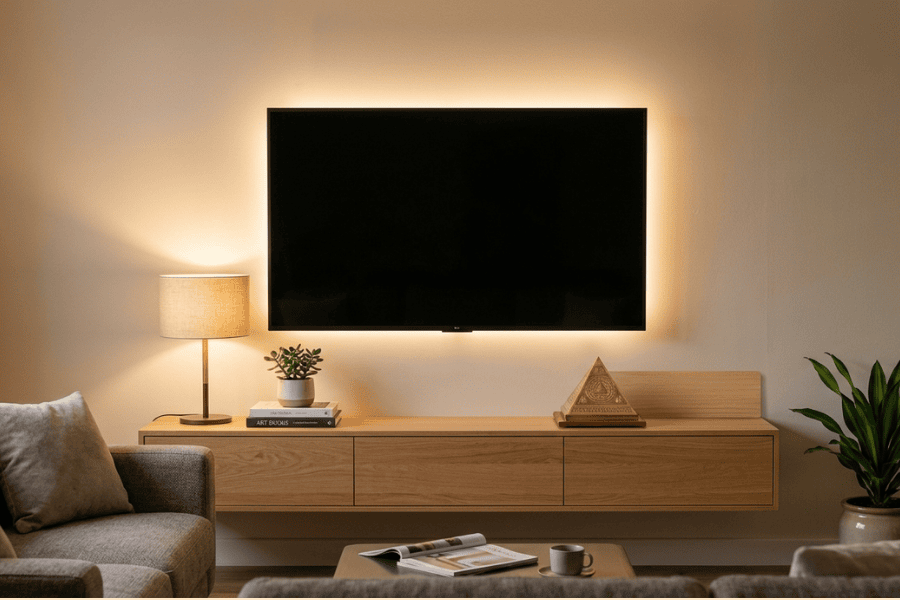
You can also use grounding décor around the area, such as earthy tones in the unit design and calm lighting that softens the harshness of the screen.
Using a Vastu Pyramid To Fix TV Vastu
A Vastu pyramid is often used as a corrective support when the TV is in a difficult location. It helps stabilise imbalance and reduces the disturbance created by electrical energy. This is especially useful when the TV sits close to a sensitive zone and shifting it is not possible.
Other common support measures include:
- Keeping the North-East free from clutter.
- Using balanced room lighting.
- Reducing reflective surfaces and no mirrors around the TV.
- Ensuring the room is not dominated by one heavy media wall.
Final Thoughts
TV placement may seem like a small home styling decision, but in Vastu it has a direct effect on energy flow. A TV carries active fire energy, so it needs a direction that can handle that force. The safest choices are usually South-East, South and West, while the North-East should be protected from it.
A balanced TV setup improves comfort, reduces tension and keeps the living room more harmonious. It also supports Vastu Shastra’s aim of aligning the five elements, directions, devtas and activities together.
If you are unsure whether your current TV setup is helping or harming your home energy, a personalised review can help. Book a home Vastu consultation with Vastu Ananda to get practical guidance for your living room, bedroom and full house layout.
FAQs
1. Where should the sofa be placed in the living room as per Vastu?
The main sofa should be placed on the South or West side of the living room. This gives support to the seating area and keeps the lighter zones, especially the North and East, more open and balanced.
2. Where should heavy furniture be kept in the living room as per Vastu?
Heavy furniture should be placed in the South-West, South or West side of the living room. These directions provide stability and help maintain proper weight distribution in the space.
3. What should be the slope direction in the living room as per Vastu?
The floor level in the living room should ideally slope gently toward the North-East or East. This supports a better flow of positive energy and keeps the room feeling lighter.
4. What is the best colour for the living room as per Vastu?
The best colours for the living room are light and balanced shades such as off-white, light beige, soft cream and other gentle earthy tones. Avoid overly harsh, dark or aggressive colours, especially around the TV wall.
5. Where should the bed be placed in the bedroom as per Vastu?
The bed should ideally be placed in the South-West part of the bedroom. While sleeping, your head should point toward the South or East for better rest and stability.
6. Where should wardrobes be placed in the bedroom as per Vastu?
Wardrobes are best placed in the South-West, South or West side of the bedroom. These directions are suitable for heavy storage furniture and help keep the room balanced.
7. Where should mirrors be placed in the bedroom as per Vastu?
Mirrors should not face the bed directly. They should be placed on a suitable wall where they do not reflect the sleeping body, as this disturbs rest and bedroom harmony.
8. How should dining room furniture be arranged as per Vastu?
Dining room furniture should be arranged so the space feels open, bright and easy to move through. Heavy storage units should be placed on the South or West side. The dining area should also be kept clean and free from strong screen distractions, such as a dominating TV nearby.
9. What is the Vastu remedy for a TV installed on the West wall?
A TV on the West wall is usually acceptable. If the setup feels too heavy, keep the unit clean, use balanced lighting and avoid clutter. There is normally no major defect to correct if the rest of the room is aligned well.
10. Where is the right place to fix the television in the East facing house as per Vastu?
In an East-facing house, the TV should still follow room-level Vastu, not only the main entrance direction. In the living room, place it on the South-East, South or West wall as available. Do not place it in the North-East just because the house itself is East-facing.
11. What should you keep in mind when choosing a TV unit or cabinet as per Vastu?
As per Vastu, a TV unit or cabinet should feel stable, clean and well-balanced. It should not be too bulky for the room or create visual heaviness around the television.
Closed storage is better than open clutter because it keeps wires, gadgets and small items out of sight. The unit should also be easy to clean, as dust and disorder around the TV disturb the energy of the space.
12. Can a TV be placed under a staircase as per Vastu?
It is best to avoid placing a TV under a staircase as per Vastu. The area below the stairs often carries compressed and heavy energy.
TVs already create active fire energy. So putting it under a staircase can increase mental pressure, discomfort and imbalance in the room.
If there is no other option, keep the space well-lit, clutter-free and use a proper Vastu remedy to reduce the defect.



































































































