Your house can be spacious, well-furnished and in a good location. But if there is frequent stress, poor sleep or unnecessary arguments within your house, then what is the point of having this great house?
This is when people realise that a good home is not just about space or appearance. It should also support mental peace and welcome divine energy into the family’s life. This is where disha Vastu starts to matter.
One of the central points in Vastu Shastra (वास्तु शास्त्र) is whether the house’s facing direction supports the people living in it.
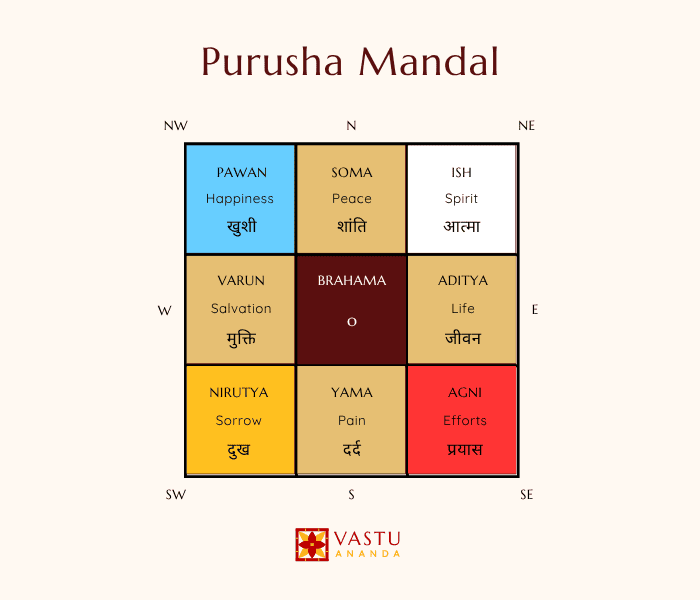
Directions help decide how a home receives light and positive energy. They also guide the room placement as per the cosmic energy flow, planetary deities’ influence and the Vastu Purusha Mandala (वास्तु पुरुष मण्डल).
This guide covers the Vastu guidelines for each direction and gives tips to avoid directional Vastu Dosha (दिशा वास्तु दोष).
What Vastu Really Means in a Home
Vastu Shastra is the traditional Indian system of planning spaces in harmony with the five elements (पंचमहाभूत). Its purpose is to support peace, health, stability and blessings of divine energy in daily life.
At its core, Vastu says something very practical: every activity has a suitable place. Cooking, sleeping, praying, working and resting all have different energy needs. When rooms are placed in ways that go against these natural elements, the home may feel less balanced.
For example, many families notice that one room feels restful while another feels heavy or unsettled. Very often, this has to do with how the room is positioned and used.
In Vastu, direction affects how energy enters a home, how people use the space and how comfortable the house feels over time.
Why Cardinal Directions Matter in Vaastu
Every direction carries a different quality in Vastu. Some directions support lightness, clarity and spirituality. Others support strength, grounding, movement or fire.
This is why Vastu does not treat all sides of the house in the same way. One cannot place the kitchen, bedroom and pooja room randomly and expect no troubles.
Vastu also bases its norms in the five elements, known as Panchamahabhuta (पंचमहाभूत): Earth, Water, Fire, Air and Space. The aim is to create a home where these elements are balanced through layout, direction, light and openness.
When this balance is disturbed, people often say the house feels “stuck”, “too heavy”, “always tense” or “never peaceful”. Such lived experiences bring many people to Vastu experts.
What Does Each Vastu Direction Signify?
Here is a table highlighting the eight main directions and how they are commonly understood in Vastu.
| Direction (दिशा) | Significance | Deities |
| East / पूर्व | Growth, light, new beginnings | Lord Indra (इंद्र) |
| South-East / दक्षिण पूर्व | Fire, activity, energy | Lord Agni (अग्नि) |
| South / दक्षिण | Strength, discipline | Lord Yama (यम) |
| South-West / दक्षिण पश्चिम | Stability, grounding | Lord Niruti (नैऋत्य) |
| West / पश्चिम | Maturity, support | Lord Varun (वरुण) |
| North-West / उत्तर पश्चिम | Movement, relationships | Lord Pawan (पवन) |
| North / उत्तर | Flow, opportunities, finance | Lord Kuber (कुबेर) |
| North-East / उत्तर पूर्व | Clarity, spirituality, wisdom | Lord Eeshaan (ईशान) |
So are all directions good? Well, not all Vaastu directions for home are equal in function. Each one is useful, but for a different purpose.
The 8 Directions and the 16 Zones in Vastu
Most people know the eight main directions: North, South, East, West and North-East, South-East, South-West and North-West.
But in a detailed Vastu analysis, the home is also understood through 16 directional zones. These are:
1. North (N)
2. North-North-East (NNE)
3. North-East (NE)
4. East-North-East (ENE)
5. East (E)
6. East-South-East (ESE)
7. South-East (SE)
8. South-South-East (SSE)
9. South (S)
10. South-South-West (SSW)
11. South-West (SW)
12. West-South-West (WSW)
13. West (W)
14. West-North-West (WNW)
15. North-West (NW)
16. North-North-West (NNW)
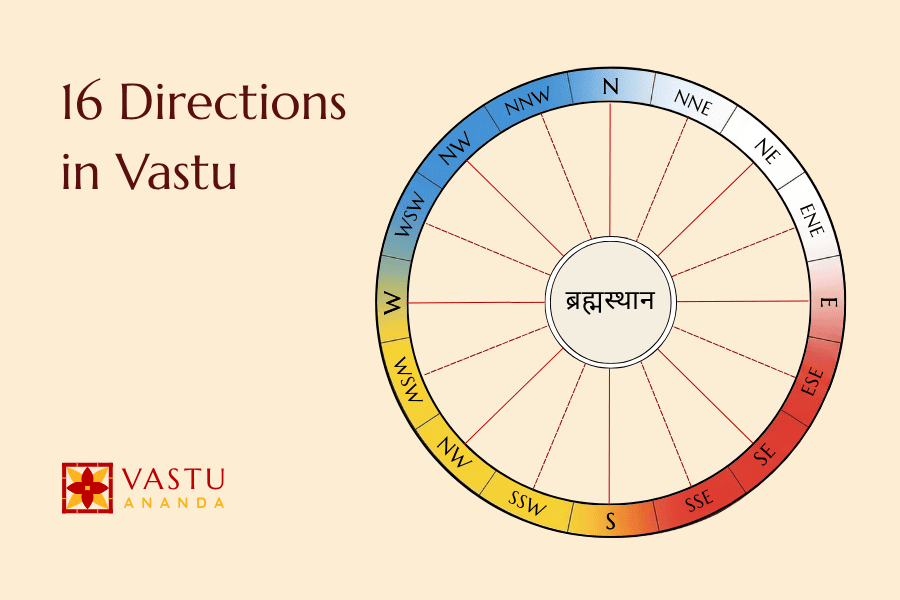
These finer divisions are especially useful for accurate Vastu analysis. It’s also to completely avoid Vastu dosh in important house spaces like the main entrance (मुख्य द्वार), the kitchen, master bedroom, toilet or a staircase. This is why,
Two homes that both appear East-facing may still give very different results in Vastu.
Why the Main Entrance Facing Is Important
The main entrance is one of the most important parts of the house in Vastu because it is where energy enters.
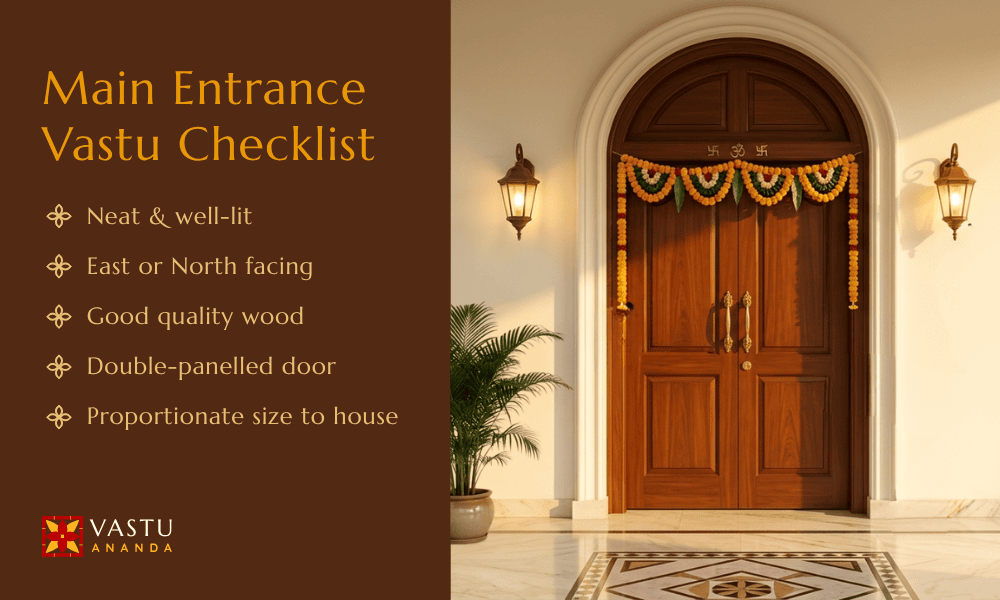
In most homes, North, East and North-East entrances are considered favourable. The entrance should feel clean, bright and easy to approach. It should not feel blocked, neglected or cramped.
This matters in everyday life more than people realise. Think of homes where shoes, broken items, old cartons and poor lighting gather near the main door. Over time, the entrance starts feeling heavy. In Vastu, this is not seen as a small issue.
The main door should also be proportionate to the home and made from good-quality wood.
This should also be a two-panel door. Avoid sliding doors in the main entrance. The entry into the house should be clockwise (मंडलाकार).
North-Facing or East-Facing: Which Is Better?
In general, North, East and North-East facing homes are linked with spirituality, wealth and growth.
North-facing homes are especially popular. This is because North is governed by Lord Kubera and is the source of Earth’s magnetic field (जैविक ऊर्जा). This direction is good for career progress and financial opportunity.
East-facing homes are next on people’s preferences. The East is governed by lord Indra and receives the energy of the rising sun (प्राणिक ऊर्जा). So it is linked with auspicious beginnings.
But there is no universal winner between the two. Both are good directions for a house’s facing.
How To Check the Facing Direction of Your House
To identify the house’s facing direction as per Vastu, stand at the main entrance inside the home and look outward. The direction you face is the facing direction of the house.
This sounds simple, but many people get confused by balconies, side gates or building orientation. The correct reference point is the actual main entrance used to enter the house/flat.
For a basic check, a reliable compass app is enough. For a plot purchase, a more accurate Plot Vastu reading is better.
You should also remember that a Vastu check is not just about facing direction. A proper review looks at room placement, plants, metal usage, wall colours, appliance placement, natural light and more.
Magnetic North vs True North
Yes, especially in detailed analysis.
Most phone compasses show magnetic North. In advanced Vastu, there can be a difference between magnetic North and true North. That difference may affect how a zone is read, especially in 16-part analysis.
If you are planning a new home or making a major Vastu decision, precise direction reading becomes more important.
Vastu Tips for New Home, Vastu-Friendly Plants & More
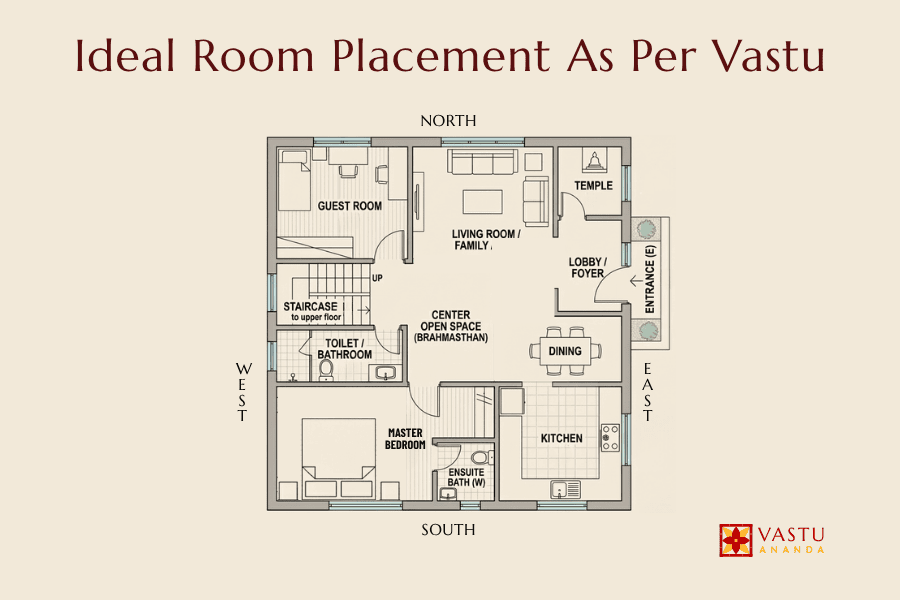
In Vastu, room placement is not random. Each direction is considered suitable for certain functions, which is why the location of the kitchen, bedroom, puja room or staircase matters.
East Direction (पूर्व दिशा) Vastu Tips
In Vastu, the East should be kept open, light and clean, as it is governed by Lord Indra.
This direction is also associated with sunrise, life force and auspicious beginnings. A balanced East is believed to support health, vitality, reputation and overall progress in life.
Best for: Main door, porch (बरामदा), basement, bathroom, library, study table
Best paint colour: White, light yellow
Best plant: Ashok tree
South-East (पूर्व-दक्षिण दिशा) Direction Vastu
South-East is the fire zone. It is most suitable for the kitchen and electrical activities. This direction is usually not preferred for the master bedroom.
Best for: Kitchen, electric room, geyser, heater
Best paint colour: Flashy silver, shiny pink, orange
Best plant: Mango tree
South (दक्षिण दिशा) Direction Vastu
The South is associated with strength and discipline. It can work well when used carefully, but it generally needs thoughtful planning. This is the sleeping direction according to Vastu.
Best for: Bedroom, locker (तिजोरी)
Best paint colour: Yellow, brown
Best plant: Audumber tree, Almond tree
South-West (दक्षिण-पश्चिम दिशा) Direction Vastu
South-West is the zone of stability and grounding. It is one of the best places for the master bedroom and for keeping the home energetically settled and stable.
Best for: Homeowner’s bedroom
Best paint colour: Yellow, brown, blue
Best plant: Audumber tree, Almond tree, Christmas tree
West (पश्चिम दिशा) Direction Vastu
West supports stability, maturity and family use. It can work well for dining or support spaces like staircases when the overall layout is balanced.
Best for: Dining room, washroom, staircase, lift
Best paint colour: Blue, grey
Best plant: Peepal (in pot), Raatraani, Mogra, Chameli
North-West (उत्तर-पश्चिम दिशा) Direction Vastu
North-West is linked with movement, communication and change. It is often suitable for a guest room, some toilets and spaces that involve regular movement.
Best for: Lift, bathroom, guest room, wind chimes
Best paint colour: White, milky, aqua (फिरोज़ी)
Best plant: Avoid heavy trees, use pots
North (उत्तर) Direction Vastu
In Vastu Shastra dish gyaan, North is associated with opportunity, flow and financial energy. It is often considered a positive direction for openings and work-related activity.
Best for: Puja room, main entrance, porch, basement, open area, well, pond
Best paint colour: Milky white, light blue, green
Best plant: Ashok tree
North-East (उत्तर-पूर्व) Direction Vastu
North-East is one of the most auspicious directions in Vastu. It is usually ideal for pooja, meditation, study and light, open use.
Best for: Puja room, pond, water features, basement, well, open area, balcony
Best paint colour: White, milky, light grey
Best plant: Tulsi plant, open garden
The Role of the Centre–Brahmasthan
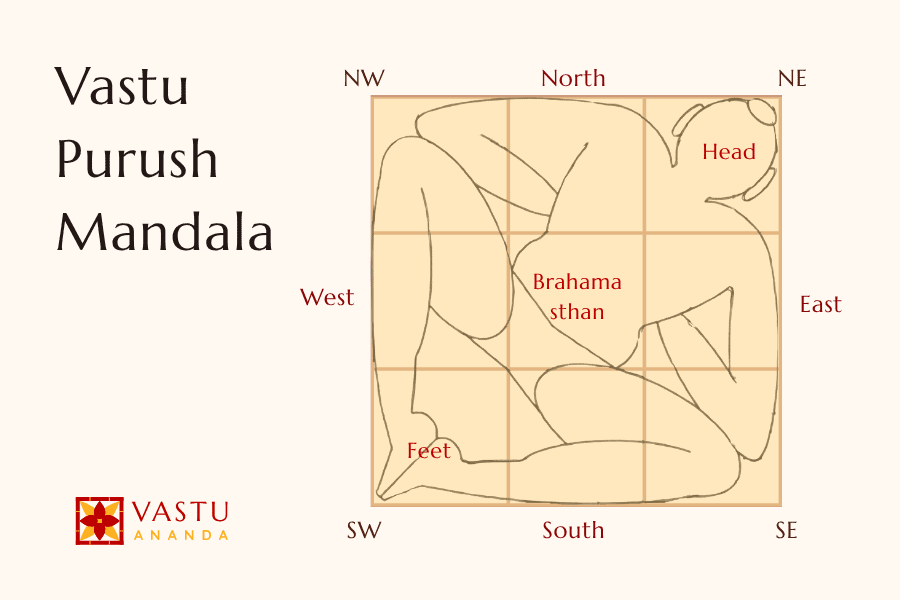
The centre of the home also has special importance. This is called the Brahmasthan (ब्रह्मस्थान). Situated on the naval of the cosmic being Vastu Purush, this spot is considered the core energy zone of the house.
It should ideally feel open, clean and free from heavy blockage.
If the centre is filled with clutter, a heavy structure or poor movement, the whole house can feel dull.
Many older homeowners relate to this immediately. They often say the house once felt open and light, but over the years, (as clutter gathered), it became crowded and mentally tiring. This is exactly the kind of shift Vastu asks us to notice.
Which Vastu Directions Need More Care?
As per Vastu disha gyan, South, South-East and South-West facing homes need the most caution.
South-facing houses are generally considered inauspicious. The South is governed by Lord Yama, the god of death and this direction is not seen as ideal for the main facing of a home. Such houses can increase stress, financial pressure, health issues, conflicts or a sense of heaviness.
South-East is ruled by Agni, the god of fire. This zone suits a kitchen, but not the main facing of a house. A South-East facing home can increase conflict, restlessness and imbalance.
South-West is governed by Niruti and is a direction of heaviness and control. It should remain strong and stable, not become the main facing. South-West facing homes are often associated with delays, instability and a lack of support.
Even if the South-West corner is cut, too open or wrongly used, people often report insecurity, delays or a lack of settled energy in the home.
For example, I have seen homes where the family kept saying, “Everything starts but nothing settles.” In such cases, the South-West zone was often weak or disturbed.
Vastu Remedies for Wrong-Facing Homes
Very few homes are perfect.
Modern flats and villas often come with structural limits. A kitchen may not be in the ideal zone. The North-East may be partially blocked. The staircase may be placed in a difficult area.
This does not mean the home is beyond correction.
In some cases, Vastu can be improved with better room use and simple remedies such as Vastu pyramids, depending on the exact defect. The goal is not fear. The goal is balance.
A few broad principles help most homes:
- Keep the North-East lighter, cleaner and less burdened
- Keep the South-West stable and well grounded
- Use the South-East carefully for fire-related functions
- Avoid blocking the Brahmasthan with heavy clutter
- Use Vastu pyramids (after consulting a Vastu expert)
- Keep sea salt or camphor in problem areas to reduce heaviness and stagnation
These remedies are commonly used to reduce imbalance and support better energy flow. But these remedies do not replace proper planning.
If you want expert guidance on disha vastu, Vastu Ananda offers consultations for plot Vastu, residential Vastu, commercial Vastu, hotel Vastu, office Vastu and more. We also offer a Vastu basic course and a Vastu advanced course for learners who want to study the subject more deeply.
Final Thoughts
The real purpose of Vastu is not to make people fearful of directions in Vastu. It is to help them build supportive homes.
When the layout is right, you can often sense it without needing to explain it. The entrance feels welcoming. The rooms feel easier to use. The space feels calmer. The mind feels lighter. Daily life begins to move with greater ease.
That is the value of understanding Vaastu directions properly.
FAQs
1. Which direction is best for Vastu?
In Vastu Shastra, North-East, North and East are usually considered the best directions. North-East supports peace and spirituality. North is linked with wealth and East brings light and positive energy. However, the overall layout of the home also matters.
2. How to check directions for Vastu?
Stand at the main entrance inside the house and look outward. The direction you face is the house’s facing direction. A compass app can help with a basic check, while a detailed Vastu review looks at the exact 16 directional zones.
3. What are the basic rules of Vastu?
Basic Vastu rules include keeping the North-East clean and open. Another rule is placing the kitchen in the South-East. The master bedroom should be in the South-West and the main entrance in North, East or North-East. The centre of the home should also stay light and clutter-free.
4. Which direction should the door face?
According to Vastu, the main door should ideally face North, East or North-East. These directions are believed to attract positive energy, light and prosperity. The entrance should also be clean, bright and uncluttered.
5. Is it necessary for all rooms to be Vastu-compliant?
Ideally, the whole layout should align with the Vastu Purush Mandala. But in modern homes, this is not always possible.
So here, what matters most is the correct placement of key areas like the main entrance, kitchen, master bedroom, pooja room and Brahmasthan.
6. Can technology help in ensuring Vastu compliance?
Yes, technology can help in ensuring Vastu compliance. Compass apps and digital floor plan tools can help check house facing direction and room placement. But for accurate results in major decisions, expert consultation is still recommended.
7. What should be avoided in a North-East direction?
In Vastu, the North-East direction should not have heavy clutter, toilets, staircases or large storage units. This zone should be kept clean, open, light and peaceful because it is associated with clarity, spirituality and positive energy.
8. Which colours are recommended for a Vastu-compliant flat?
A Vastu-compliant flat should generally use light and calming colours for Vastu. Recommended colours include white, light yellow, light blue, light green, beige and soft grey. These colours support brightness, peace and balance in the home.
9. How does Vastu influence financial stability?
According to Vastu Shastra, financial stability is linked with the North direction.
As the zone of Lord Kubera, it is associated with wealth and opportunities. A clean and open North entrance can support better financial flow and stability.
10. Is Vastu applicable to flats in multi-story buildings?
Yes, Vastu is applicable to flats in multi-story buildings. In apartments, Vastu mainly focuses on the flat’s main entrance direction, rooms, kitchen location, bedroom position and the openness of the North-East. Even if the entire building is not Vastu-based, the flat itself can still be assessed.
11. Where should I keep medicines in the house for better health?
The best direction for medicines in your house is the North-North-East (NNE). North, North-East and East are also good for this purpose.