Have you ever walked into a home that looked perfectly fine but still felt heavy, restless or unsettled?
Many homeowners notice this feeling but cannot explain it. In Vastu Shastra (वास्तु शास्त्र), one of the first places to check is the Ishanya corner, the North-East direction of the house. If this zone is blocked, cluttered or used poorly, the whole home can feel less peaceful.
This matters even more for families who want stability, good health and a calm living environment. For many couples buying a home after years of hard work, the goal is not just a beautiful house. It is a house that supports peace, comfort and prosperity.
The Ishanya corner is often treated as the most sensitive and auspicious area of the property. It is linked with light, clarity, prayer, wisdom and the water element. That is why its use, design and condition can make a noticeable difference.
In Vastu, space is often studied through directional grids. Along with the main directions, practitioners also work with a fuller set of directional zones. When people refer to the 16 zones, they usually mean a more detailed directional division that includes North, North-North-East, North-East, East-North-East, East, East-South-East, South-East, South-South-East, South, South-South-West, South-West, West-South-West, West, West-North-West, North-West and North-North-West.
In this article, we will look at what Ishanya corner means, why the North-East direction is considered so important, the common doshas seen in modern homes and practical remedies that make sense for real people living in real houses and flats.
What Exactly Is The Ishanya Corner?
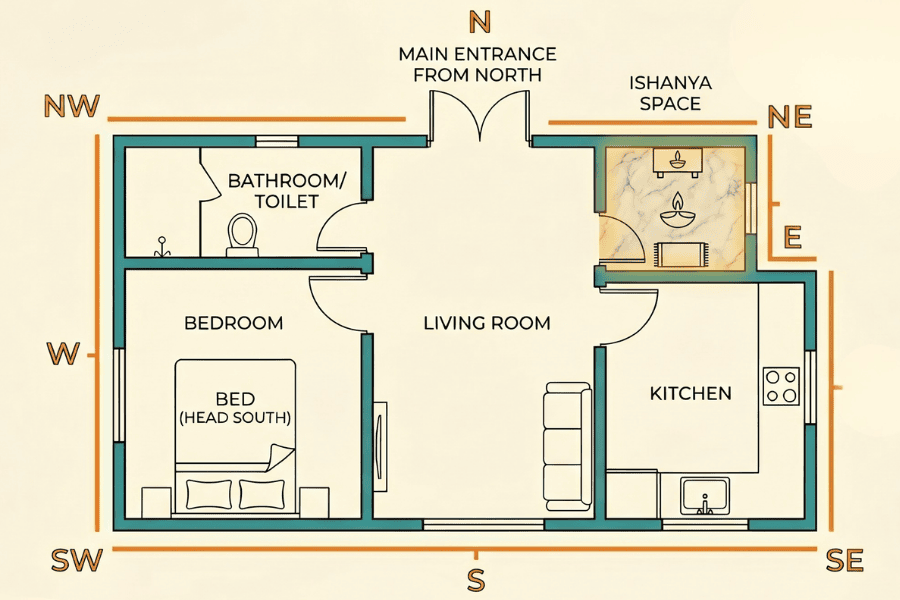
The Ishanya corner is the North-East part of a home, room, office or plot. If you stand at the centre of a house and find the space between North and East, that is the Ishan or Ishanya zone.
So if you have ever asked, “Which side is Ishan corner?” the answer is simple: it is the North-East side. In many traditional texts and consultations, this area is also called Ishanya Kon or Ishan Kon.
In Vastu, this corner is linked with purity, mental clarity and divine energy. Many traditions also connect it with prayer and grace. That is why people often choose this area for a puja room, meditation space or quiet sitting corner.
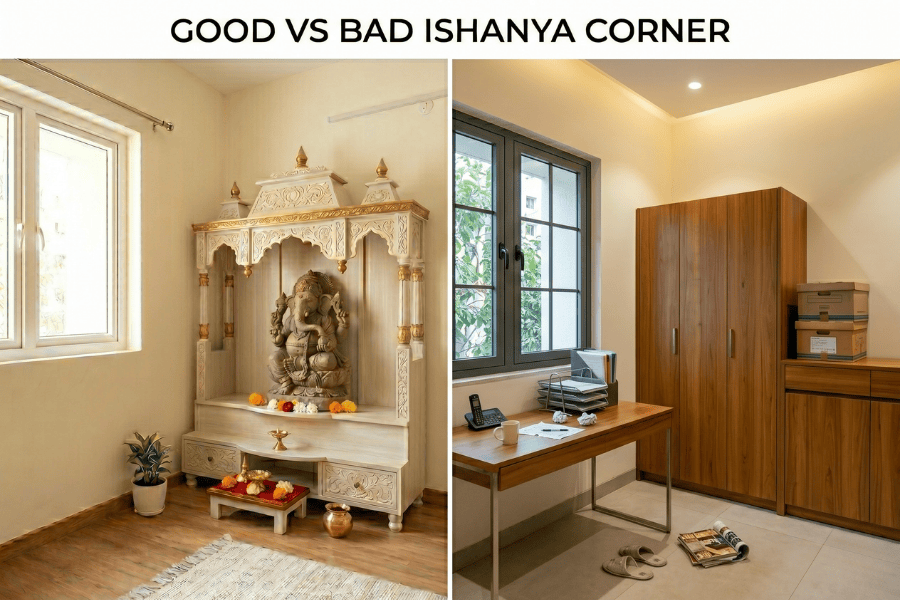
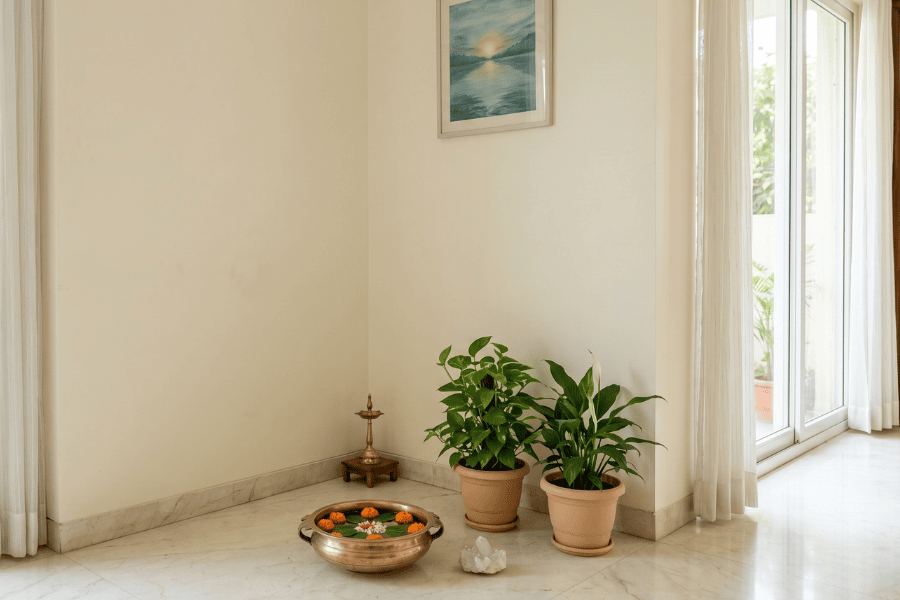
In practical terms, ishanya corner means a space that should stay light, open and clutter-free. It is not meant for heaviness, clutter or neglect.
A common real-life example is a flat where the North-East corner becomes a dumping space for old cartons, paint buckets or broken stools. The family may not think much of it. But over time, the area starts to feel dull and forgotten. In Vastu terms, that is exactly what should be avoided in the Ishanya zone.
Why The North-East Is Given So Much Importance In Vastu
Among all directions, the North-East is seen as the most delicate and beneficial. This is why so many articles describe it as the power zone of the home.
The importance of North-East direction in Vastu comes from its connection with lightness, calmness and inner balance. Traditional Vastu advice usually says that this part of the home should remain open and free from obstruction.
Many homes built without this in mind may still function well, but people often say the house feels “closed”, “stuck” or “not fully peaceful”. In many cases, the North-East is dark, overloaded or wrongly used.
The phrase “capturing the cosmic vibes” may sound modern, but the idea behind it is simple. When the Ishanya corner is clean, bright and balanced, the whole house often feels easier to live in. Good planning here is also believed to support energy flow throughout the home.
This does not mean every problem in life comes from one corner of the home. But it does mean this area deserves careful attention.
Why This Corner Is Seen As Sacred
The Ishanya corner is often described as a sacred space because it is associated with prayer, reflection and quietness. It is also linked in Vastu tradition with spiritual growth and inner steadiness.
For many Indian families, especially older homeowners, this is easy to relate to. In many traditional homes, the cleanest and calmest corner was always reserved for prayer, morning light or a water pot. That instinct is closely aligned with Vastu thinking.
Some traditions connect this zone with Lord Shiva, while others also associate the wider North and North-East influence with Lord Kubera and abundance. This is one reason the area is treated with extra respect.
Some people also ask about the side effects of Ishanya corner temple placement. In most cases, the issue is not the temple itself. The problem starts when the area around it becomes cramped, dusty or mixed with storage.
A temple in the North-East can be supportive. But like any sacred area, it should be maintained with respect.
Planning The North-East In A Practical Way
Planning your North-East zone does not have to be complicated.
The basic rule is simple: use this area for functions that suit its nature. Quiet use is better than heavy use. Openness is better than crowding. Cleanliness is better than decoration for the sake of decoration.
This is why North-East Vastu is often applied to prayer corners, reading corners, small seating areas and open spaces. Even in flats, the idea is still useful.
For example, if a retired couple buys an apartment and the North-East cannot be used as a puja room, they can still keep it clean, light and uncluttered. A simple chair, a lamp and a well-kept shelf can work much better than forcing an unsuitable function into the area.
In some homes, this is also the preferred area for a borewell because of the traditional water association of the zone. Similarly, placing a healthy Tulsi plant nearby is sometimes seen as a simple way to maintain freshness and sanctity, provided the space remains neat and balanced.
What Supports The Ishanya Corner And What Disturbs It
A clear way to understand this zone is to look at what generally helps and what usually weakens it.
| What Usually Supports The Ishanya Corner | What Usually Disturbs The Ishanya Corner |
|---|---|
| A clean and open layout | Heavy storage and blocked corners |
| Prayer, meditation or quiet sitting | Toilets, clutter and waste-heavy use |
| Natural light and fresh air | Darkness, dampness and neglect |
| Simple, peaceful design | Broken items and visual heaviness |
| Regular upkeep | Long-term disuse and mess |
These are not complicated rules. They are common-sense ways of protecting a sensitive part of the home.
Why Cleanliness Matters So Much Here
The North-East should not feel forgotten.
This is one of the biggest reasons the purity of cleanliness in the Northeast is discussed so often. Overflowing dustbins, broken objects, piles of unused things and poor ventilation can make the area feel heavy very quickly.
In many homes, this happens slowly. A stool is placed there for a few days. Then an old bag, then some folded cardboard, then extra buckets. Within months, the corner has lost its purpose.
Before trying any remedy, it is always better to clear, clean and lighten the area first. In my view, this is one of the most practical parts of Vastu advice.
Common Ishanya Doshas Seen In Modern Homes
Today, the most common Ishanya corner doshas are not always dramatic. They usually come from modern design choices and space constraints.
A North-East cut is one of the best-known issues. This means the corner is missing, reduced or irregular in the plot or layout. A big pillar in Ishanya corner is another concern because it creates visual and structural heaviness.
Bathrooms, toilets, store use and constant clutter are also frequent problems. In apartments, people often ask how to erase Vastu doshas from apartments because they cannot change the structure. That is a fair question.
In traditional Vastu language, the North-East is sometimes compared to the head of the Vastu Purush, which explains why disturbance in this area is taken seriously. The goal in such cases is not perfection. It is reduction of imbalance.
Is A Water Utility Area In The Ishanya Corner Good Or Not?
This is one of the most searched questions on the topic.
The North-East is linked with the water element, so people often assume any water-related use is good. But that is not always true. A clean and calm water presence is very different from a messy utility zone.
If the area is used for washing clutter, storing cleaning supplies, handling drainage issues or keeping damp items, the quality of the space changes. That is why the question “ishanya corner water utility area is good or not” cannot be answered with a simple yes or no.
It depends on whether the area remains clean, orderly and light. If the utility function brings constant mess, then it is not ideal for the Ishanya zone.
Bathroom In The Ishanya Corner: How Serious Is It?
A bathroom or toilet in the North-East is generally treated as a Vastu dosh. This is because the function of the space does not match the traditional nature of the zone.
That said, many modern homes have this issue, especially in apartments. There is no benefit in frightening people about it. The more helpful approach is to reduce the intensity of the problem.
Verified articles on this subject repeatedly recommend practical steps such as cleanliness, dryness, ventilation and light colours. That advice is sensible.
If you are looking for an ishanya corner bathroom vastu dosh copper remedy or an ishanya corner vastu dosh copper remedy, remember that copper remedies are usually supportive measures. They are not a substitute for keeping the bathroom clean and well maintained.
A realistic example is a family who keeps the North-East bathroom spotless, dry and well ventilated, while also avoiding extra storage in and around it. That is always better than placing a remedy item in a damp and neglected toilet.
Remedies For A North-East Cut And Other Defects
Not every defect can be fully corrected without rebuilding. But many can be softened.
A North-East cut, a heavy pillar, visual blockage or long-term clutter can often be improved through better use of space, better lighting and careful symbolic correction. Some practitioners recommend mirrors, yantras, crystals or copper items. Others may suggest specific products such as Zinc Helix Vastu remedies for North-East Ishanya dosha nivaran.
These measures may be used, but they should come after the basics are fixed.
- Clear the area and reduce heaviness
- Improve light and ventilation
- Keep the space clean and dry
- Use symbolic remedies only as supportive measures
This approach is especially useful for flats and smaller homes where structural change is not possible.
A Simple Way To Think About Ishanya Remedies
It helps to remember that Vastu is not only about objects. It is about balance.
| Common Issue | Most Practical First Step |
|---|---|
| North-East cut | Lighten and visually open the affected area |
| Big pillar in Ishanya corner | Reduce nearby heaviness and clutter |
| Bathroom in North-East | Improve hygiene, dryness and ventilation |
| Utility use in North-East | Keep the space clean and avoid waste-heavy use |
| Temple in cramped North-East | Remove clutter and maintain the area respectfully |
If homeowners understand this one point, they can avoid many common mistakes. Remedies work best when they support good planning, not replace it.
For those who want professional guidance, Vastu Ananda offers vastu consultations for plot vastu, residential vastu, commercial vastu, hotel vastu and office vastu. They also offer a vastu basic course and a vastu advanced course for learners.
Final Thoughts
The Ishanya corner is one of the most important parts of a home in Vastu Shastra (वास्तु शास्त्र). It is the North-East zone, a space linked with peace, purity, prayer and clarity.
If this corner is blocked, neglected or wrongly used, the home can start to feel heavier than it should. If it is kept light, clean and balanced, the whole house often feels calmer and more settled.
Whether you are moving into a new flat, reviewing an old family home or helping your children choose a property, the same principle applies. Treat the North-East with care. In most cases, that simple step goes a long way.
FAQs
What Happens If There Is A North-East Cut?
A North-East cut is considered a significant dosh because an important part of the layout is reduced or missing.
Can Copper Remedy Help Reduce Ishanya Corner Defects?
Copper remedies may be used as support, but they should never replace basic corrections such as cleanliness, openness and proper use.
What Are The Side Effects Of Poor Temple Placement In Ishanya Corner?
The issue is usually not the temple itself. Problems arise when the area is cramped, dusty or mixed with clutter and storage.
What Is Ishan Corner In Vastu?
It is the North-East zone in Vastu, associated with purity, spiritual energy and mental clarity.
Can A Staircase In The Ishanya Corner Create A Vastu Dosh?
Yes, a staircase in the Ishanya corner is generally considered unfavourable in Vastu because it adds weight and pressure to a zone that is meant to stay light, open and calm.