Have you ever walked into a home and felt instantly at ease? Or the opposite, where the entrance felt dark, cramped or somehow unsettling?
Many homeowners notice this feeling but do not know how to explain it. In Vastu Shastra (वास्तु शास्त्र), the main entrance is seen as the point where energy enters the house. So if you are buying a home, planning changes or simply trying to understand why the space feels off, the entrance is one of the first things to check.
This matters even more for families who have waited years to buy the right home. Many couples in their 50s and 60s want peace, stability and comfort in the next phase of life. If the entrance feels wrong, it can stay at the back of the mind. This guide will help you check your home entrance step by step in a simple and practical way, using trusted Vastu principles and a practical understanding of main door vastu.
Why The Main Entrance Matters So Much In Vastu
In Vastu, the main door is more than an entry point. It is where movement, light and outside energy first enter the home.
That is why entrance Vastu is given so much importance. A well-placed and well-kept entrance is believed to support ease, balance and better energy flow through the house. Many families also connect a harmonious entrance with positive energy, prosperity, wealth, health and overall well-being.
Think of a common real-life situation. A family may spend a lot on interiors, marble flooring and furniture, but the main door opens to a dark passage, a cluttered shoe pile or a damaged frame. The house may look good inside, but the first point of entry still feels disturbed. That is often the first sign that Vastu doshas may be affecting the entrance experience.
Start Here: Find The Exact Direction Of Your Entrance
Before checking whether an entrance is good or not, you need to know its correct direction.
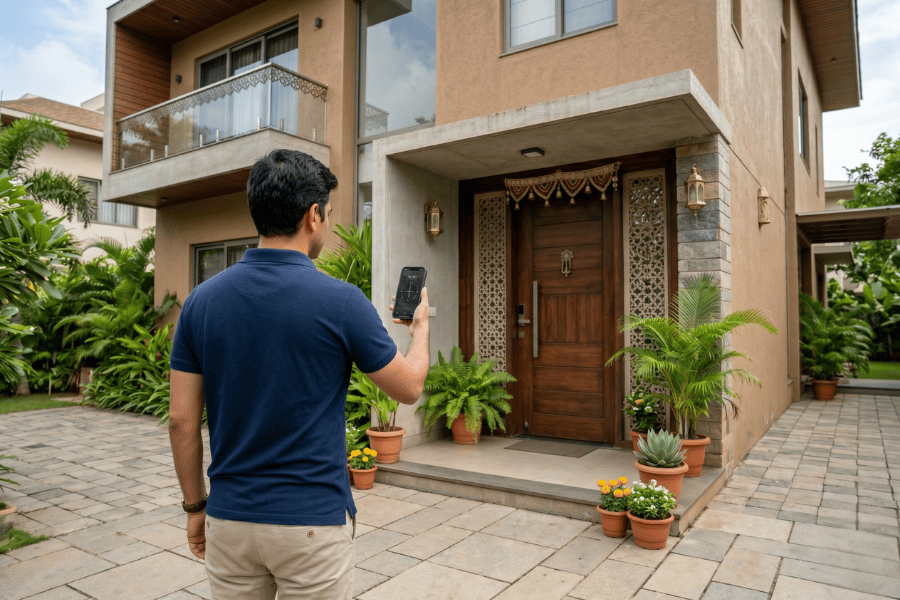
The right way is simple. Stand at the main door and face outward, as if you are leaving the house. The direction you face is the facing direction and orientation of the entrance.
You can use a physical compass or a compass app on your phone. If you use your phone, keep it flat and step away from metal gates, grills or parked vehicles if possible. These can affect the reading.
Take the reading two or three times so you do not rely on a single result.
The Full 16 Vastu Directions
When people talk about direction, they often mention only the main 8 directions. But in actual Vastu assessment, the full 16 directional zones are often considered for better accuracy.
These 16 zones are:
- North (उत्तर)
- North-North-East
- North-East (ईशान)
- East-North-East
- East (पूर्व)
- East-South-East
- South-East (आग्नेय)
- South-South-East
- South (दक्षिण)
- South-South-West
- South-West (नैऋत्य)
- West-South-West
- West (पश्चिम)
- West-North-West
- North-West (वायव्य)
- North-North-West
This is one reason why two east-facing homes may not give the same result. One entrance may sit in a better part of the east wall, while the other may fall into a weaker zone close to the southwest side of the layout or drift too near the Northeast balance line.
How To Check If Your Entrance Follows Vastu
Once you know the direction, the next step is to look at the entrance itself.
Do not stop at saying, “My house is east-facing” or “My door is north-facing.” In Vastu, the exact position of the door on that wall matters as much as the overall direction.
For example, if a home is east-facing but the main door is pushed too far towards the South-East corner, that can change the assessment. In the same way, a south-facing entrance is not judged by fear alone. Its exact placement decides more than the label.
Traditional Vastu consultants may check this through the Vastu Purusha Mandala (वास्तु पुरुष मण्डल) and the 32 entrance divisions. For most homeowners, the practical first step is simpler: check whether the entrance is correctly placed, open, bright and free from pressure. In some homes, expert remedies may be suggested when the position cannot be changed. This is where practical door Vastu becomes useful.
A Quick Way To Assess The Entrance
Look at the entrance and ask:
- Is the area outside the main door clean and easy to approach?
- Is the entrance well-lit?
- Is there clutter, broken items or a dustbin near the door?
- Does the door open smoothly inward?
- Is the main door stronger and more prominent than the internal doors?
- Is there a pole, tree, sharp corner or drain directly in front of the entrance?
These checks may sound basic, but they often reveal the real problem.
A common example is a flat in a good location with a decent direction, but the entrance opens into a narrow, dark corridor with a shoe rack, cleaning buckets and boxes piled nearby. In practical terms, that entrance is not supporting a good flow into the home. The same issue is often seen in an apartment where shared passages make the entry feel cramped or poorly maintained.
Which Entrance Directions Are Usually Considered Better
Some directions are generally preferred in Vastu for the main entrance. But direction should always be read with exact placement.
North, East and North-East are usually treated as favourable. West can also work well in many homes.
South, South-East and North-West need more careful judgement. South-West is usually the least preferred zone for an entrance.
Here is a simple table for quick reference:
| Direction | General Vastu View | What To Keep In Mind |
|---|---|---|
| North | Favourable | Often linked with opportunity and steady movement |
| North-East | Highly favourable | Usually seen as the most sensitive and beneficial zone |
| East | Favourable | Often associated with freshness, light and positive flow |
| West | Can work well | Needs correct placement and a clean, open entrance |
| North-West | Mixed | Can be acceptable in some layouts |
| South-East | Mixed | Needs careful evaluation |
| South | Sensitive | Exact placement matters a lot |
| South-West | Usually avoided | Commonly seen as the least suitable entrance zone |
Check The Main Door, Not Just The Direction
A good entrance is not only about compass reading. The physical condition of the main door also matters.
The door should be strong, stable and easy to use. In many Vastu guidelines, the main door should be the largest door in the house and should open inward in a smooth way. The materials used for the entrance also matter. In many traditional homes, a wooden door is preferred because it gives warmth and a grounded feel.
Avoid a main door that is cracked, shaky, noisy or difficult to open. Also avoid placing the entrance exactly in the corner. Faulty locks should be repaired quickly because a damaged entry point affects both function and the feel of the home.
This is especially relevant in older homes. Many families living in independent houses built 20 or 30 years ago may have a sound structure, but the main entrance may now have rusted fittings, faded polish or poor lighting. These details may seem small, but they affect how the entrance feels every day.
Entrance Décor Matters More Than Most People Think
Once the door placement is checked, look at the entrance setting.
In many Indian homes, the entrance becomes a storage point without anyone planning it that way. Shoes collect near the door. Old pots stay there. A torn toran (तोरण) remains hanging for months. The result is visual and energetic clutter.
Simple, respectful décor works best. Good Vastu tips usually focus on cleanliness, order and elements that support calmness rather than too many decorative objects.
What You Can Keep At The Entrance
A few elements are commonly considered supportive in Vastu:
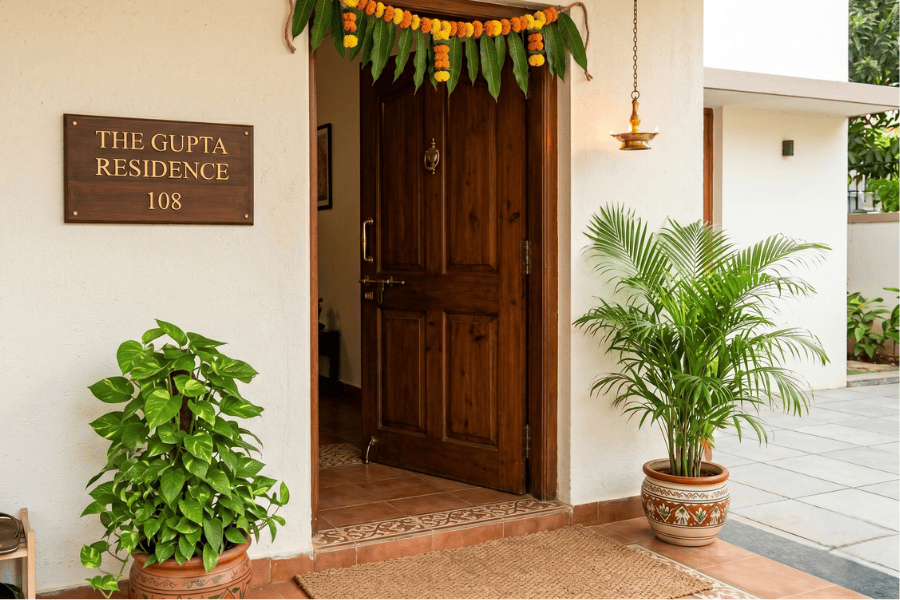
- A neat nameplate
- A visible house number
- A clean doormat
- A traditional toran
- Soft lighting
- Rangoli (रंगोली) on special days or regularly if practical
- Healthy green plants
Sacred symbols such as Om (ॐ) or Swastik (स्वस्तिक) are also placed by many families near the main door. If used, they should be kept clean and made neatly. Some households also place images of deities near the entrance in a respectful way.
Nameplate, Lighting And Plants
A good nameplate adds identity and order. It should be easy to read and in good condition.
Lighting matters just as much. A dark entrance often feels heavy, especially in flats with long corridors or enclosed stair lobbies. Soft, even lighting is usually better than harsh or uneven light.
Plants can add freshness, but keep them healthy. Avoid thorny plants near the entrance. A well-kept money plant is often chosen for this area because many homeowners associate it with growth and abundance. Some families also keep Tulsi near the entrance if the space allows and the plant can receive proper care.
Common Entrance Mistakes That People Overlook
Most entrance Vastu problems are not dramatic. They are small, everyday issues that keep repeating.
These are some of the most common ones:
- Clutter around the main door
- A shoe pile directly at the entrance
- Broken or creaking door fittings
- Poor lighting
- faded symbols or torn decorative items
- Thorny or dried plants
- A dustbin near the door
- A direct obstruction such as a pole or tree in front
- A dark, cramped approach to the entrance
- Damage to the threshold or frame
Many homeowners ignore these because they seem normal. But if you ask people what they notice first when entering a house, it is often cleanliness, light and ease of movement.
Also avoid placing mirrors directly opposite the main entrance, as many Vastu practitioners believe they can bounce incoming energy back out. The position of the staircase near the entrance can also affect how open or heavy the space feels, especially in duplex homes.
Direction-Wise Entrance Guidance For Homeowners
If you are buying or evaluating a home, here is a practical way to think about the main directions.
East-Facing Entrance
An east-facing entrance is often preferred. It is usually considered better when the door sits in a suitable section of the east side and not too close to the South-East edge.
North-Facing Entrance
North-facing entrances are also widely preferred. These often suit homes where the entrance feels open, balanced and properly lit. Natural light from nearby windows can improve the feel of this area.
South-Facing Entrance
A south-facing home should be checked carefully, not rejected immediately. The exact segment of the south wall matters more than the label alone.
This is important because many buyers walk away from a south-facing house out of fear, even when the entrance is not badly placed. A proper assessment gives a fairer picture. The result also depends on how other spaces such as the kitchen and toilets are arranged in the house.
West-Facing Entrance
A west-facing entrance can work well if the door is placed correctly and the entrance area is not dark, heavy or blocked. It also helps when the nearby living room does not feel cut off from light and movement.
Can You Check Home Entrance Vastu Online?
Yes, to a basic level.
You can use a compass app, your floor plan and clear photos of the entrance to do an initial review. This helps you understand the facing direction, the approximate door placement and any obvious issues like clutter, darkness or direct obstruction.
But online checking has limits. It may not fully capture the 32 divisions, the effect of surrounding roads, plot shape or the internal relationship between the entrance and the rest of the layout. For example, nearby water bodies, internal room positions or heavy defects in the South-West can affect the reading. The placement of bedrooms can also change how balanced the home feels overall.
So it is useful for a first check, but not always enough for a final judgement.
A Quick Vastu Checklist For Your Home Entrance
Before you finalise your view of the entrance, do one last quick review.
Check that you have measured the direction correctly by standing at the main door and facing outward. Look at whether the entrance is clean, well-lit and free from clutter. Make sure the main door is in good condition, opens inward smoothly and does not feel cramped or neglected.
Also check that there is no major obstruction directly in front of the entrance, that the nameplate is visible and that any décor, symbols or plants near the door are neat and well maintained.
This quick review is often enough to spot the most common entrance issues in a home and whether the entrance supports peace and fortune.
What To Put At The House Entrance As Per Vastu
This is one of the most common questions homeowners ask.
The answer is simple: keep the entrance clean, balanced and welcoming. The best items are usually the simplest ones.
You can keep:
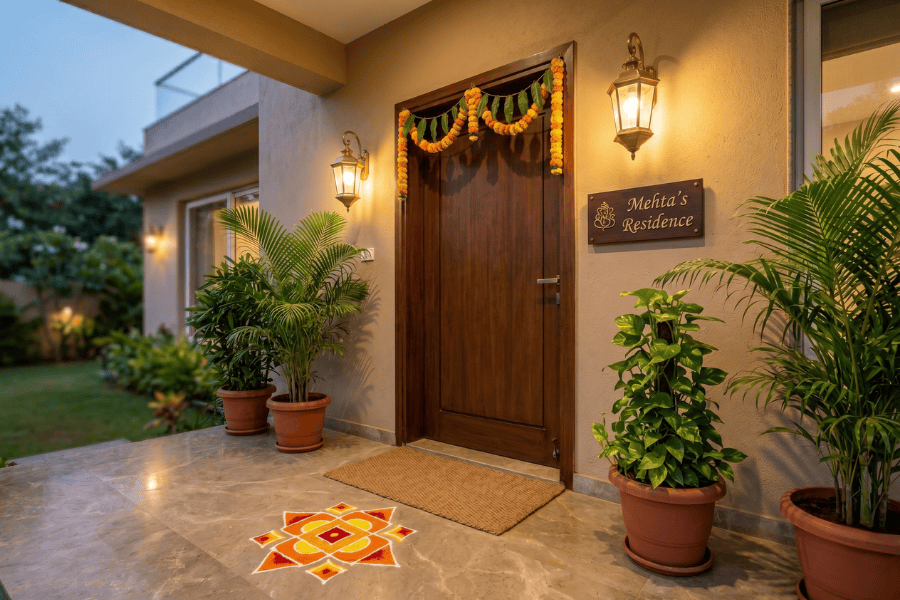
- A nameplate
- A toran
- Rangoli
- Warm lighting
- Sacred symbols used respectfully
- Healthy plants
- A clean mat
What matters most is not how much you place there. It is whether the entrance feels calm, clear and cared for.
Final Thoughts
If you want to know how to check Vastu for home entrance, begin with the basics. Find the exact direction. Check where the door sits on that side. Then look honestly at the condition of the entrance, the lighting, the clutter and the movement around it.
In many homes, the problem is not the direction alone. It is the way the entrance is being used every day.
A small correction can sometimes make the space feel noticeably better. This is especially true in homes where the family wants more peace, less friction and a stronger sense of comfort in daily life.
If you would like expert guidance, Vastu Ananda offers Vastu consultations for plot Vastu, residential Vastu, commercial Vastu, hotel Vastu and office Vastu. We also offer a Vastu basic course and Vastu advanced course for learners who want to study the subject in depth.
FAQs
How Do I Check The Direction Of My Home Entrance?
Stand at the main door and face outward, as if you are leaving the house. Use a compass or a phone compass app to note the direction you are facing. Take the reading two or three times for better accuracy.
Is A South-Facing Entrance Bad In Vastu?
Not always. A south-facing entrance should be checked carefully, but it should not be rejected automatically. In Vastu, the exact segment of the south side where the door is placed matters more than the label alone.
What Should Be Kept At The Main Entrance As Per Vastu?
Simple and clean items work best. A nameplate, toran (तोरण), rangoli (रंगोली), soft lighting, sacred symbols, a clean doormat and healthy plants are commonly used near the entrance as per Vastu.
What Should Be Avoided At The House Entrance?
Avoid clutter, broken items, thorny plants, faded décor, poor lighting, dustbins and large obstructions directly in front of the main door. A noisy, damaged or neglected entrance is also best avoided.
Why Does The Main Entrance Matter So Much In Vastu?
The main entrance is seen as the point where energy enters the home. That is why its direction, placement, condition and surrounding area are all considered important in Vastu Shastra (वास्तु शास्त्र).