Have you ever walked into a kitchen and felt that something was just not working, even though everything looked fine on the surface?
For many homeowners, the problem is not only storage, lighting or layout. The kitchen may feel too cramped, too heated or strangely unsettled. In Indian homes, where the kitchen supports the whole family every day, that feeling matters.
A kitchen is not just a place to cook. It is where the morning begins, where tea is made for guests and where daily care takes shape. In Vastu Shastra (वास्तु शास्त्र), this space is linked with the fire element, so its direction and arrangement are considered important.
That is why kitchen design in Vastu Shastra goes beyond appearance. It looks at the kitchen’s location, the stove position, the sink, colours, storage, ventilation and the way different elements work together.
In many homes, especially flats and ready-built houses, not every rule can be followed perfectly. That is completely normal. The goal is not fear or rigid perfection, but balance that supports daily life in a practical way.
Why Kitchen Design Matters In Vastu Shastra
In Vastu Shastra, every part of the home is linked with a direction and an energy quality. The kitchen is connected with Agni, or the fire element, so it should support warmth, nourishment and activity without creating conflict with water or heavy placement.
This is why Vastu-compliant kitchen design focuses on both the location of the kitchen and the internal layout. The room may look modern and beautiful, but if the basic arrangement feels strained, daily use often becomes difficult too.
Many families notice this in simple ways. Meals feel rushed, the kitchen feels crowded, the stove and sink clash or the room remains dark even in the daytime. These are practical issues, but in Vastu, they also point to imbalance.
When the kitchen is planned well, the space usually feels easier to use. Cooking becomes smoother, movement is more natural and the room feels calmer.
Which Kitchen Direction Is Best As Per Vastu?
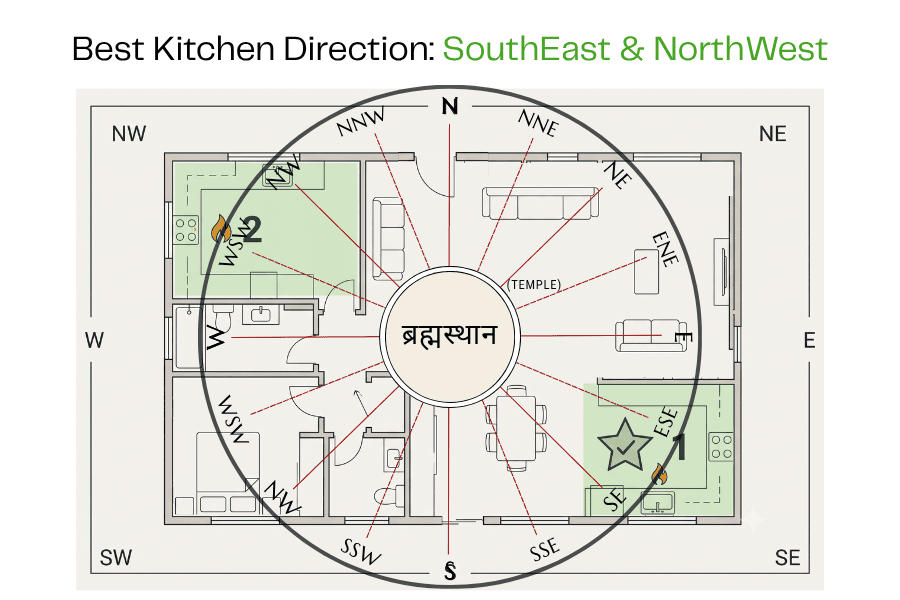
The first thing to understand is the directional framework used in Vastu. Most people know the eight main directions, but traditional Vastu also studies sixteen directional zones.
These sixteen zones are: north, north-north-east, north-east, east-north-east, east, east-south-east, south-east, south-south-east, south, south-south-west, south-west, west-south-west, west, west-north-west, north-west and north-north-west.
For kitchen planning, the south-east zone is the most preferred because it is governed by the fire element. This makes it the most suitable location for cooking.
If south-east is not available, north-west is usually considered the second best option. Many Indian flats and builder floors use this as a practical alternative.
The north-east is usually avoided for kitchens because it is associated with calmness, clarity and prayer. The south-west is also not ideal because it is considered a heavy and stable zone, which does not match the active nature of a kitchen.
Best And Less Suitable Kitchen Directions
| Direction | Vastu View | Practical Meaning |
|---|---|---|
| South-East | Best | Most suitable for kitchen placement |
| North-West | Good alternative | Acceptable when South-East is not possible |
| East Or West | Conditional | Can work with proper internal layout |
| North-East | Usually avoided | Fire energy may disturb this zone |
| South-West | Usually avoided | Too heavy for kitchen activity |
A simple real-life example is a couple buying a flat where the kitchen is already fixed by the builder. They may not be able to change the room itself, but they can still improve how the fire and water areas are arranged inside it.
North-Facing Kitchens And Northwest Kitchen Remedies
A north facing kitchen vastu concern usually comes up in apartments and compact homes where the kitchen falls in the northern section of the house.
This is not usually the first choice in Vastu because the north is not the natural zone for the fire element. Still, it does not mean the kitchen is doomed or unusable.
In such cases, the internal layout becomes more important than panic. If possible, place the stove in the south-east part of the kitchen itself and try to cook facing east.
The same applies to what many people call northside kitchen vastu. The advice is mostly about correction, not fear.
A north-west kitchen is generally more acceptable. In fact, it is often treated as the second best option after south-east.
Still, some north-west kitchens feel restless or unsteady in everyday use. In such homes, simple northwest kitchen vastu remedies can help. Keep the space well ventilated, avoid very dark colours and maintain a clear separation between the stove and sink.
Clutter matters here more than people think. A technically good kitchen that stays crowded and messy often feels worse than an average kitchen that is clean and balanced.
Kitchen Entrance, Ventilation And Basic Layout
Once the kitchen location is understood, the next step is the working layout. This is where many good kitchens either become practical or frustrating.
The entrance should allow smooth movement. In general, east, north or west openings are commonly accepted, while awkward corner entries are less preferred.
Ventilation is equally important. A kitchen that traps heat, smoke and moisture can quickly become uncomfortable, especially for older homeowners who spend long hours cooking.
An east-facing window is often considered helpful because it allows light and freshness in the morning. Even if the exact direction cannot be chosen, natural light and airflow should always be improved where possible.
The slab and floor also affect how the kitchen feels. Light flooring usually keeps the room open and easy to maintain. A slab that leaves enough working space between the hob, sink and preparation area supports both comfort and balance.
Stove Direction, Hob Position And Cooking Direction
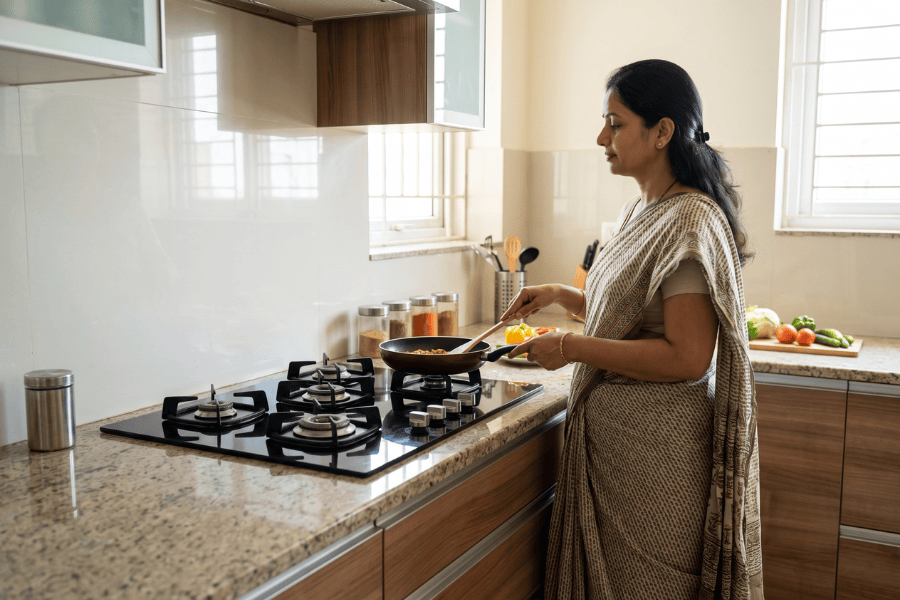
The stove is the centre of the kitchen in Vastu because it directly represents fire. This is why gas stove direction as per vastu is one of the most important topics in kitchen planning.
The usual guidance is to place the stove in the south-east part of the kitchen. The person cooking should ideally face east.
This is one of the most repeated points in well-known Vastu guidance because it is practical and easy to apply. In many homes, even a small shift in stove placement can improve the feel of the kitchen.
Think of a typical family home where one person cooks while another washes vegetables right beside the stove. The area becomes crowded, hot and stressful. A better layout immediately feels calmer.
Can We Place Gas Stove In North Direction?
This is a very common question, especially in modular kitchens where the counter is already fixed.
In most cases, placing the gas stove in the north direction is not preferred. North is not usually recommended for the fire element.
If there is no other option, then focus on reducing the imbalance. Keep the stove zone clean, avoid placing water right next to it and try to maintain an east-facing cooking position where possible.
Hob Position As Per Vastu
The same principle applies to a built-in hob. Hob position as per vastu should follow the same logic as gas stove placement.
The hob should ideally sit in the south-east area of the kitchen platform. It should not be directly under a beam, and it should not be pressed too close to the sink.
A good rule is simple: the cooking zone should feel settled, not squeezed.
3 Burner Gas Stove Vastu: 3 Burner Vs 4 Burner
Many homeowners now ask about 3 burner gas stove vastu or 3 burner vs 4 burner gas stove vastu when designing a modular kitchen.
In practice, burner count matters less than proper proportion. A 3 burner stove is often enough for a medium kitchen. A 4 burner stove is also fine if the slab is large enough.
The real concern is whether the stove dominates the counter and reduces working space. A kitchen should not feel overloaded just because a larger unit seems more modern.
Sink, Drinking Water And The Fire-Water Balance
One of the basic Vastu rules is to keep fire and water apart as much as possible.
The stove represents fire. The sink, water purifier and drinking water area represent water. When these sit too close together, the kitchen can feel visually and functionally mixed up.
The sink is often better placed in the north or north-east part of the kitchen. Drinking water can also be kept in these zones if the layout allows it.
This is often a real issue in city homes. In a small flat, the builder may place the sink and stove side by side to save space. If that happens, even a modest gap between the two is better than direct contact.
Storage, Refrigerator And Electrical Appliances
Storage should support order and ease. Heavy storage units are often better in the south or west side of the kitchen, where they do not interrupt movement.
Daily-use items should remain easy to reach. This is especially important for homeowners in their 50s and 60s, because constant bending, stretching or lifting from awkward places makes the kitchen harder to use.
The refrigerator is often placed in the west, south-west or north-west depending on the available space. It should not block the entry or narrow the passage around the cooking area.
Other electrical appliances such as microwaves, grinders, ovens and mixers are generally more suitable in the south-east zone because they align better with active and heat-related use.
Best Colours For Kitchen As Per Vastu
Colour has a strong effect on mood. In a kitchen, it can also change how warm, clean or heavy the room feels.
| Good Kitchen Colours | Why They Work |
|---|---|
| Cream | Feels light and clean |
| Beige | Adds warmth without heaviness |
| Soft Yellow | Brings brightness and energy |
| Peach | Supports warmth gently |
| Light Green | Feels fresh and balanced |
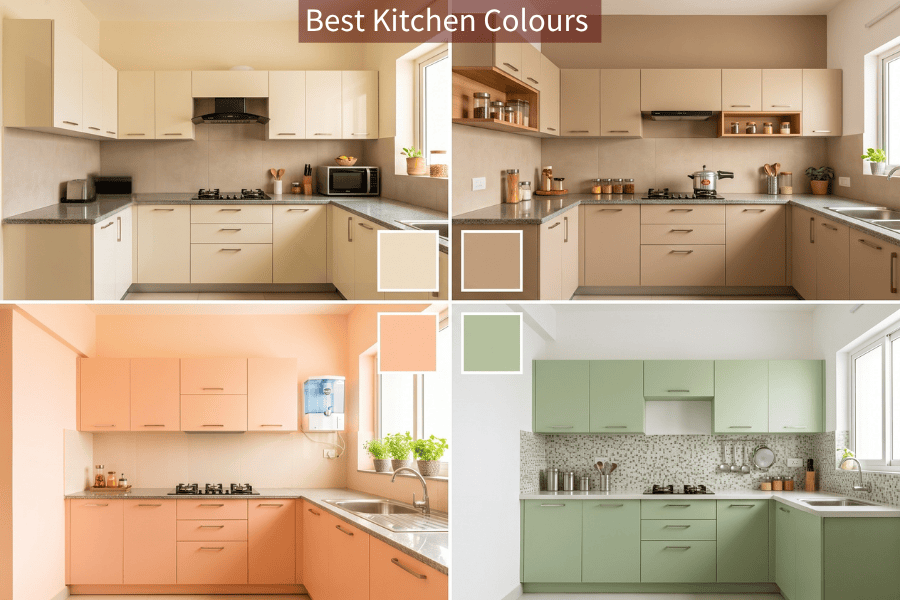
According to vastu which colour is good for kitchen, the usual answer includes light and warm shades. Soft yellow, cream, beige, peach and gentle green are commonly recommended.
These colours work well because they feel calm, bright and welcoming. They also suit Indian kitchens where the space is used every day for long periods.
The best colors for kitchen slabs as per vastu are usually the ones that create warmth without making the room feel dark or intense. Light cabinet finishes, warm neutrals and soft earthy tones are often the safest choices.
| Colours To Avoid Or Limit | Why They Need Care |
|---|---|
| Black | Can feel too heavy in large amounts |
| Dark Blue | Strongly linked to the water element |
| Dark Grey | May make the space feel dull |
| Deep Purple | Can feel too intense |
| Harsh Metallic Shades | May make the kitchen feel cold |
Everyday Kitchen Vastu Tips For Existing Homes
Not every family can rebuild or redesign the kitchen. That is why simple corrections matter.
If your kitchen is already built, focus first on what can be improved without major work. Keep the stove clean, fix leaking taps, reduce clutter with a well-placed dustbin, and improve light and ventilation.
These may seem like small things, but they have a strong effect on how the kitchen feels. A dark, crowded kitchen is tiring to work in, even if it is in a good direction.
Here are a few simple steps that help in most homes:
- Keep the cooking area clean and active
- Avoid storing broken or unused items in the kitchen
- Leave some gap between the stove and sink
- Use light, warm colours where possible
- Improve ventilation with windows or exhaust systems
- Keep heavy storage away from the main work area
In many Indian homes, especially older homes, the kitchen slowly becomes a storage room for extra jars, old utensils and rarely used machines. Clearing these out often improves the space immediately.
Which Direction Should You Face While Eating?
This is a smaller topic, but many homeowners still ask about it.
Traditional guidance often suggests facing east or north while eating. East is associated with clarity and vitality, while north is linked with support and steadiness.
This should not become a source of stress. The more important thing is that meals are eaten in a calm, clean and settled environment.
Final Thoughts
A good kitchen should support daily life with ease. That is the heart of kitchen design Vastu Shastra.
The most important principles are simple: choose the right kitchen direction where possible, place the stove carefully, separate fire and water, allow light and ventilation and use balanced colours.
Even if your kitchen is already built, practical changes can still make a difference. In many cases, small improvements in layout, storage and maintenance do more than people expect.
If you would like expert guidance, Vastu Ananda offers vastu consultations for plot vastu, residential vastu, commercial vastu, hotel vastu and office vastu. We also offer a vastu basic course and a vastu advanced course for learners.
FAQs
Which Is The Best Kitchen Direction As Per Vastu?
The south-east is widely considered the best direction for the kitchen. North-west is usually the second best option.
Can We Place Gas Stove In North Direction?
It is generally not preferred. If it cannot be avoided, try to maintain balance by keeping water away from the stove and using the space carefully.
What Is The Ideal Hob Position As Per Vastu?
The hob should ideally be placed in the south-east part of the kitchen platform with enough free space around it.
Which Colour Is Good For Kitchen According To Vastu?
Cream, beige, soft yellow, peach and light green are commonly recommended.
What Is A Simple Remedy For Kitchen Vastu Defects?
The most useful remedies are better stove placement, separation of fire and water, decluttering, good ventilation and suitable colours.