
Have you ever walked into a house and felt unsure, even when everything looked fine on paper?
This happens more often than people admit. A flat may have a good location and a fair price, but something still feels off. For many Indian families, that is the moment when questions about Vastu Shastra (वास्तु शास्त्र) begin.
Often, the worry starts just before a big decision. A couple may be about to pay the token amount. Parents in their 50s or 60s may be helping choose a retirement home. Someone may already be living in the house and wondering why the space never feels settled.
That is why it helps to know how to check Vastu properly. Not through random tips or fear, but through a clear process. You look at the direction, the entrance, the centre of the home and the placement of each room to understand the overall energy flow.
This guide explains that process in a simple way. It is written for Indian homes, including flats, villas and independent houses.
Why People Check Vastu Before Saying Yes to a House
In India, Vastu is often part of how families judge a property. It matters before buying, before moving in and sometimes before renovating.
For some, it is about faith and tradition. For others, it is about wanting a home that feels balanced, practical and comfortable.
A common example is a family visiting two flats in the same building. One may feel bright, open and easy to imagine living in. The other may feel heavy or awkward, even with the same square footage. Vastu is one way people try to understand that difference.
A proper check can help you:
- Understand if the house layout supports daily life
- Notice major issues before making a commitment
- Separate small concerns from serious planning problems
- Decide whether the home is workable as it is, or needs changes
The aim is not to reject every house with one flaw. The aim is to assess the full picture.
First, Understand What You Are Actually Checking
Before checking any property, it helps to know what Vastu is looking at.
Vastu Shastra (वास्तु शास्त्र) studies how direction, placement and spatial balance affect a built space. In practical house checks, this usually means the entrance, the centre of the home, room placement, open areas and the way the house is used.
Direction plays a major role. Many people know the four main directions and the four corner directions, but deeper Vastu analysis may also refer to 16 zones. These include North, North-North-East, North-East, East-North-East, East, East-South-East, South-East, South-South-East, South, South-South-West, South-West, West-South-West, West, West-North-West, North-West and North-North-West.
The centre of the house is called the Brahmasthan (ब्रह्मस्थान). This is usually treated as a sensitive zone and is best kept open, clean and light.
Room function matters too. A kitchen, a bedroom and a pooja room are not judged in the same way. That is why a proper Vastu check is always done step by step, following core Vastu principles.

What You Need Before You Begin the Check
Do not begin with remedies or assumptions. Start with clear details.
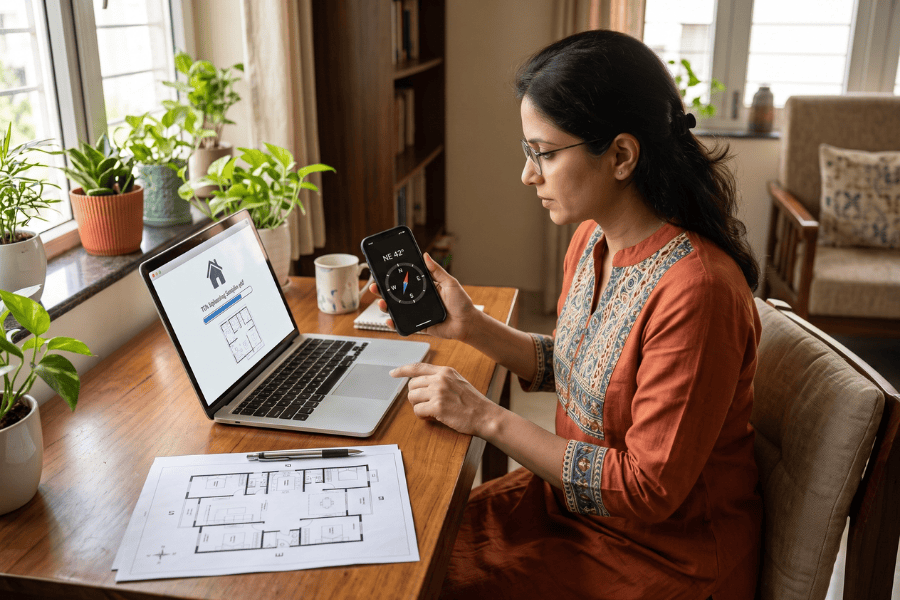
You will need the floor plan or a rough layout of the house. You also need a compass, either physical or on a mobile phone, to identify the correct North direction.
It also helps to know the type of home you are checking. Flats, villas and independent houses follow the same core principles, but the way you assess them can differ.
Here is a simple starting point:
| What You Need | Why It Matters |
|---|---|
| Floor Plan Or House Layout | Helps you map the entrance, centre and room positions |
| Compass Or Mobile Compass App | Helps you mark the correct North direction |
| Home Type Details | Flats, villas and independent houses need slightly different checks |
| Notes On Actual Room Use | A room may be used differently from the original plan |
| Entrance And Surrounding Details | Important for judging access, openness and flow |
Many mistakes happen because people skip this stage. They begin with one room, or they depend on what the broker says, without checking direction properly.
How To Check Vastu for a House Step by Step
The best way to assess a house is to move in order. If you jump between the bedroom, the main door and the kitchen without mapping the house first, the check becomes confusing.
Step 1: Start With the Plot or Overall Shape
If you are checking an independent house or a villa, begin with the plot. Regular shapes such as square and rectangle are usually considered easier to work with than irregular ones.
Also look at the road position, open space around the house and any major imbalance in the site. If one side feels heavily cut off or extended, make a note of it.
For flats, focus on the shape of the unit. Severe cuts or missing corners can affect how the home is assessed.
Step 2: Find the Exact North Direction
This step is essential. If the direction is wrong, the rest of the analysis can also go wrong.
Use a compass and mark North on the floor plan. When checking the entrance, stand at the main door and face outwards. This gives you the facing direction in a practical way.
This is where many buyers make simple mistakes. For example, a family may assume a flat is East-facing because sunlight enters in the morning, but sunlight alone is not enough to confirm direction.
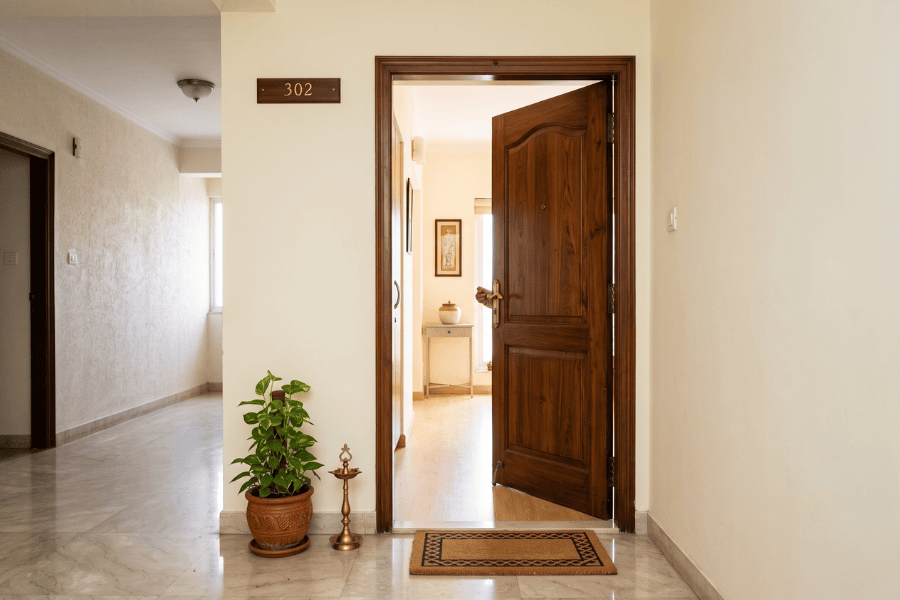
Step 3: Check the Main Entrance Carefully
The main entrance is one of the first things people notice in Vastu. Many Indian references and property guides consider North, East and North-East more favourable for the main door.
But direction is not the only factor. The entrance should also be clean, well lit and easy to open. A broken door, a noisy hinge or a cluttered threshold may also count against the space.
Ask simple questions:
- Is the entrance direction clear?
- Does the door open smoothly?
- Is there clutter, a dustbin or blockage right outside?
- Does the entrance feel dark or cramped?
A retired couple choosing a downsizing home may not be thinking in technical terms, but they often notice if the entrance feels welcoming or uneasy. That instinct is worth paying attention to because it often affects how the home’s energy is experienced day to day.
Step 4: Find the Brahmasthan
After the entrance, locate the Brahmasthan (ब्रह्मस्थान), or the centre of the home.
A simple way to do this is to divide the layout into equal sections and identify the middle zone. This central area should ideally remain open and free from heavy storage or obstruction.
If the centre is blocked by a large built-up element, heavy clutter or an awkward use of space, make a note of it. This is a common issue in modern homes and may affect the sense of positive energy in the house.
Step 5: Review Each Important Room
Once the basic layout is clear, move to the room-by-room check.
This is the stage where you assess whether the kitchen, bedrooms, bathrooms, pooja room and living room are in suitable zones. You also look at how they are arranged inside.
A Room-by-Room Vastu Check That Actually Helps
This part is where most homeowners spend the most time. That makes sense, because room placement affects daily life directly.
Still, each room should be checked in relation to the full plan, not in isolation.
Living Room
The living room is often preferred in the North, East or North-East. In some cases, North-West is also treated as workable.
What matters in practice is whether the room feels open, receives light and allows movement without too much heaviness. Large furniture is often better placed towards the South or West side of the room.
Kitchen
The kitchen is linked with the fire element, so its zone matters. South-East is widely treated as the preferred placement. North-West is often seen as the next practical option.
Inside the kitchen, look at the stove and sink. They should not be pressed tightly together if possible, because fire and water are treated as conflicting elements.
This is a very common issue in city flats. A buyer may accept a compact kitchen, but still want to know whether the basic layout is manageable.
Bedrooms
The master bedroom is commonly preferred in the South-West zone. For sleeping, many Vastu references advise keeping the head towards the South or East rather than North.
Bed placement also matters. A bedroom may be in the right zone, but still feel cramped if the bed is forced into a poor position or if mirrors and storage create visual heaviness. For older homeowners especially, a restful bedroom is closely tied to comfort and health.
Bathrooms and Toilets
Bathrooms and toilets are a major concern in many flat layouts. North-West and West are commonly treated as more suitable than North-East or South-West.
Check ventilation, drainage and cleanliness as well. Even from a practical point of view, a poorly placed or badly maintained bathroom can affect how the whole home feels.
Pooja Room
The pooja room is usually preferred in the North-East, or sometimes East. It should feel calm, clean and separate from heavy activity.
Balcony, Dining Area, Windows, Doors and Water Placement
These details matter too, but they should come after the main checks above.
Balconies in the North or East are often considered more favourable. Windows should support light and airflow. Water placement should also be reviewed with care, especially in larger homes.
Small details can influence comfort more than people expect. Even choices around colors, natural light and simple plants in the right area can change how a space feels, though they should not be used to hide major layout issues.
How To Check Vastu in Flats, Villas and Independent Houses
The process is the same, but the focus changes depending on the home type.
Flats and Apartments
In flats, you usually cannot change the structure much. So the most important checks are the entrance, direction of the unit, the centre of the flat and the placement of key rooms.
This is why flat buyers often do a quick Vastu check just before booking. They want to know if the home is broadly workable without major changes.
Independent Houses
Independent houses allow a fuller review. You can assess the plot, open spaces, slope, staircase, water placement and the overall room arrangement.
This gives a much deeper Vastu picture than a flat.
Villas
Villas combine both types of assessment. You need to check the plot, the entrance and the room layout, but also the staircase, parking, terrace and use of upper floors.
In many cases, a villa may seem fine at first glance, but the full layout across floors tells a different story.
Common Vastu Problems People Notice in Real Homes
Most homes are not perfect. The key question is whether the issue is small, manageable or serious.
Here are some common concerns:
- Entrance in a weak zone
- Kitchen in the wrong area
- Toilet in a sensitive zone
- Blocked Brahmasthan
- Missing corners or an irregular layout
- Wrong room use compared to the ideal zone
Some issues are easier to handle through better space use, decluttering or practical internal changes. Others are more structural and need a closer review.
| Common Issue | What To Check |
|---|---|
| Main Door Problem | Direction, lighting, clutter and door condition |
| Kitchen Concern | Zone, stove position and sink placement |
| Toilet Issue | Exact location, drainage and ventilation |
| Centre Of Home Blocked | Heavy storage, pillars or built-up obstruction |
| Bedroom Problem | Room location, bed placement and sleeping direction |
| Irregular Layout | Missing corners, sharp cuts and awkward room use |
A useful rule is this: do not panic over one defect, but do not ignore a pattern of issues either.
For many families, the real question is not whether a house is perfect. It is whether the home supports peace of mind, stability and long-term prosperity.
Can an Online Vastu Check Tool Help?
Online Vastu tools are now common, especially for flats and ready floor plans.
Most work in a similar way. You upload the floor plan, mark the direction, sometimes set the boundary and then receive a report or score.
This can be helpful in the early stage. It gives you a rough idea of the layout, the centre and the room zones.
But online tools have limits. They may not understand how the house is actually being used. They may not capture the surroundings. They also depend on the user marking the direction correctly.
So yes, online Vastu checks can help. But for an important property decision, they work best as a first screen rather than the final word.
A Simple Vastu Checklist Before You Buy or Move In
If you want a quick self-check, use this order:
- Confirm The North Direction
- Check The Main Entrance
- Find The Centre Of The Home
- Review The Kitchen Zone
- Check Bedroom Placement
- Examine Bathrooms And Toilets
- Note Balcony, Windows And Water Placement
This helps you stay focused on the main topic: how to check Vastu for a house in a practical, organised way.
Can a House Become More Vastu Compliant?
Not every problem needs demolition or expensive reconstruction. Sometimes the better approach is to review room use, improve openness, reduce clutter or correct internal placement.
At the same time, some layout issues are more fundamental. That is why a house should be judged as a whole, not through one isolated rule.
Many homeowners are really asking whether a home will support family comfort, financial stability and even wealth over time. A balanced assessment is more useful than a dramatic answer.
If you want a deeper property review, Vastu Ananda offers consultations for plot Vastu, residential Vastu, commercial Vastu, hotel Vastu and office Vastu. They also offer a Vastu basic course and a Vastu advanced course for learners.
Final Thoughts
A house often becomes one of the biggest decisions a family makes. That is why uncertainty around Vastu can feel personal, not just technical.
The best way to check Vastu is to stay calm and methodical. Start with the layout, confirm the direction, review the entrance, locate the centre and then assess the rooms one by one.
That approach gives you something much more useful than generic tips. It helps you make a grounded decision about whether the home feels balanced, practical and right for the people who will live in it.
FAQs
How Can I Check the Vastu of My House Myself?
Start with a floor plan and a compass. Mark the North direction, check the main entrance, locate the Brahmasthan and then review the kitchen, bedrooms, toilets and pooja room.
How Do I Know the Direction of My Flat as per Vastu?
Use a compass and check the direction at the main entrance. In most practical checks, you stand at the main door facing outwards and then mark that direction on the layout.
Is Vastu Different for Flats and Independent Houses?
The basic principles are the same, but independent houses need a fuller plot-based review. Flats rely more on entrance, room placement and internal balance.
Are Online Vastu Checkers Accurate?
They can be useful for an initial review, especially for floor plans. But they should not be treated as the final answer for a major property decision.