A wall clock may look like a simple everyday object, but in Vaastu Shastra (वास्तु शास्त्र), it carries symbolic weight. It represents time, movement and the rhythm of daily life. Because of that, its direction, condition and placement can affect the overall feel of a space.
Vastu principles often focus on order, function and energy balance. A well-placed clock supports this sense of flow, while a broken, badly placed or neglected one can create visual and mental discomfort.
This guide will walk you through the significance of wall clocks in Vastu, the best directions to choose, room-by-room placement tips for the home, practical design advice and the main mistakes to avoid.
Why Wall Clocks Matter in Vaastu Shastra
In Vastu Shastra, time is linked with movement and progress.
A wall clock symbolises how smoothly life is moving inside a home.
A stopped wall clock is commonly seen as a sign of stagnation and a cracked or dusty one suggests neglect. On the other hand, a clean and correctly placed one supports a sense of routine, clarity and steady growth.
That is why Vastu places importance on three things:
- Where the wall clock is placed
- Whether it is working properly
- Whether its design feels balanced and pleasant
Best Wall Clock Direction As Per Vastu Principles
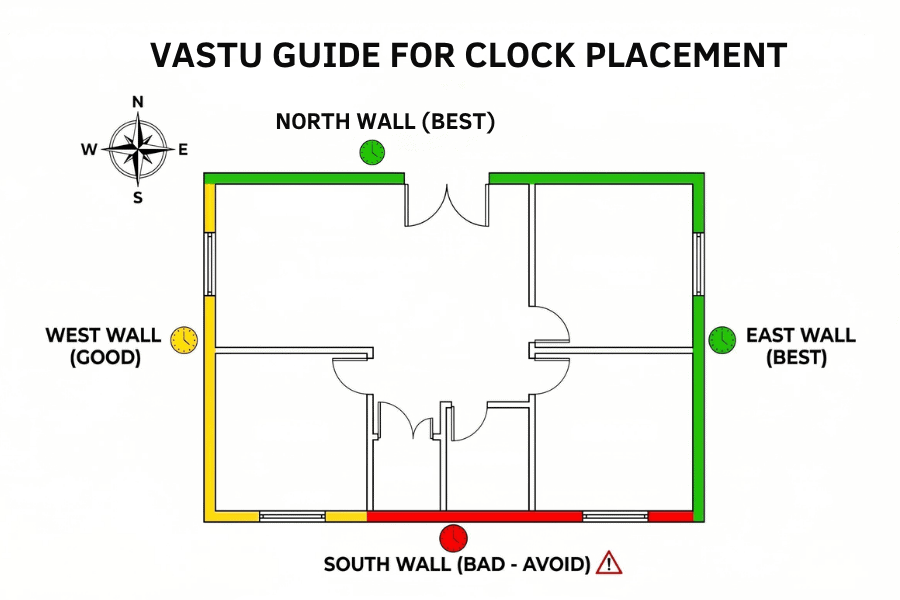
The direction is the most important point in this topic.
| Wall Clock Direction | Vastu View | Interpretation |
|---|---|---|
| North | Most favourable | Linked with prosperity and smooth financial flow |
| East | Favourable | Linked with freshness, health and positive beginnings |
| West | Acceptable in some homes | Seen as stable, though usually not the first choice |
| South | Best avoided | Often associated with heaviness, delay and imbalance |
North
The North direction (उत्तर) is widely considered the best placement for a wall clock.
In Vastu Shastra, this direction is associated with Lord Kubera (कुबेर देव), the deity linked with wealth and prosperity. Because of this, a clock on the North wall is believed to support financial stability and forward movement.
This is a strong option for both homes and offices.
East
This is another very good choice. The East direction (पूर्व) is linked with sunrise, light and new beginnings. In practical terms, it suits areas where you want freshness, alertness and a positive daily rhythm.
Bedrooms, study rooms and living rooms can all work well with a clock placed on the East wall.
West
The West direction (पश्चिम) is sometimes accepted as a secondary option when North or East directions are not available. If you use the West wall, keep the rest of the features simple and balanced.
South
The South (दक्षिण) wall is generally not recommended for wall clock placement. It is often linked with stagnation, unwanted stress or a heavier energy.
Wall Clock Placement for Different Areas of the Home
Once the wall clock direction is chosen, the next step is placement by room.
Bedroom
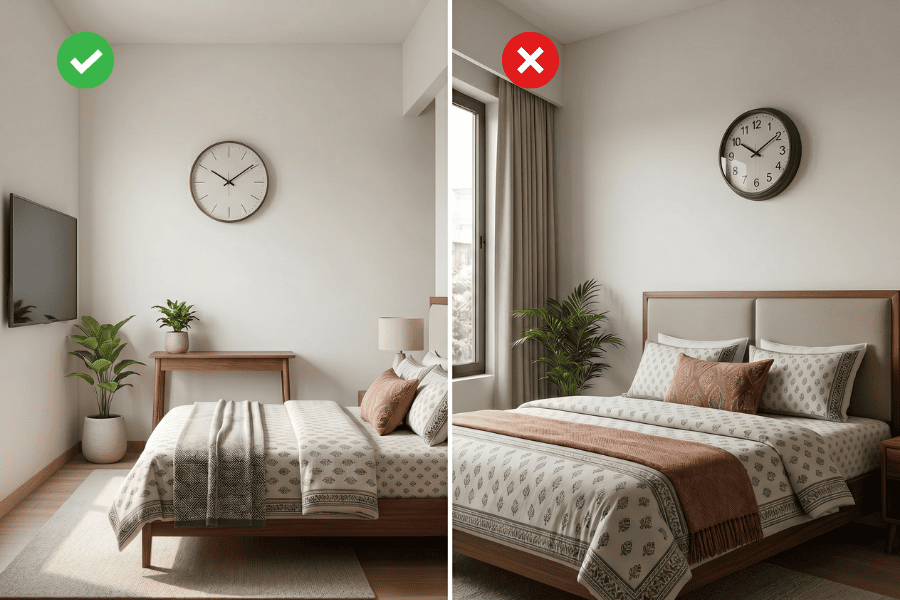
A wall clock in the bedroom should be kept visible but not placed directly in front of the bed. It’s best to avoid reflective glass from facing the bed.
Bedrooms are meant for rest so very loud ticking sounds should also be avoided. If you use a pendulum clock, it is better placed in another room.
Living Room
The living room is one of the best places for a wall clock. In many homes, this is the easiest space to place a clock in a central but balanced way.
Choose a clock that is easy to read and proportionate to the wall size. The living room can also handle slightly larger designs, as long as they are not too dark, damaged or visually harsh.
Study Room
In a study room or home office, the clock should help support focus and order.
The North wall is usually the strongest office placement because it is linked with wealth and career support. The East wall is especially suitable for students and learning spaces because it is associated with clarity, alertness and fresh energy flow.
It is also important to keep the clock design simple. Study room elements should not distract attention or create noise.
Kitchen
A wall clock in the kitchen is acceptable when placed carefully. It should be easy to see while working, but it should not dominate the room. Avoid placing it too close to heat, smoke or grease-heavy areas.
Entrance
This is an area where caution is important. Vastu Shastra advises against placing a wall clock directly above the main entrance or facing the main door. This position can create a feeling of pressure or rushing energy.
If you want a clock near the entrance, place it on a nearby wall rather than over the doorway itself.
Additional Tips for Wall Clock Placement
Design details also matter and they help complete the overall Vastu effect.
Design
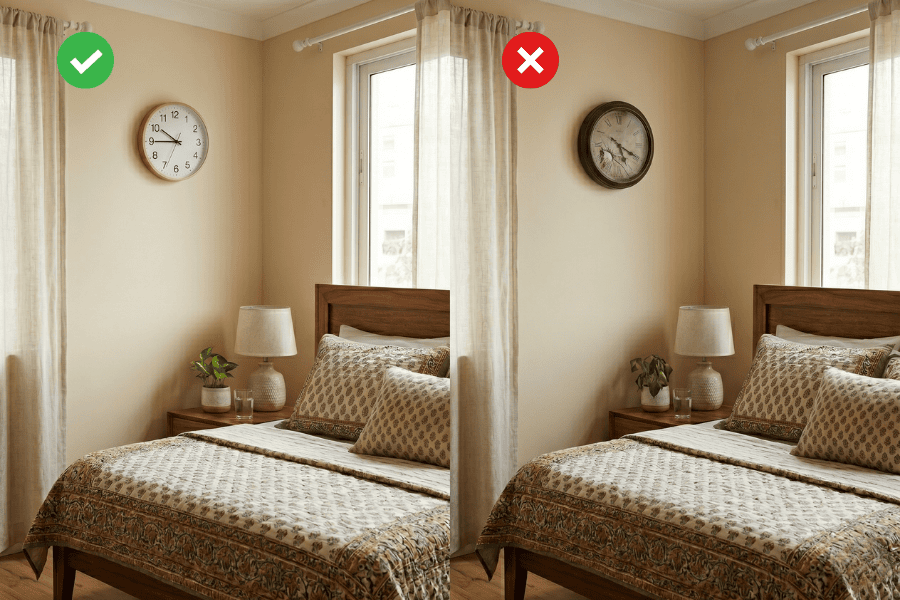
Choose a design that feels calm, clean and easy to live with. Avoid clocks with disturbing imagery, aggressive themes or very cluttered detailing.
Shape
Circular and square shapes are the most commonly recommended. They feel balanced and visually stable. Round clocks are especially popular in Vastu discussions because they suggest continuity and natural flow.
Avoid very irregular, sharp or triangular shapes where possible.
Colour
Light and soft colors are generally preferred. White, beige, light grey, sky blue and some wooden tones are often considered suitable.
Very dark or dull shades are commonly discouraged, especially if they make the wall feel heavy.
Condition
This point is non-negotiable. Never let a clock lag, stop or remain damaged. It should be:
- working properly
- clean
- free from cracks
- set to the correct time or a few minutes ahead
Number
Do not overcrowd the home with too many wall clocks. They can create mental clutter and a constant feeling of urgency.
Common Mistakes To Avoid
Many people often repeat these small mistakes:
- Placing the clock on the South wall
- Hanging it above the main door
- Using a broken or stopped wall clock
- Keeping a dusty or cracked wall clock
- Choosing irregular or harsh shapes
- Putting a loud ticking clock in the bedroom
- Using too many clocks in one area
- Placing it where it directly faces or dominates a doorway
Wall Clock Vastu at a Glance
| Element | Best Practice | Avoid |
|---|---|---|
| Wall Clock Direction | North (उत्तर) or East (पूर्व) | South (दक्षिण) |
| Shape | Round or square | Irregular or sharp-edged shapes |
| Colour | Light, soft or natural shades | Very dark or dull tones |
| Condition | Clean, accurate and working | Broken, cracked or stopped |
| Placement | Visible internal wall | Above the main door |
Final Thoughts
Wall clock Vastu is really about balance, order and mindful placement. A clock should support the rhythm of the home, not disturb it. When selected carefully and placed with thought, it becomes a small but meaningful part of a calm and well-balanced space.
If you want personalised guidance for your home or workplace, Vastu Ananda offers vastu consultations for plot vastu, residential vastu, commercial vastu, hotel vastu and office vastu, along with a vastu basic course and vastu advanced course for learners.
FAQs
1. Which direction is best for a wall clock as per vastu principles?
The North direction (उत्तर) is generally considered the best. The East direction is also highly favourable.
2. Why is the South wall avoided for wall clocks?
In Vastu, the South direction (दक्षिण) is often linked with heavy or unfavourable energy. This is why it is commonly avoided for clock placement.
3. Is it good to keep a wall clock in the bedroom?
Yes, as long as it is placed on the North or East wall and does not have loud ticking or reflective glass facing the bed.
4. Can a broken clock affect vastu?
A broken or stopped clock is widely seen as a symbol of delay and stagnation. It should be repaired or removed.
5. How many wall clocks should a home have?
There is no fixed number, but it is best not to overdo it. Keep only the clocks you actually need.
6. Are pendulum clocks good as per vastu shastra?
Pendulum clocks are generally better suited for living rooms or common areas. They shouldn’t be placed in in bedrooms, where their movement or sound may disturb rest and create discomfort.