Have you ever stood at the entrance of a house and felt that something was not right?
Many homeowners feel this at a T-point property. The road comes straight toward the house, the headlights hit the gate at night, privacy feels weak, and the mind does not settle easily. Couples planning retirement homes and families buying a permanent house often pause at such plots and ask one question: Will this house bring peace or pressure?
A T-point house needs careful attention because it receives a direct road thrust. This can affect health, finances, peace of mind and family stability.
Still, not every T-point house gives the same result. The direction of the road, the entrance placement, the plot shape and the internal layout all matter. With proper analysis, Vastu principles and remedies, many T-point houses can be improved.
What a T-Point House Means in Vastu
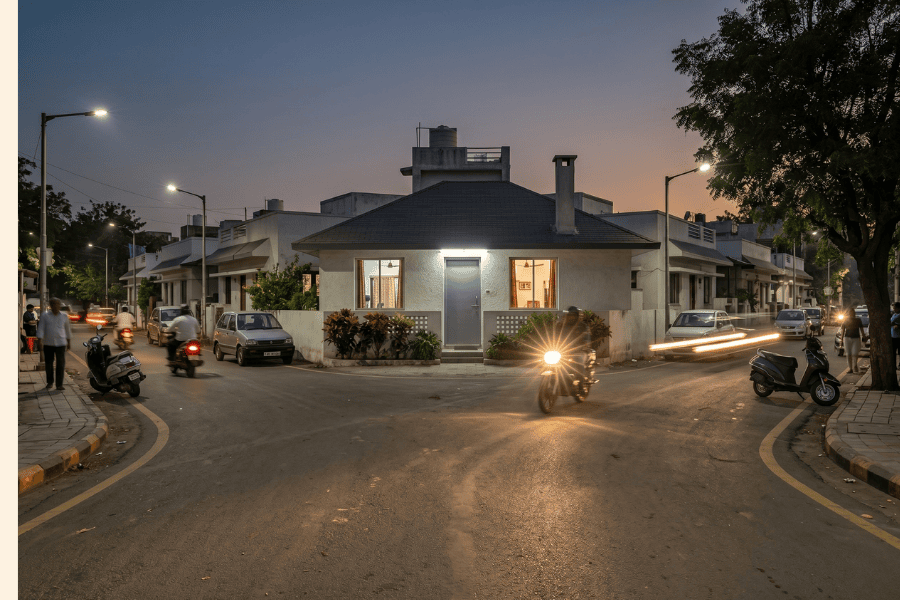
A T-point house stands where one road ends and meets another, with the moving road hitting the plot or house directly. This is also called a T-junction house.
In Vastu, a road is not just a traffic path. It carries movement, force and subtle energy. When that force strikes a property head-on, it creates pressure on the house and disturbs the natural energy flow.
This is known as Veedhi Shoola. “Veedhi” means road, and “Shoola” means spear. So the road acts like a spear pointed at the home.
That is why some T-point houses feel exposed from the start. A family may like the size of the house and the location, yet still say, “The front feels too open” or “The house does not feel settled.”
Vastu studies these effects through directions and zones. On a detailed level, the plot is assessed through 16 directional zones.
These zones connect with the five elements: Earth (पृथ्वी), Water (जल), Fire (अग्नि), Air (वायु) and Space (आकाश). When a direct road thrust disturbs these zones, the balance of the house also gets disturbed and negative energy starts building in the affected area.

Why a T-Point House Feels Challenging
A T-point house feels challenging because the incoming force is sharp and concentrated. Instead of energy flowing smoothly around the home, it rushes straight into one zone.
This creates agitation. People often notice more mental restlessness, sleep disturbance, arguments or a feeling that the house is always under pressure.
In practical life too, these homes often get stronger light glare, direct traffic movement and less privacy. A retired couple may enjoy the house in the daytime, but by evening, the constant vehicle movement and front exposure start feeling tiring.
This is one reason many buyers hesitate before choosing a T-point property. Even when the house looks attractive on paper, the lived experience can feel unsettled.
In Vastu, the effect also changes with the devta of the direction. North is linked with Kuber (कुबेर), East with Indra (इंद्र), South with Yama (यम) and West with Varun Dev (वरूण देव). If the road thrust hits an unfavourable zone, the disturbance becomes stronger and draws more negative energy into the home.
That said, a T-point house is not always inauspicious. The result depends on the direction of the thrust, the exact zone it strikes, the main gate and whether the house has enough protection.
When a T-Point Plot Can Still Work Well
A T-point plot can still work well when the direction is supportive, and the house is properly planned. In some cases, a road hit from North (उत्तर) or East (पूर्व) can be easier to handle than one from South (दक्षिण) or West (पश्चिम).
The plot shape matters too. A regular shape with a proper boundary wall and a well-placed entrance performs better than an irregular plot with a gate in the direct line of the road.
The surrounding environment also changes the result. A calm residential road is very different from a busy road with constant headlights, dust and noise.
For example, two homes may both be on a T-point. One may sit on a quiet lane with a shifted gate, green buffer and open North-East (उत्तर पूर्व). Another may face a busy road with no compound wall and a central gate. The first can be corrected. The second often feels much harsher.
| Condition | General Meaning |
|---|---|
| East or North road thrust with proper protection | More manageable |
| Regular plot shape | Better stability |
| The gate shifted away from a direct hit | Reduced pressure |
| Open and clean North-East | Better flow of positive energy |
| Strong South-West protection | More grounding and control |
Practical Disadvantages of T-Point Houses
T-point houses do not only feel difficult in Vastu terms. They also create very real day-to-day discomfort.
Homes facing direct traffic often deal with stronger noise, vehicle glare and a loss of privacy. This affects sleep, mood and overall ease. This matches what homeowners often say. “The house is good, but we do not feel calm here.” That feeling is very common in road-hit properties.
At night, direct vehicle lights can also create strain. So when Vastu warns about harsh incoming force, people often recognise the same issue through daily living experience.
Direction-Wise Effects of T-Point Houses
East-Facing T-Point House
An East-facing T-point house is often easier to manage than many other directions. The East is connected with early light, clarity and vitality.
If the hit is not too sharp and the entrance is well placed, this house can support name, visibility and fresh opportunities. This is especially true when the East-North-East zone remains open and clean.
Still, too much direct force from the East can create mental pressure. People may feel rushed, impatient or unable to relax fully at home.
A common example is a homeowner who says, “Work is moving, but there is no peace.” That usually points to overactive energy rather than blocked energy.
Remedies for this direction of T-point houses include softening the frontage with a boundary wall, plants or a screen. Keep the East clean and bright, but do not leave it fully exposed to the road thrust. If you’re living in a rented bungalow, a few Vastu tips for this side include using indoor plants near the entrance zone and avoiding heavy objects that block healthy energy flow.
North-Facing T-Point House
North-facing T-point houses are often linked with finances and opportunities because the North belongs to Kuber (कुबेर). When handled well, this direction can support income and business growth.
But when the road force is too direct, it can create unstable cash flow and restless thinking. Money may come, but it may not stay.
This is something many business families relate to. They may notice movement in work, yet feel there is no financial stability in the house.
Keeping the North light and open, protecting the gate from the full hit and avoiding heavy clutter is an effective remedy for T-point houses facing North. In some cases, well-placed water elements, such as a small fountain in the correct zone, can support flow and financial steadiness.
South-Facing T-Point House
A South-facing T-point house needs more caution. South is a strong direction and does not respond well to harsh incoming pressure.
When a direct road hits from the South, the house can feel heavy, draining and unsettled. Residents may experience repeated setbacks, health strain or emotional burden.
This is often the kind of property where people say, “We are trying hard, but things keep getting delayed.” In Vastu, that pattern is taken seriously.
Remedies for South-facing housing placed at T-points include strengthening the South with a solid compound wall and keeping this side heavier. Also, avoid a direct central entrance in the line of the road hit.
West-Facing T-Point House
A West-facing T-point house can bring slow and heavy results. It often affects peace of mind and can create stagnation.
Residents may feel the home lacks freshness. Progress becomes delayed, and the atmosphere feels serious or emotionally draining.
Use buffering through plants, walls and controlled entry points as a remedy for such houses and properties. Keep the North-East lighter to maintain balance against the heavy road force from the West. Mirrors should be used very carefully in such homes and only in the right place, because the wrong mirror placement can push negative energy deeper into the interior.
| Facing Direction | Main Effect | Common Problem | Remedy Focus |
|---|---|---|---|
| East | Visibility and movement | Overactivity | Soften and guide entry |
| North | Financial flow | Instability in money | Regulate incoming energy |
| South | Pressure and obstacles | Delays and strain | Strengthen protection |
| West | Heaviness and stagnation | Emotional stress | Create buffers and lighten the home |
Planning the Layout of a T-Point Home
Good internal planning helps a T-point household’s stability. If the direct force cannot be removed fully, it should be redirected and controlled.
The North-East or Ishan (ईशान कोण) should stay light, clean and open. The South-West or Nairutya (नैऋत्य कोण) should stay heavier and more stable.
Sensitive rooms should not sit in the direct line of the road hit. It is better to break this line using a foyer, partition, wall feature or landscape element.
During planning or renovation, it also helps to avoid large openings exactly where the road force strikes the house. This supports smoother energy flow and protects the house from constant external pressure.
Why Entrance Placement Changes Everything
In a T-point house, the main door placement hugely influences how the road force enters the home. A badly placed entrance can make the dosha much stronger.
If the gate and main door sit exactly in the direct path of the road, the house takes the full force. If the entry is slightly shifted or shielded, the effect reduces.
That is why two similar T-point homes can perform very differently. One may feel exposed and disturbed. Another may feel controlled and manageable simply because the entry has been planned better.
A clean, protected and well-marked entrance improves the energy of the home. Even simple changes such as a threshold, a side entry or a screen wall can make a visible difference.
Interior design should also calm the home, not increase the sharpness of the road thrust.
The living room should feel open but protected. Bedrooms should be placed in calmer zones so residents can sleep properly and feel secure.
The kitchen works best in the South-East, the Agni (अग्नि कोण) zone. Bathrooms should be planned carefully so they do not weaken the North-East or centre.
These simple design choices help:
- Use open planning carefully: keep the flow inside the house, but do not create a straight channel from the road to the interior.
- Add curves and soft edges: rounded furniture and softer lines reduce harshness.
- Bring in natural light and ventilation: fresh air improves the feeling of the home.
- Use earthy colours and textures: these build grounding and stability.
- Place plants wisely: plants help soften the front energy and improve the visual feel of the home. Indoor plants can be especially useful in selected areas to calm the atmosphere without blocking movement.
- Use mirrors carefully: mirrors can help redirect focus in some spaces, but they should never reflect the direct road hit or disturb the home’s balance.
Vastu Remedies That Help a T-Point House
The best remedy depends on direction, severity and house layout. But some remedies work well in many T-point properties.
- Build a solid compound wall to cut the direct road force
- Create a green buffer with plants or shrubs
- Shift the gate away from the exact hit line if possible
- Add a screen wall or partition near the entrance
- Keep the North-East open and uncluttered
- Make the South-West stable and heavier
- Use Om, Swastik or Vastu pyramid remedies where suitable
- Maintain regular cleanliness and diya lighting near the entrance
- Add suitable water elements only in the right zones and avoid them in sensitive areas
- Follow simple Vastu tips consistently instead of relying on one remedy alone
The purpose of every remedy is the same: reduce the spear-like effect of the road and restore balance to the house. These steps follow core Vastu principles and help stop negative energy from settling in the most affected zones.
A common real-life correction is a home with constant front disturbance that becomes calmer after adding a boundary wall, side gate and dense plants. The property itself does not change, but the way it receives energy changes completely.
If your house is on a T-point and you want a direction-specific remedy plan, you can book a Vastu consultation for T-point houses with Vastu Ananda for practical guidance based on your plot, entrance and layout.
Should You Buy a T-Point House?
A T-point house should be checked very carefully before purchase. Do not judge it only by price, size or location.
Look at the direction of the road hit, the slope of the land, the traffic intensity, the entrance position and the internal room layout. Also, check whether the house allows practical remedies.
A T-point property can still be worth buying if the direction is manageable and corrections are possible. But if the road hit is severe, the entrance is directly exposed and the house has multiple Vastu faults, it is better to avoid it.
This matters even more for families buying a long-term home in their 50s or 60s. At that stage of life, peace, health and steadiness matter more than taking on a difficult property that demands constant correction.
Final Thoughts
A T-point house is not always bad, but it should never be taken lightly. The direction of the road, the exact zone it strikes, the gate, the layout and the available remedies all decide the result.
When a T-point house is analysed properly, many problems become clear and correctable. The aim is not to fear the property. The aim is to understand where the pressure is coming from and reduce it in the right way.
With proper Vastu planning, a difficult T-point house can become more stable, peaceful and supportive for family life.
Frequently Asked Questions
What Is A T-Point House In Vastu?
A T-point house is a property where a road comes straight and hits the plot or house directly. In Vastu, this is called Veedhi Shoola.
Is A T-Point House Always Bad?
No. The effect depends on the direction, exact zone, entrance placement, plot shape and available remedies.
Which Direction Is Best For A T-Point House?
North and East are usually easier to manage than South and West, especially when the entrance and layout are planned correctly.
What Are The Best Remedies For A T-Point House?
A compound wall, green buffer, shifted gate, screen wall, well-placed water elements, selected indoor plants and proper direction-based layout correction are among the best remedies.
Can A T-Point House Be Corrected Without Demolition?
Yes. Many T-point issues can be corrected through layout changes, entry corrections, plant buffers, careful use of mirrors and structural shielding without demolition.
Should I Buy A T-Point House?
Buy it only after checking the direction, road force, entrance, traffic and remedy options with a Vastu expert. If the dosha is severe and correction is limited, avoid it.